

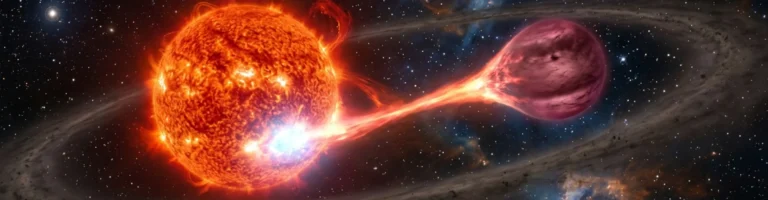

Deep within the Taurus constellation, astronomers have captured an extraordinary manifestation of stellar cannibalism: in research published in Nature Astronomy, an international team led by Dr. Kareem El-Badry of the California Institute of Technology (Caltech) presented an exhaustive analysis of the ultracompact binary system ZTF J0440+2325. In this cosmic pairing, a cool low-mass red dwarf star continuously siphons gas from its substellar brown dwarf companion, completing a full mutual orbit in an astonishing 87 minutes.
Breaking the Cataclysmic Paradigm: Smooth Mass Transfer Without Nova Detonations
In standard astrophysics, interacting compact binaries are classified as cataclysmic variables, where the accretor is almost invariably a white dwarf or neutron star. Hydrogen gas cascading into the deep gravitational well reaches tens of millions of degrees, triggering explosive nova or dwarf nova thermonuclear outbursts.
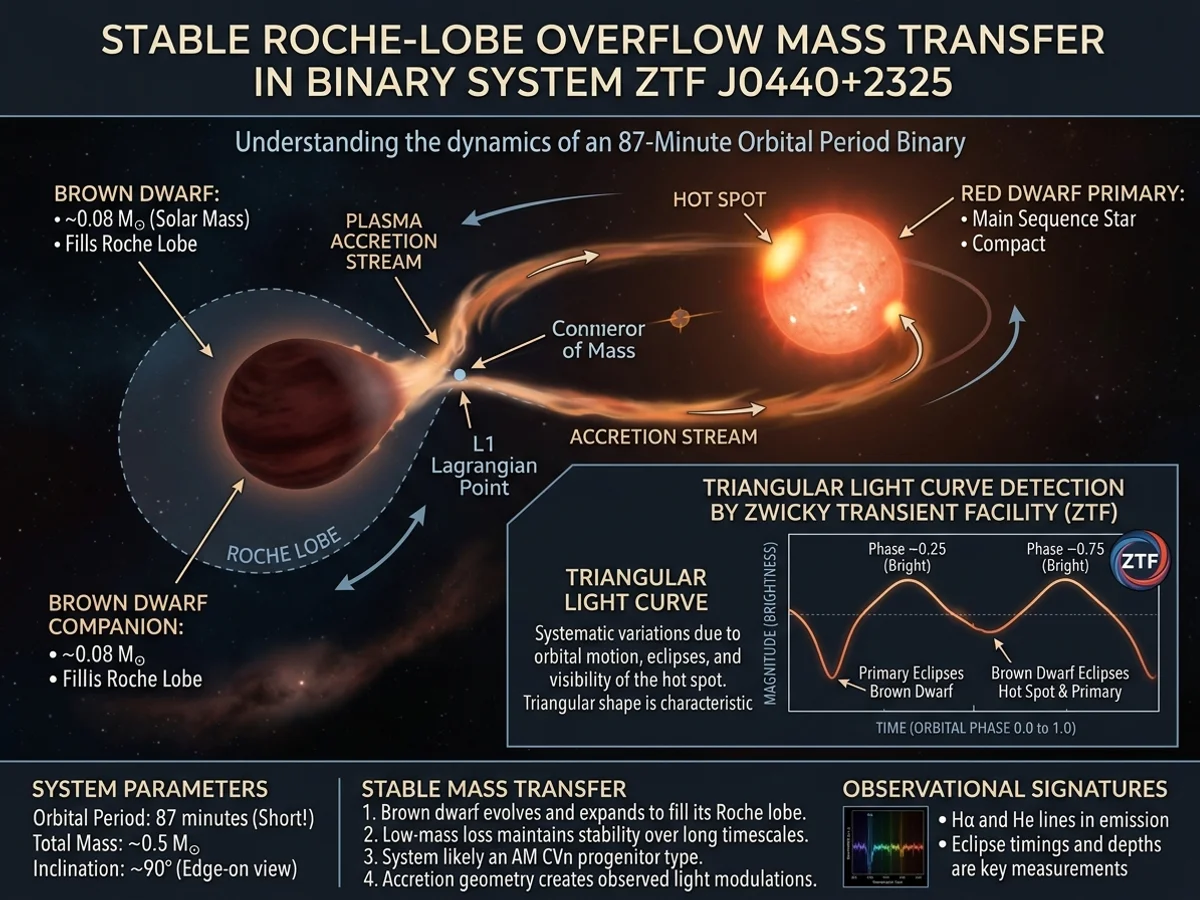
ZTF J0440+2325 defies this blueprint. The accreting primary is an ordinary M-dwarf main-sequence star possessing just 0.15 solar masses. Its 45-Jupiter-mass brown dwarf donor orbits so tightly that it has distorted into a tear-drop Roche geometry, smoothly feeding a steady laminar stream of pristine gas across the inner Lagrangian L1 point directly onto the red dwarf equator.
“We are witnessing an elusive evolutionary crossroads between planetary systems and contact stellar binaries. The mass transfer proceeds in an unusually quiet, hydrodynamic laminar state, methodically stripping the brown dwarf layer by layer without explosive shockwaves.”
Dr. Kareem El-Badry, Lead Binary Star Astrophysicist at Caltech
Remarkable 87.4-minute orbital period with orbital separation under 250,000 miles—barely the distance between Earth and the Moon.
The donor fills 100% of its critical equipotential surface, continuously funneling atmospheric gas through L1.
Orbital shrinkage is governed by continuous angular momentum drain driven by millihertz gravitational wave emissions.
Total stripping of the envelope, transitioning the stripped substellar relic into an exotic ultra-dense gas giant remnant.
A Verification Target for the Space-Based LISA Observatory
Due to its rapid orbital revolution, ZTF J0440+2325 acts as a persistent beacon of millihertz gravitational waves. The European Space Agency (ESA) has earmarked the system as an essential verification benchmark for the upcoming LISA (Laser Interferometer Space Antenna) mission slated for launch in the mid-2030s.
Video: Why Red Dwarfs Will Be the Last Stars in Existence
In this classic documentary short by Kurzgesagt, the physics, stability, and trillion-year lifespans of red dwarf stars are clearly detailed:
The Fate of the Donor: Demotion from Star to Planet
Within several hundred million years, the brown dwarf will forfeit the bulk of its envelope. Once its mass dips below 10 Jupiter masses, deuterium fusion halts permanently, completing its metamorphosis from a failed star into an exotic metallic planet locked in a permanent orbital waltz.