

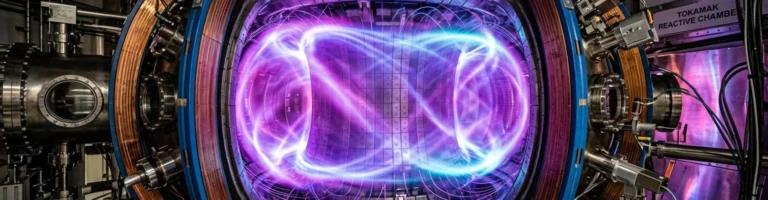

Physicists at the U.S. Department of Energy’s Princeton Plasma Physics Laboratory (PPPL) have achieved a landmark theoretical and computational breakthrough in magnetic confinement fusion: in a study published in Physical Review Letters, researchers demonstrated that the classical operational trajectory toward thermonuclear ignition followed for the past 70 years was thermodynamically suboptimal. A reformulated multidimensional Lawson criterion shows that staggering plasma heating and fuel compression unlocks self-sustaining fusion burn at roughly one-third the auxiliary heating power previously deemed mandatory.
70 Years of Lawson’s Criterion: The Radiation Loss Trap
Formulated in 1955 by British engineer-physicist John D. Lawson, the criterion establishes that net energy production requires the triple product of plasma ion density ((n)), temperature ((T)), and energy confinement time (( au)) to surpass a fundamental threshold. For decades, tokamak designs from early models to ITER pursued a synchronized approach: ramping density alongside external microwave and neutral-beam heating.
However, this strategy drove plasmas straight into a ferocious radiation trap: electron bremsstrahlung losses scale directly with the square of density. At high densities, radiation and turbulent cross-field transport sap energy faster than heating systems can supply it.
“For generations, fusion science pushed plasma uphill along the steepest possible gradient. Our revised thermodynamics demonstrate that heating low-density plasma to extreme ignition temperatures bypasses peak bremsstrahlung dissipation before rapid compression is triggered.”
Dr. Luis Delgado-Aparicio, Head of Advanced Projects at Princeton Plasma Physics Laboratory (PPPL)
Alpha fusion byproducts dilute fresh deuterium-tritium fuel, quenching ignition if confinement isn’t staged properly.
High-Z divertor ions induce catastrophic line radiation and bremsstrahlung cooling under elevated core density.
Relativistic electron gyro-radiation escalating within high-field high-temperature superconducting (HTS) magnets.
Turbulent micro-tearing modes and gyro-kinetic drift waves leaking heat across confining magnetic flux surfaces.
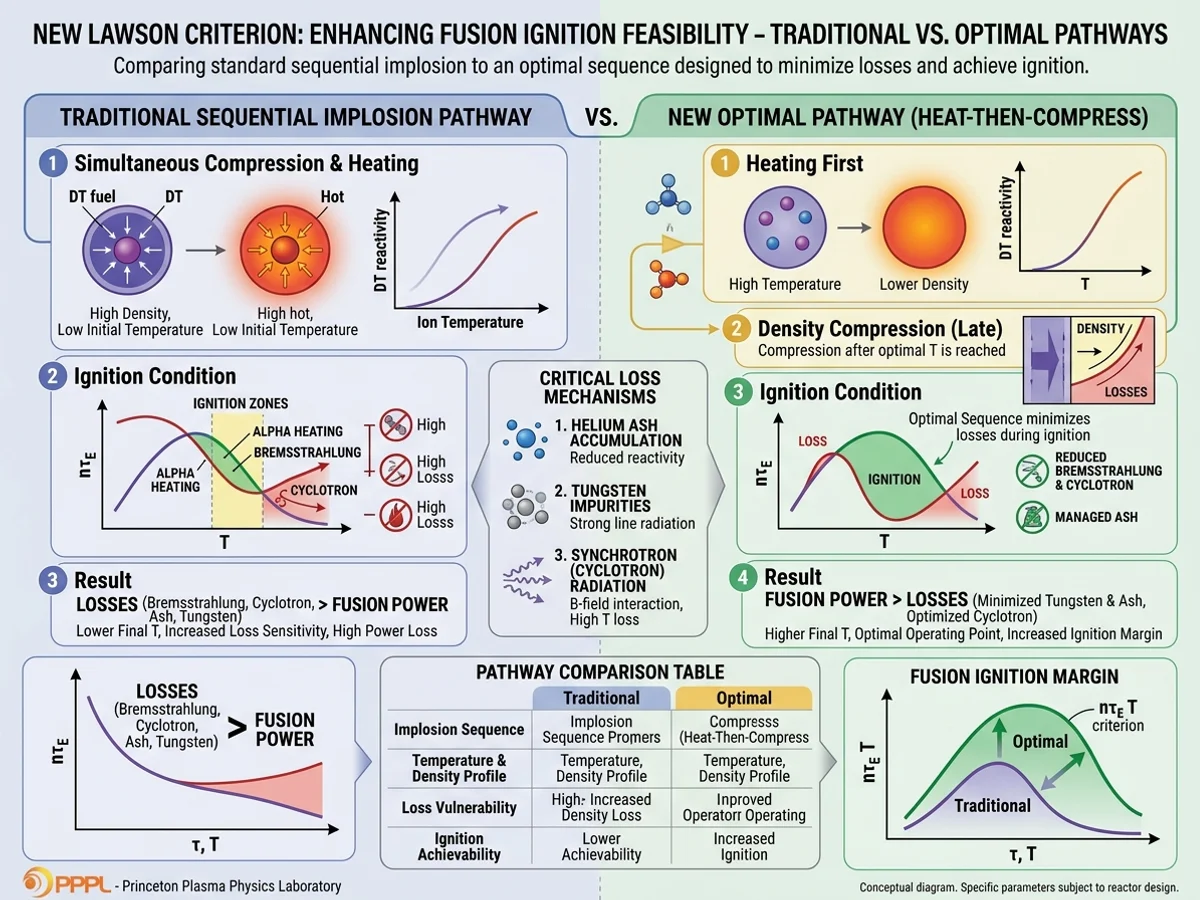
PPPL Staged Trajectory: Heat First, Fuel Later
The revised model authored by Luis Delgado-Aparicio, Masayuki Ono, and Jonathan Menard charts a two-stage route. First, a tenuous plasma is heated to 150–200 million °C. With density held low, bremsstrahlung remains trivial, maximizing auxiliary power efficiency. Next, ultra-fast cryogenic fuel pellet injection combined with adiabatic magnetic compression drives density upward, initiating self-heating alpha capture instantaneously.
Video: Inside Tokamaks and the Future of Nuclear Fusion
In this comprehensive overview by Kurzgesagt, the underlying physics and monumental engineering obstacles of magnetic fusion are clearly visualized:
Accelerating Commercial Deployment on ITER and SPARC
The operational protocol is already being incorporated into plasma shot schedules for ITER in France and the MIT-affiliated Commonwealth Fusion Systems SPARC tokamak in Massachusetts. By slashing magnet and heating requirements, the PPPL model substantially shortens the timeline toward commercially viable, carbon-free fusion energy.