

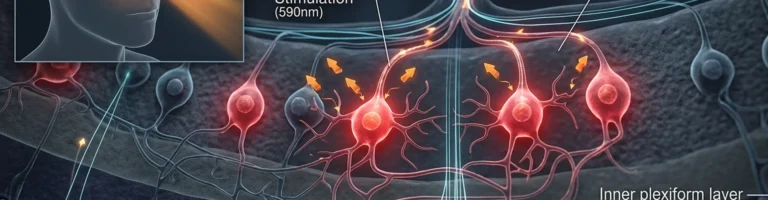

Medical science has achieved a monumental triumph against previously incurable blindness: in findings published in The New England Journal of Medicine (NEJM), investigators reported triumphant Phase 2 clinical trial results from the international PIONEER study. Spearheaded by Prof. José-Alain Sahel of the Institut de la Vision in Paris and the University of Pittsburgh School of Medicine, the team proved that a single intravitreal gene therapy injection coupled with light-stimulating bioengineered goggles successfully restored functional visual perception in legally blind patients suffering from end-stage retinitis pigmentosa.
Algal Bioengineering: The ChrimsonR Channelrhodopsin Breakthrough
Retinitis pigmentosa is an aggressive inherited retinal dystrophy where genetic flaws lead to irreversible apoptosis of photoreceptor rods and cones. Historically, once photoreceptor cells withered away, complete blindness was permanent and untreatable, as the neural architecture could not regenerate.
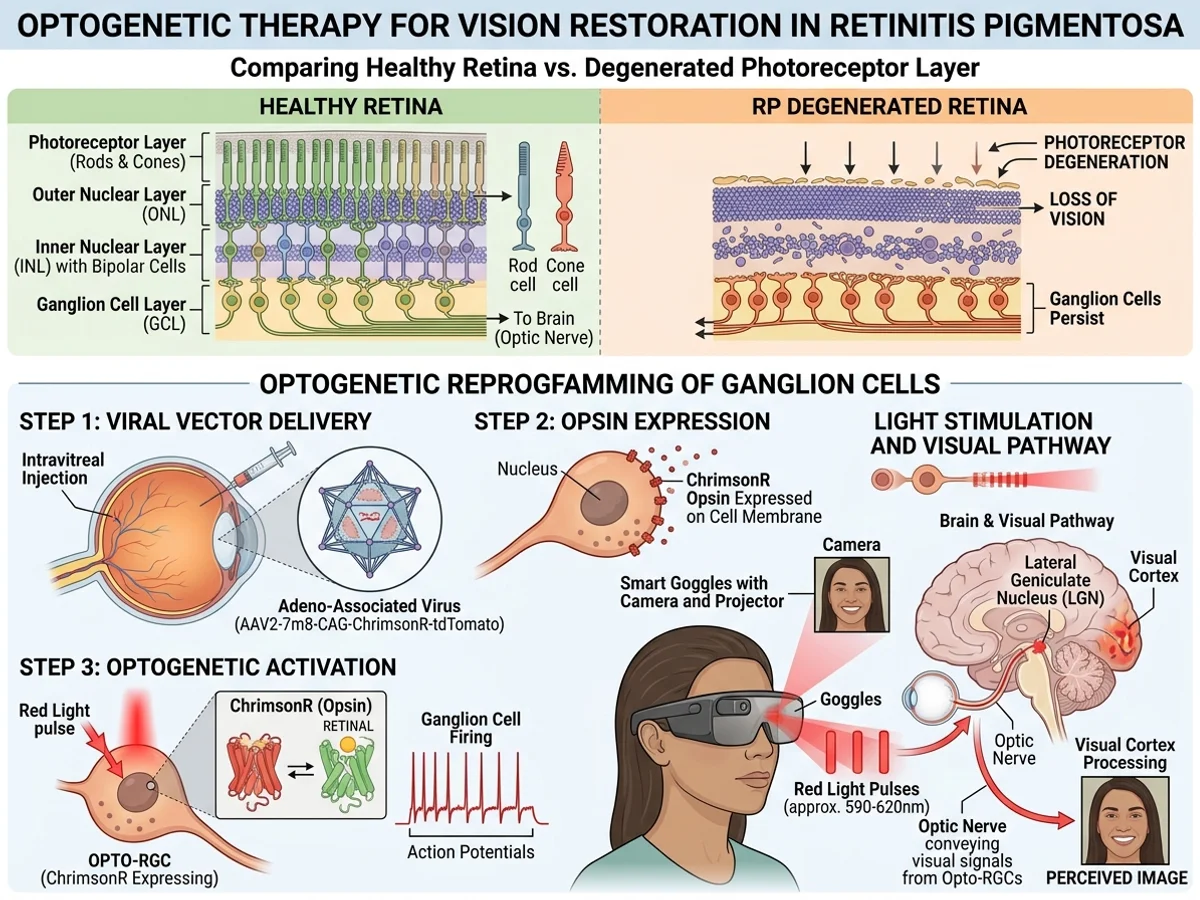
Optogenetics sidesteps this biological dead end. Investigators engineered a high-performance opsin gene, ChrimsonR, sourced from the unicellular alga Chlamydomonas noctigama, and packaged it inside a safe adeno-associated virus vector (AAV2). The therapy targets surviving retinal ganglion cells—the underlying relay neurons that bypass ruined photoreceptors to project signals straight to the optic nerve.
“We are not resurrecting dead cells; we are imparting de novo light sensitivity into surviving downstream neurons. Converting dormant ganglion cells into artificial biological sensors marks a paradigm leap for gene therapy.”
Prof. José-Alain Sahel, Lead Clinical Investigator and Chair of Ophthalmology, University of Pittsburgh
Recombinant viral capsid selectively transduces ChrimsonR DNA into the membranes of foveal ganglion neurons.
ChrimsonR responds optimally to amber wavelengths (595 nm), eliminating the phototoxic risks associated with high-energy blue light.
An event-driven sensor records scene contrast dynamics, projecting localized millisecond pulses of amber light onto the retina.
Patients successfully perceive doorways, locate household objects on tables, identify crosswalks, and navigate urban spaces.
Harmonizing Genetics and Photonics: How Stimulation Goggles Function
Engineered channelrhodopsin proteins require concentrated amber photons to induce depolarization. To achieve this safely, patients wear customized neuromorphic goggles: rather than recording continuous video frames, onboard microchips detect pixel-level contrast shifts, beaming microsecond-pulsed patterns of amber light directly onto the transduced retina.
Each light flash activates ChrimsonR ion pores, allowing cation influx to generate action potentials that race down the optic nerve, allowing the visual cortex to rebuild spatial shapes.
Video: Genetic Engineering, Viral Vectors, and the Future of Medicine
In this compelling explainer by Kurzgesagt, the power of bioengineering and genetic technologies in conquering human disease is illustrated:
Next Steps: Phase 3 Trials and Expanded Macular Applications
With unequivocal clinical validation documented in NEJM, the consortium is preparing Phase 3 pivotal trials for FDA and EMA regulatory approval. Simultaneously, investigators are adapting the optogenetic platform to address geographic atrophy in dry age-related macular degeneration (AMD), offering newfound hope to tens of millions of elderly individuals worldwide.