

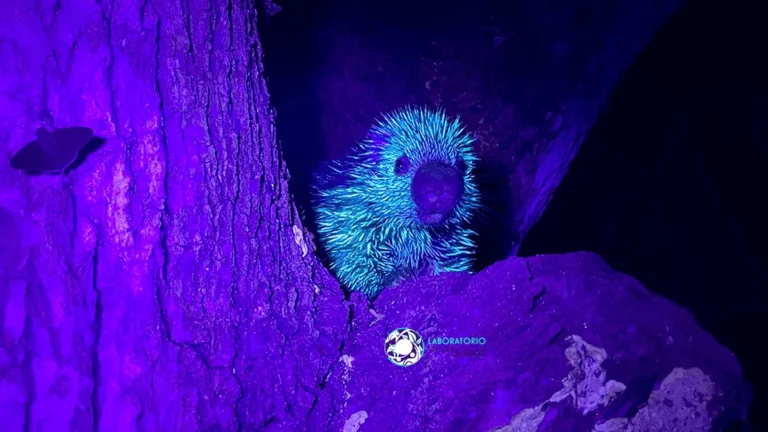

A shy, tree-dwelling rodent of Central America’s tropical canopies has given mammalogists a dazzling surprise. Researchers have discovered that the Mexican hairy dwarf porcupine (Coendou mexicanus) exhibits vivid ultraviolet-induced photoluminescence—its quills light up in shades of neon blue and green, while its nose, palms, and feet glow bright yellow under a UV flashlight.
A Chance Discovery in Chetumal: Shining UV Light on Rescued Porcupines
Ranging from southern Mexico to Panama, the Mexican hairy dwarf porcupine (Coendou mexicanus) is a solitary, nocturnal, and strictly arboreal rodent equipped with a prehensile tail and dark fur laced with pale yellow-brown spines. Because these animals spend nearly their entire lives hidden high in forest canopies, wildlife biologists have struggled for decades to count populations accurately or monitor their conservation status.
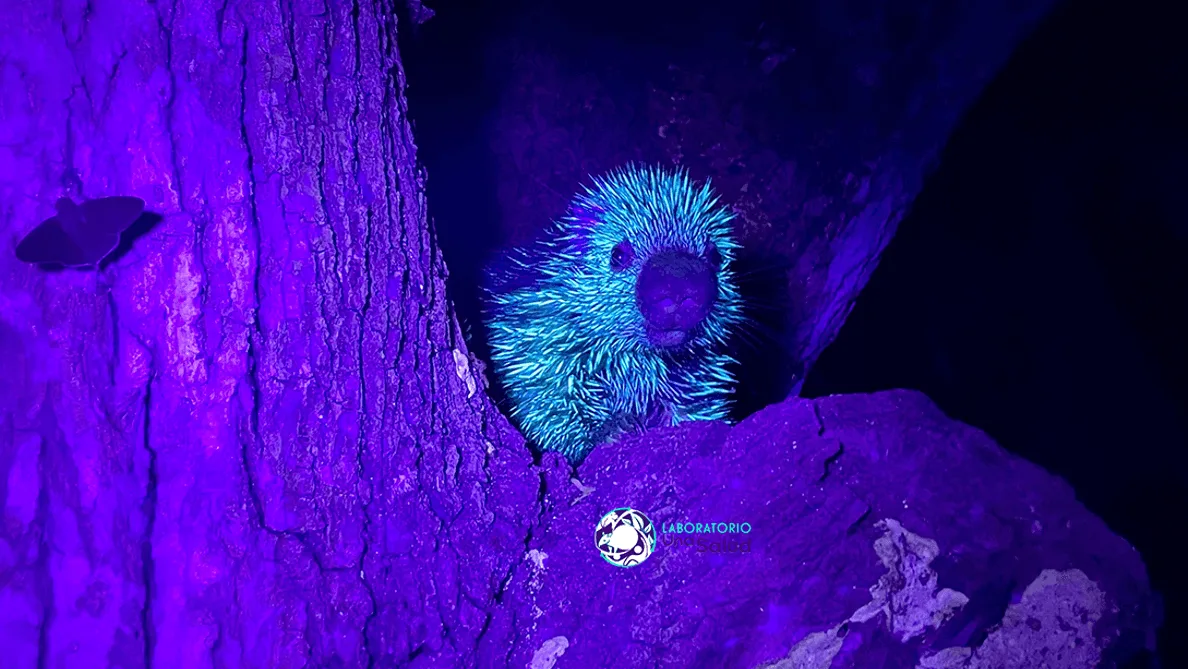
The hidden glow came to light in June 2024 during routine rescue and clinical evaluations in Chetumal, Quintana Roo, Mexico. Lead researcher Jonathan Pérez-Flores (Jonathan Pérez-Flores) of El Colegio de la Frontera Sur (ECOSUR) shone a portable 395-nanometer ultraviolet flashlight onto a rescued animal and watched its spines ignite with eerie blue-green luminescence.
As reported by IFLScience and published in November 2026 in the journal Neotropical Biology and Conservation, Pérez-Flores teamed up with Humberto Bahena-Basave (Humberto Bahena-Basave), Holger Weissenberger (Holger Weissenberger), Anthony Anaya-Constantino (Anthony Anaya-Constantino), Manuel Olguin-Zepeda (Manuel Olguin-Zepeda), Salvador Julio-Cardoso (Salvador Julio-Cardoso), and Arturo González-Jaimes (Arturo González-Jaimes) to test whether the trait held across live individuals.
Twenty Out of Twenty: Live Animals Glow Far Brighter Than Museum Skins
Over a three-month period, working under environmental authority permits and continuous veterinary supervision, the researchers examined 20 adult live porcupines in their care. Every single Mexican hairy dwarf porcupine tested—100 percent of the cohort—glowed vividly under 395 nm ultraviolet illumination.
The glowing colors varied strikingly by anatomy. The head shone brightest of all, while the back, limbs, and tail radiated strong greenish-blue hues. Fresh quills that appear yellow or brown in ordinary daylight shifted into crisp blue and green fluorescence under UV light. Meanwhile, hairless skin on the face, palms, and soles of the feet emitted a contrasting bright yellow glow.
To test how preservation affects the phenomenon, the team also examined older museum specimens. Preserved pelts produced only a weak, faded greenish shimmer, confirming that photoluminescent compounds degrade after death and that live animals exhibit far richer fluorescence than museum collections suggest.
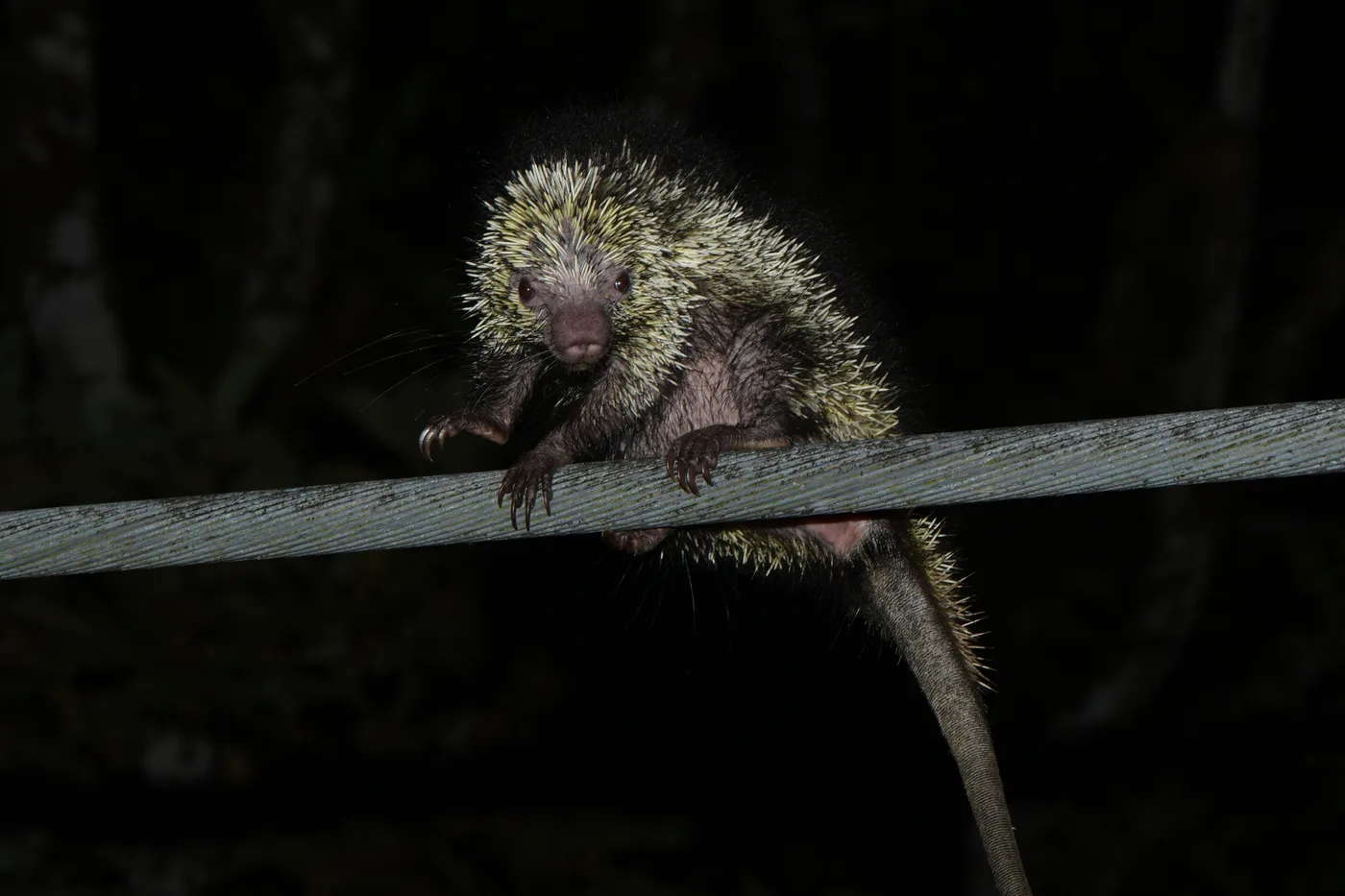
«Over a three-month period, 20 adult porcupines under the team’s care were tested with UV light with permission from environmental authorities—and every single animal glowed.»
Based on the study led by Jonathan Pérez-Flores (Jonathan Pérez-Flores), Neotropical Biology and Conservation (2026)
Why the Mexican Hairy Dwarf Porcupine Glows: Photoluminescence Explained
Biologists carefully distinguish this phenomenon from bioluminescence—the chemical reaction fireflies or deep-sea fish use to generate light from scratch inside their bodies. Instead, the Mexican hairy dwarf porcupine displays photoluminescence (biofluorescence): molecules embedded within keratin spines and skin absorb high-energy invisible UV photons at 395 nanometers and re-emit part of that energy at longer visible wavelengths.
In recent years, scientists have documented UV fluorescence across an expanding roster of mammals, including platypuses, wombats, flying squirrels, opossums, and hedgehogs. Yet most previous studies relied heavily on preserved museum specimens rather than systematic surveys of living animals.
Whether the glow carries any biological purpose for the porcupines—such as helping solitary individuals spot one another at dusk, deterring predators, or simply arising as a harmless biochemical byproduct of quill keratin—remains an open mystery. Nature is full of surprising sensory and structural adaptations, much like the bizarre symbiosis explored in our report on a deep-sea clam living inside a sea urchin’s throat 5,000 meters underwater.
All 20 live adult Coendou mexicanus individuals tested in Chetumal glowed brightly under a 395 nm UV torch.
Quills and head shine blue and green, while hairless skin on the face, palms, and soles emits yellow light.
Old museum specimens displayed only a faint greenish glow, proving live photoluminescence fades over time.
Portable UV flashlights can help researchers spot elusive canopy-dwelling porcupines during night surveys.
A Practical Conservation Breakthrough: UV Torches in the Canopy
Even if porcupines themselves ignore the glow, the discovery hands field ecologists an unexpectedly effective conservation tool. Traditional nighttime surveys using standard white flashlights frequently miss Coendou mexicanus, because dark fur and mottled spines blend seamlessly into bark and shadowed leaves.
In preliminary field trials, walking forest transects with inexpensive portable 395 nm UV flashlights made camouflaged individuals stand out cleanly against dark foliage thanks to their bright blue-green halo. The approach is completely non-invasive, requiring no stressful live traps, radio collars, or costly thermal imaging gear.
The ECOSUR team hopes that standardized UV-light monitoring protocols will help researchers accurately census wild Mexican hairy dwarf porcupine populations across fragmented Neotropical forests—turning an adorable optical quirk into a practical lifeline for biodiversity protection.
- Photoluminescence re-emits absorbed 395 nm UV photons as visible light, unlike chemical bioluminescence.
- The phenomenon was first spotted in June 2024 during veterinary checks of rescued animals in Quintana Roo, Mexico.
- Its exact evolutionary purpose—whether signaling, camouflage, or a keratin byproduct—remains under investigation.
- Field tests show UV torches offer a low-cost, non-invasive way to monitor elusive arboreal rodents in the wild.