

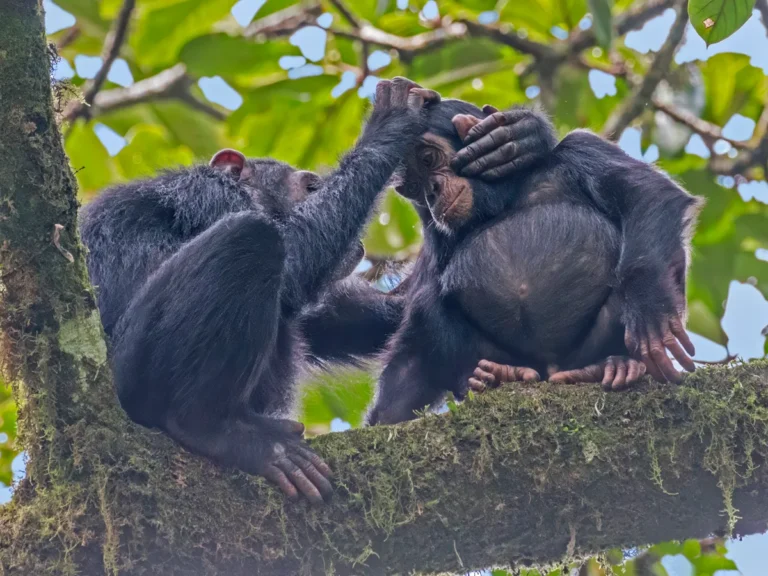

For decades, a central dogma in evolutionary primatology posited that ape vocal repertoires are rigidly hardwired and innately determined, lacking the cultural malleability that characterizes human speech. A landmark investigation by international primatologists has now shattered this long-held premise: scientists have demonstrated that sophisticated vocal learning in chimpanzees occurs through observational imitation of older group mentors who actively enforce cultural communicative conventions.
The Acoustic Phenomenon: How Lip Vibrations Revealed Vocal Learning in Chimpanzees
In a breakthrough study published in the Proceedings of the National Academy of Sciences (PNAS), an international research team from the Institute of Cognitive Sciences at the French National Centre for Scientific Research (CNRS / Université Claude Bernard Lyon 1) and the Taï Chimpanzee Project examined an unusual communicative sound: the «raspberry» (an unvoiced bilabial vibration produced by tightly pursing the lips and expelling air).
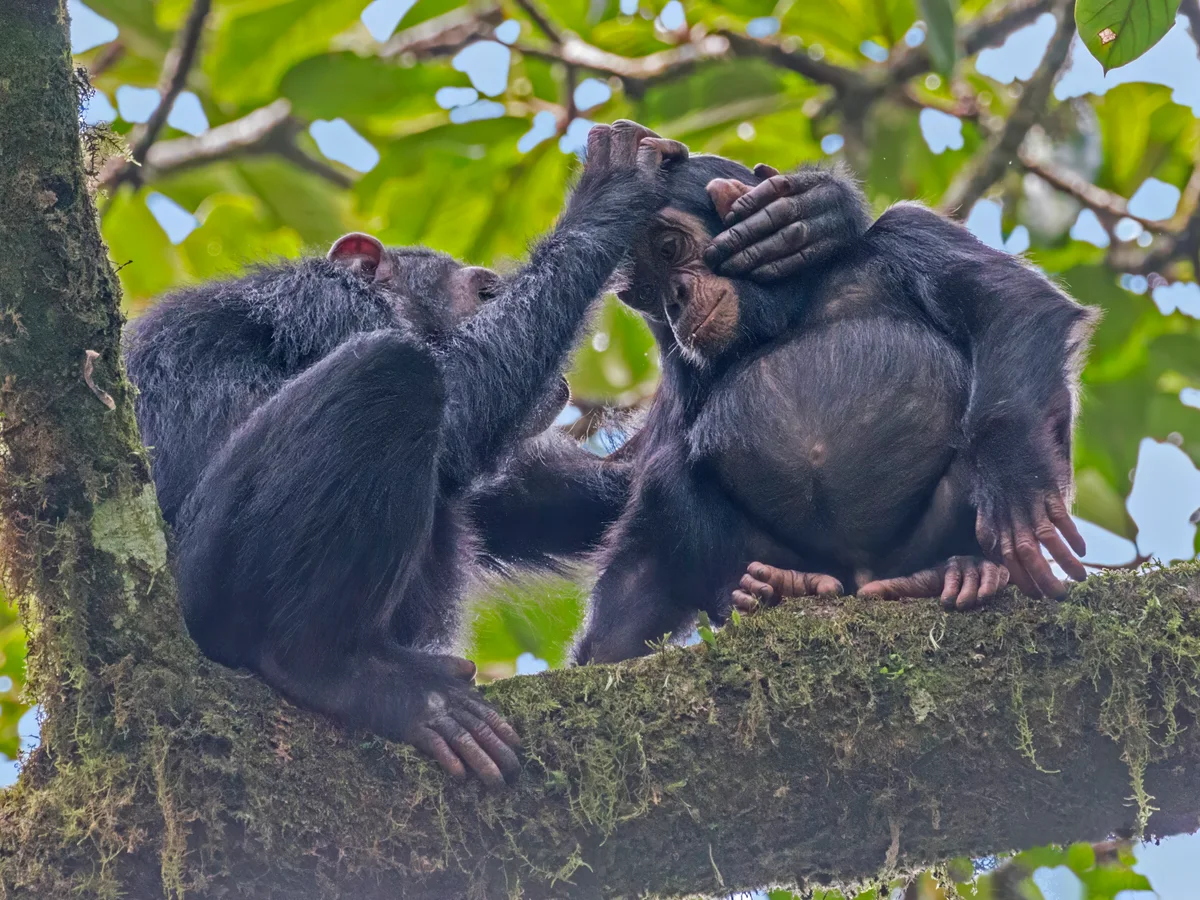
Lead author Antoine Valet and senior investigator Dr. Catherine Crockford systematically observed 91 wild and rescued western chimpanzees (Pan troglodytes verus), spanning infants to 55-year-old adults. The cohort encompassed two radically contrasting social environments: wild, multi-generational communities inhabiting the primary rainforest of Taï National Park in Côte d’Ivoire, and orphaned chimpanzees raised by peer cohorts at the Tacugama Chimpanzee Sanctuary in Sierra Leone following their rescue from the illegal wildlife trade.
Comparative acoustic and behavioral analysis yielded a profound insight: while the biomechanical capacity to produce the raspberry is innate, the communicative grammar—specifically when, where, and for what purpose to deploy the sound—is culturally acquired. Young wild chimpanzees learn to prune and focus this signal into a shared communal norm through prolonged social observation of older adult role models.
This discovery highlights the profound cognitive adaptability of great apes: as shown in cognitive dexterity and tool use in wild primates, cultural transmission and peer learning serve as the bedrock of advanced primate society.
Wild Clans Versus Sanctuaries: A Stark Cultural Discrepancy
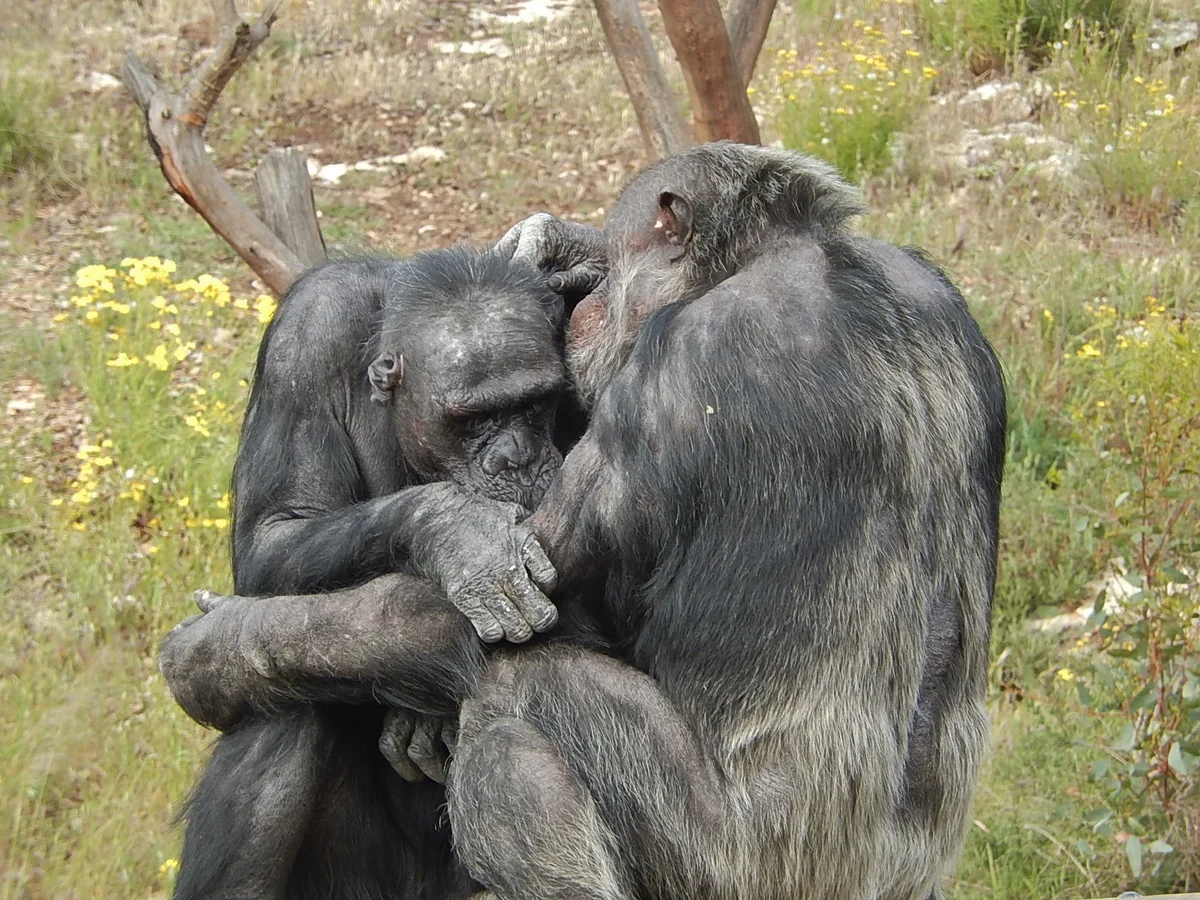
In the wild communities of Taï National Park, the raspberry signal is governed by a strict communicative convention. Adult chimpanzees emit the sound almost exclusively during allogrooming—the ritualized social grooming practice that maintains dominance hierarchies, reconciles disputes, and cements coalitions.
An adult wild chimpanzee uses the raspberry call to either initiate a grooming session or prompt their grooming partner to adjust body orientation, such as shifting an arm or turning a shoulder to expose tick-prone areas. Outside the grooming context, wild adults never utter the raspberry call, treating it as an exclusive communicative convention.
In stark contrast, juvenile chimpanzees at the Tacugama sanctuary exhibited communicative chaos. Raised without adult role models, these young orphans used raspberries indiscriminately across disjointed activities: during exuberant play bouts, while wrestling, during feeding excitement, or simply in moments of solitary frustration.
Longitudinal observations revealed that wild infants initially emit raspberries in diverse settings, but adult group members selectively respond only when the call occurs within proper grooming contexts. By rewarding appropriate usage with soothing touch and ignoring inappropriate outbursts, adults socially shape and constrain the youngsters’ communicative repertoire into a uniform cultural standard.
«Our findings demonstrate that conventionalized acoustic signaling is not a uniquely human trait. Chimpanzees acquire the contextual meaning of communicative calls through social learning, mirroring how human children absorb words from their linguistic culture.»
Dr. Catherine Crockford, Senior Primatologist at CNRS and Director of the Taï Chimpanzee Project
Neuromotor Articulation and Cortical Control Over Lip Vibrations
Executing a raspberry requires sophisticated voluntary motor control over the orbicularis oris and buccinator facial muscles, paired with precise modulation of pulmonary air pressure. Unlike emotional alarm barks or pant-hoots driven by subcortical limbic circuits, bilabial articulatory gestures are mediated by the primary motor cortex.
High-resolution acoustic spectrography demonstrated that while fundamental resonant frequencies vary across individual chimpanzees due to facial anatomy, temporal duration and modulation profiles remain remarkably consistent across the wild population. This confirms that chimpanzees intentionally regulate their oral articulators to produce an agreed-upon acoustic template.
Previously, communicative conventions—symbols or signals whose meaning is established by arbitrary social consensus rather than direct physical reflex—were considered unique to human language. These findings show that the cognitive architecture required for socially learned symbolic conventions predates the emergence of the human genus.
91 wild and sanctuary chimpanzees across Taï National Park (Ivory Coast) and Tacugama Sanctuary (Sierra Leone).
Unvoiced bilabial raspberry vibration requiring fine voluntary cortical control of facial musculature.
Adult mentors guide juveniles, restricting the signal into an exclusive convention for social grooming.
Proves communicative signal conventions emerged millions of years prior to the evolution of Homo sapiens.
An Evolutionary Stepping Stone Toward Human Speech
Human language is fundamentally conventional: arbitrary words such as «water» or «stone» carry meaning solely because society agrees on their definition. Discovering an identical convention-crystallizing mechanism in our closest living relatives bridges a longstanding chasm in evolutionary linguistics.
As co-authors Richard Moore and Roman Wittig emphasize, while chimpanzee gestural traditions have long been accepted as cultural artifacts, vocal and articulatory communications were historically dismissed as rigid. The present study demonstrates that an ape community’s social fabric cultivates communicative competence in young primates through mechanisms directly analogous to human language acquisition.
These revelations carry vital implications for wildlife conservation. When rehabilitating orphaned apes in African sanctuaries, providing biological sustenance alone is insufficient; young chimpanzees must be integrated with adult matriarchs and elders who can transmit the irreplaceable linguistic and cultural heritage of their species.
- Published in the Proceedings of the National Academy of Sciences (PNAS).
- Adult wild chimpanzees deploy raspberry vibrations strictly to coordinate social grooming.
- Orphaned juveniles raised without adults utter the call indiscriminately across random contexts.
- First empirical demonstration of socially learned communicative conventions in great ape vocalizations.