

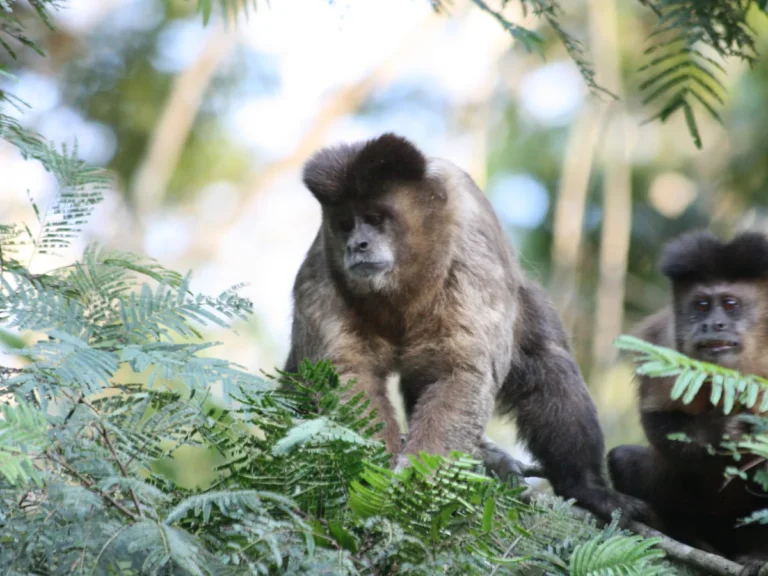

In the wild, non-human primates frequently astound researchers with sophisticated tool-use behaviors: chimpanzees crack oil palm nuts with heavy hammerstones, orangutans fashion foliage rain umbrellas, and capuchins extract wood-boring beetle larvae with slender twigs. However, groundbreaking footage captured by field biologists in an urban ecological park in southern Brazil has unveiled an astonishing new dimension of primate cognition: a wild juvenile male black-horned capuchin monkey (Sapajus nigritus cucullatus) was observed engrossed in spontaneous aerial juggling, rhythmically tossing a dried coconut into the air and catching it repeatedly with both hands. Published in the journal Primates, this marks the first scientific record of spontaneous object juggling in wild New World monkeys, demonstrating exceptional sensorimotor integration and abstract object play.
The Observation at Córrego Grande: Aerial Dynamics and Object Play
The remarkable event took place within the Córrego Grande Municipal Ecological Park in Florianópolis, southern Brazil, where a habituated group of black-horned capuchins thrives in close proximity to urban infrastructure. A field research team led by Augusto Saraiva was conducting standard ethological surveys on foraging strategies when their cameras caught a young male disengaging from the troop. Rather than foraging for insects or seeds, the juvenile perched comfortably on a palm frond holding a small, spherical dried queen palm coconut (Syagrus romanzoffiana).
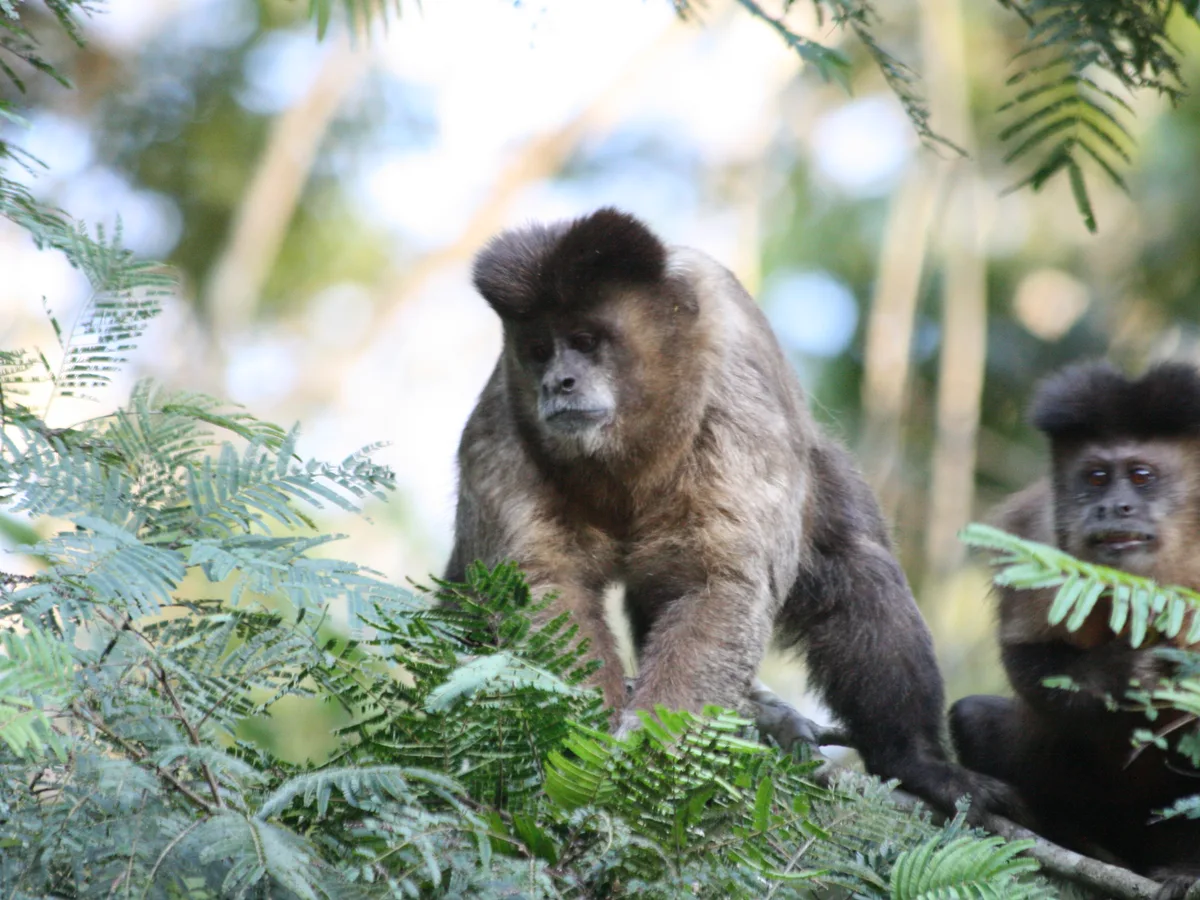
The monkey began rhythmically launching the dried fruit vertically into the air between 20 and 50 centimeters, catching it cleanly mid-flight with its right paw, left paw, and occasionally both hands simultaneously. Over several minutes, the juvenile executed repeated tossing-and-catching sequences. Whenever the coconut slipped and tumbled to the ground, the monkey deliberately climbed down, retrieved the exact object, and resumed his aerial performance atop the branch, indifferent to surrounding distractions.
While rudimentary object manipulations known as «stone handling» have been cataloged in provisioned Japanese macaques (Macaca fuscata), those behaviors typically involve rolling, rubbing, or striking stones against hard substrates. True aerial juggling involving the coordinated tossing and mid-air recapture of an airborne projectile had never before been documented in free-ranging wild primates outside of highly trained circus environments.
Neurobiology of Dynamic Coordination: The Cerebellum and Opposable Precision
From a neurocomputational standpoint, catching a free-falling projectile is an extraordinary feat. In fractions of a second, the primate central nervous system must calculate gravitational acceleration, factor in aerodynamic drag and wind gusts, trigger spinal alpha motor neurons, and close the distal phalanges with millisecond timing. Among New World platyrrhines, capuchins boast the highest brain-to-body mass ratio, featuring an encephalization quotient second only to hominids.
Crucial to this motor agility is an expanded primary motor cortex (M1) and a deeply folded dentate nucleus within the cerebellum, which coordinates rapid ballistic motor sequences. Just as biological identifying markers exist throughout the animal kingdom, such as how unique golden iris patterns in Amazonian treefrogs serve as individual biometric fingerprints, individual psychomotor dexterity among capuchins exhibits profound variation and cognitive innovation.
Anatomically, Sapajus capuchins possess pseudo-opposable thumbs and complexly differentiated forearm flexor muscles. This unique musculoskeletal architecture grants them the ability to switch effortlessly between a powerful whole-hand power grip and a delicate thumb-and-index precision grasp, rivaling the manipulative dexterity of great apes.
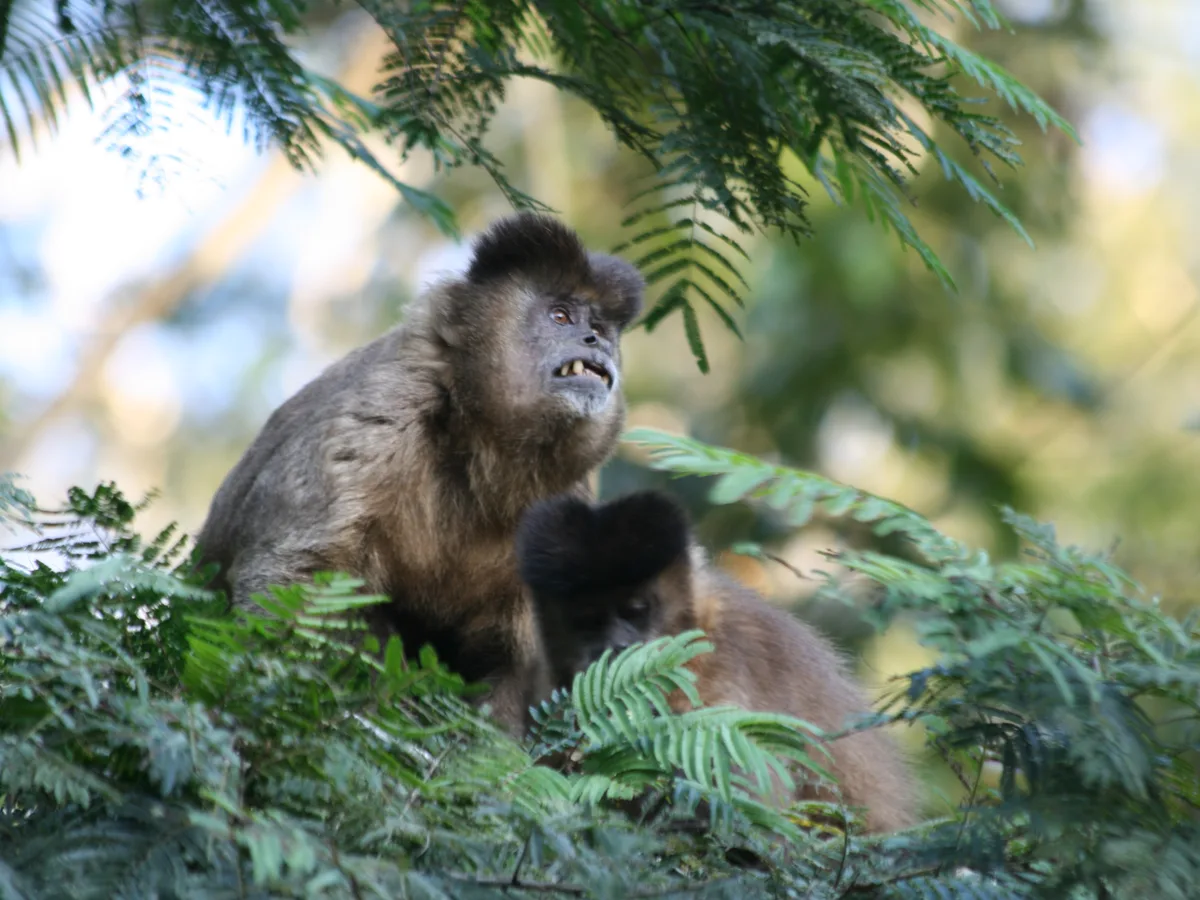
«Juggling requires ultra-precise real-time prediction of parabolic trajectories, seamless visual-motor integration across both forelimbs, and continuous proprioceptive feedback calibration. The fact that a juvenile wild capuchin performed this entirely spontaneously, without food reinforcement and purely for the intrinsic pleasure of sensorimotor play, highlights the remarkable evolutionary plasticity of cerebellar neural circuits in the genus Sapajus.»
Augusto Saraiva, Lead Author and Primatologist at the Federal University of Santa Catarina
Tool Culture in the Genus Sapajus: 3,000 Years of Non-Human Archaeology
To understand the emergence of such advanced dexterity, one must examine the evolutionary deep history of capuchin tool culture. Tufted and bearded capuchins are recognized as master engineers of the animal kingdom. At the Serra da Capivara National Park in northeastern Brazil, archaeologists have excavated stratified layers of stone anvils and hammerstones used by capuchins to crack open resilient cashew nuts dating back at least 3,000 years.
These primates routinely select heavy quartzite hammerstones weighing up to a kilogram—often amounting to half their own body weight—and transport them across distances to stable anvil roots. They carefully judge the elasticity of the nut, center it within a carved divot on the anvil surface, and deliver calculated vertical strikes with optimal kinetic efficiency.
The evolutionary foundations of such mechanical prowess are ancient: just as cartilaginous fish evolved biomechanical perfection hundreds of millions of years before the emergence of terrestrial trees, South American platyrrhines underwent convergent evolution with African hominids, driving dramatic encephalization and fine motor specialization.
A subspecies of black-horned capuchin endemic to the Atlantic Forest of Brazil, celebrated for outstanding tool ingenuity.
The juvenile tossed palm nuts up to 50 cm high, alternating catches between left, right, and two-handed grips without fumbling.
Archaeological proof that capuchins have maintained an unbroken tradition of using stone hammers and anvils for millennia.
An exceptional brain-to-body mass ratio and expanded cerebellar dentate nuclei enable microsecond proprioceptive tuning.
The Evolutionary Function of Object Play: Calibration Without Utility
Why do intelligent animals expend precious metabolic calories on activities that offer no immediate survival reward, such as food, mating opportunities, or predator evasion? In modern ethology, object play is recognized as a vital evolutionary mechanism of pre-adaptation. During juvenile development, the mammalian brain undergoes synaptogenesis, and tactile play acts as an indispensable testing ground to calibrate neuromuscular circuits.
By juggling the palm nut, the young capuchin was not merely idling: he was fine-tuning sensorimotor reflexes essential for intercepting erratic prey (treefrogs, swift lizards, large insects) and calculating dynamic branch recoil during high-canopy locomotion. In an arboreal environment where a miscalculated leap at 20 meters can result in fatal falls, rigorous vestibular and ocular calibration is a direct matter of life and death.
Furthermore, complex play signifies substantial cognitive surplus and psychological safety. Animals under acute ecological distress, nutritional deficit, or predatory threat virtually never engage in solitary object manipulation. The presence of unprompted juggling in Florianópolis indicates a troop experiencing robust social stability and thriving resource access.
- Spontaneous aerial juggling in the wild documented for the first time in New World primates without human training.
- The behavior served no immediate foraging or tool-use goal, representing pure cognitive-sensorimotor play.
- Bimanual coordination and precision thumb opposability in capuchins functionally parallel human hand motor skills.
- Urbanized fringe habitats serve as rich behavioral catalysts, stimulating novel cultural and cognitive traditions.
Urban Ecology as a Catalyst for Cultural Behavioral Innovation
Field biologists increasingly note that the intersection of natural habitats and urban landscapes functions as an evolutionary catalyst for primate ingenuity. In suburban parks, capuchins regularly encounter novel manufactured objects—rubber balls, discarded beverage containers, plastic caps. This exposure to varied elasticities and shapes stimulates investigative curiosity, encouraging novel manipulation repertoires.
The research team at the Federal University of Santa Catarina intends to maintain long-term camera monitoring of the Córrego Grande troop to observe whether this juggling behavior spreads socially through observational learning. If other juveniles begin mimicking the aerial tossing technique, science will witness the inception of a localized, socially transmitted cultural meme.
This discovery once again bridges the perceived chasm between human ingenuity and animal intelligence. The spontaneous delight of launching and catching a moving object, the impulse of creative physical play, and the joy of mastering one’s own motor limits are universal principles of advanced cognition that bind us to our primate relatives.
The video recording captured by the research team in Córrego Grande Park shows the remarkable fine motor skills of the wild capuchin monkey deftly juggling and catching palm fruits in mid-air: