

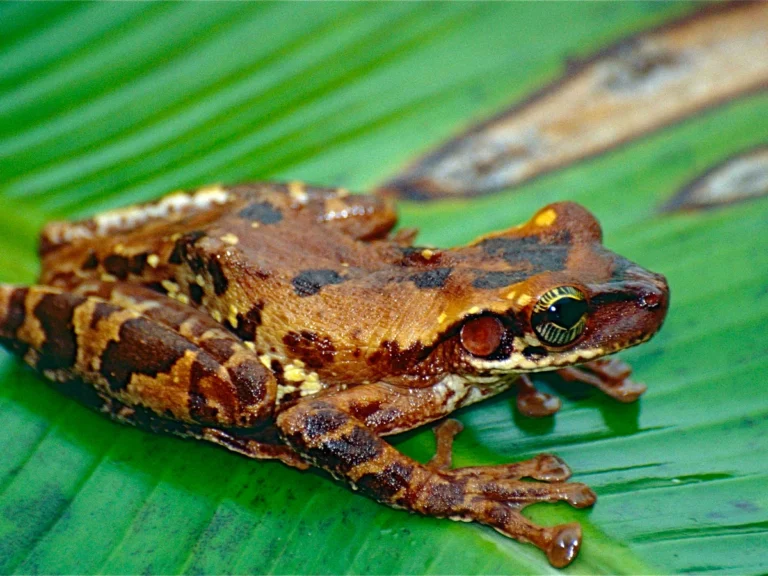

Deep within the Amazon rainforest canopy, herpetologists discovered a breathtaking biological marvel: the dazzling golden eyes of the treefrog Osteocephalus oophagus possess an iris pattern so intricate and unique that they serve as permanent biometric fingerprints.
Treasures of the Amazon Canopy: The Frog with Gleaming Eyes
The Amazonian rainforest shelters the most concentrated biodiversity on Earth, with each ecological stratum exhibiting extraordinary evolutionary adaptations. High up in the rainforest canopy dwells the egg-eating spiny-backed treefrog (Osteocephalus oophagus), a slender arboreal amphibian native to the Amazon Basin and French Guiana.
Herpetologists have long been intrigued by the species’ remarkable maternal care. Males and females utilize phytotelmata—microscopic water bodies accumulated in the leaf axils of epiphytic canopy bromeliads—as specialized nurseries for their larvae. The female returns periodically to deposit unfertilized trophic eggs to sustain her developing tadpoles.
However, recent research revealed a visual discovery that eclipses even its maternal behavior: the golden eyes of treefrogs act as an infallible, non-invasive biometric passport.
The upper canopy of the Amazon rainforest forms an extreme microhabitat perched 30 to 50 meters above the forest floor. Osteocephalus oophagus spends its entire adult life navigating this dizzying canopy labyrinth, relying on bromeliad reservoirs for hydration and reproduction.
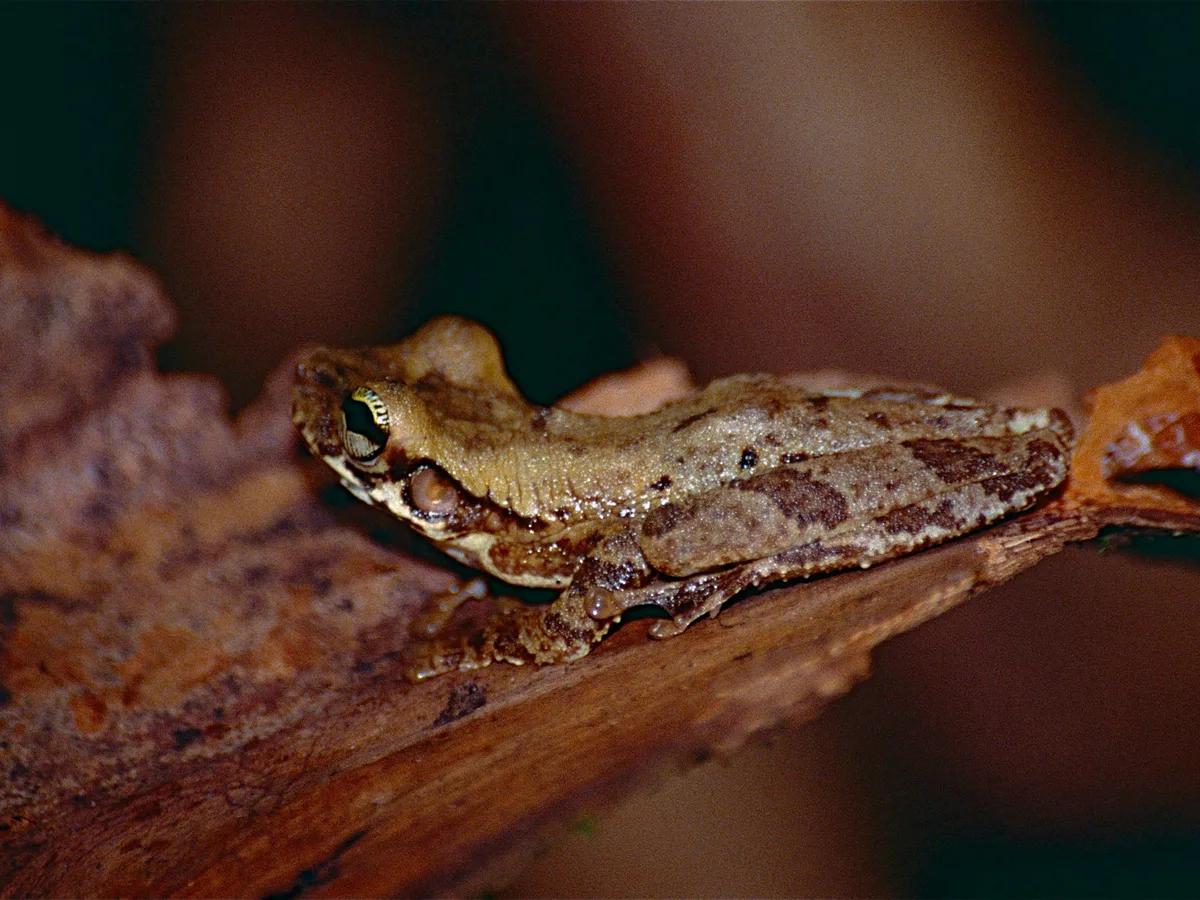
The Herpetozoa Study: Individual Fingerprints in the Iris
An international research team led by Dr. Mélissa Peignier, alongside co-authors Lauriane Bégué, Fabrice Petel, Vincent Premel, and Eva Ringler, conducted extensive field surveys in the pristine rainforests of French Guiana. Their research was published in the peer-reviewed zoological journal Herpetozoa (DOI: 10.3897/herpetozoa.39.e165432).
The scientists examined the mesmerizing optical architecture of Osteocephalus oophagus. The species exhibits a luminous metallic gold iris traversed by a dense, irregular network of thin black lines, reminiscent of fine filigree or marble veining.
By performing computerized pattern matching on hundreds of high-resolution macro photographs, the team proved that the geometric orientation of these dark veins is entirely unique to each individual. Just like human dermal friction ridges on fingertips or human retinal scans, no two frogs share an identical iris pattern.
Histological examination reveals that the striking black lines are formed by localized aggregations of melanophores situated above reflective iridophores packed with crystalline guanine. This cellular interplay generates both the individual biometric fingerprint and a protective shield against high-intensity tropical ultraviolet radiation.
«The iris of Osteocephalus oophagus looks like a work of fine gold jewelry: the network of dark lines across the gleaming background is completely unique to each frog and remains identical across its entire lifespan.»
Dr. Mélissa Peignier, Lead Study Author and Evolutionary Biologist
A Humane Paradigm Shift: Retiring Invasive Toe-Clipping
For field herpetology, validating iris biometric individuality represents a monumental ethical and ecological breakthrough. For over a century, the primary method for tracking wild amphibians has been toe-clipping—the surgical excision of digital phalanges in predefined numerical combinations.
For arboreal hylid treefrogs, toe-clipping can be a death sentence. Treefrogs rely on expanded adhesive digital pads that secrete specialized mucous to generate capillary adhesion against vertical trunks and rain-slicked canopy leaves. Truncating digits impairs climbing agility, increases fatal falls from the canopy, and introduces systemic bacterial infections.
Iris biometrics completely eliminates the necessity of touching, handling, or restraining the animal. A field biologist simply approaches a frog resting on a bromeliad and captures a sharp macro image using a telephoto lens from a comfortable distance.
Transitioning to non-invasive biometrics upholds the gold standard of modern ethical field biology. Eliminating toe-clipping preserves authentic ecological behaviors, ensuring that territorial male calling, canopy locomotion, and amplexus during mating remain uncorrupted by physical injury.
The intersection of fine black lines against the metallic golden iris produces a distinct geometric pattern unique to each individual frog.
This optical technique replaces the harmful historical practice of amputating digit tips, safeguarding the adhesive toe pads vital for canopy climbing.
Pattern-recognition software matches iris photographs with greater than 95% accuracy, enabling cataloging without physical capture.
The species reproduces inside phytotelmata of epiphytic bromeliads, where females feed tadpoles unfertilized trophic eggs.
WILD-ID Algorithms: Computer Vision for Rainforest Conservation
To automate identification across large populations, the researchers adapted WILD-ID, an open-source pattern-matching software originally created to identify pelage markings on large mammals. The algorithm detects key junction nodes and intersecting angles across the frog’s iris, calculating an individualized similarity score.
WILD-ID achieved an identification accuracy exceeding 95 percent. Furthermore, longitudinal recaptures confirmed that the iris pattern remains perfectly stable throughout ontogeny, shedding cycles, and environmental variations.
This non-invasive technological methodology aligns with broader breakthroughs in evolutionary biology, such as paleobiological studies investigating ancient evolutionary adaptations in reptiles and amphibians.
Deploying WILD-ID across amphibians underscores the adaptability of machine vision in conservation science: an algorithm engineered to identify pelage markings on snow leopards and whale sharks adapted seamlessly to the microscopic reticulation of canopy treefrog irises.
- Non-invasive photo-ID empowers researchers to track individual survival, migration, and lifespans under shifting climate conditions without animal stress.
- Eliminating physical contact halts the transmission of lethal chytrid fungus spores between wild amphibians via scientific handling.
- The findings by Dr. Mélissa Peignier and her team were published in the international peer-reviewed journal Herpetozoa.
Protecting Amphibians Amid the Global Extinction Crisis
Amphibians are currently the most severely threatened class of vertebrates on our planet, with over 40 percent of species threatened with extinction due to habitat fragmentation, climate warming, and the lethal chytrid fungus (Batrachochytrium dendrobatidis).
Touch-free iris scanning prevents field researchers from inadvertently transmitting deadly pathogens between frogs on gloves or collecting equipment during field sampling.
The technique validated on Osteocephalus oophagus paves the way for humane, lifelong biometric monitoring of endangered amphibians worldwide, proving that cutting-edge computer vision can be one of nature’s greatest allies.
Researchers anticipate that touch-free iris biometrics will establish a new international standard for herpetological monitoring, empowering conservationists to track vulnerable tropical populations amidst intensifying climate disruptions.