


When the haunting notes of a bone flute first resonated through the limestone caves of Ice Age Europe, human beings had already cultivated an intricate heritage of vocal melody and synchronized communal rhythm for dozens of millennia. For over a century, orthodox archaeology posited that human musical creativity emerged approximately 40,000 years ago during the Upper Paleolithic cultural explosion. However, a seminal investigation conducted by Austrian cognitive biologists and published in Frontiers in Psychology has fundamentally upended this paradigm: the roots of human music-making stretch back at least 135,000 years into deep antiquity, long before the earliest modern human lineages diversified across the globe.
The Bone Flute Paradox: Why Archaeology Looked in the Wrong Place
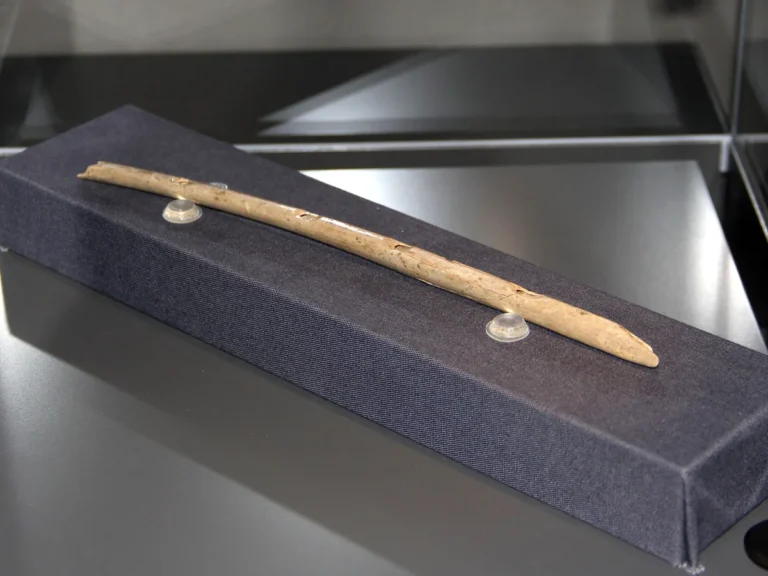
For decades, textbooks traced the dawn of music to a handful of subalpine caverns nestled in the Swabian Jura of southwestern Germany. Unearthed from the fertile Aurignacian strata of Hohle Fels, Vogelherd, and Geißenklösterle, flutes carved from the radius bones of griffon vultures (Gyps fulvus) and mammoth ivory have been dated to between 35,000 and 40,000 years before the present. Featuring exquisitely beveled finger holes and aerodynamically refined embouchures, these delicate artifacts were long celebrated as humanity’s earliest proof of acoustic design.
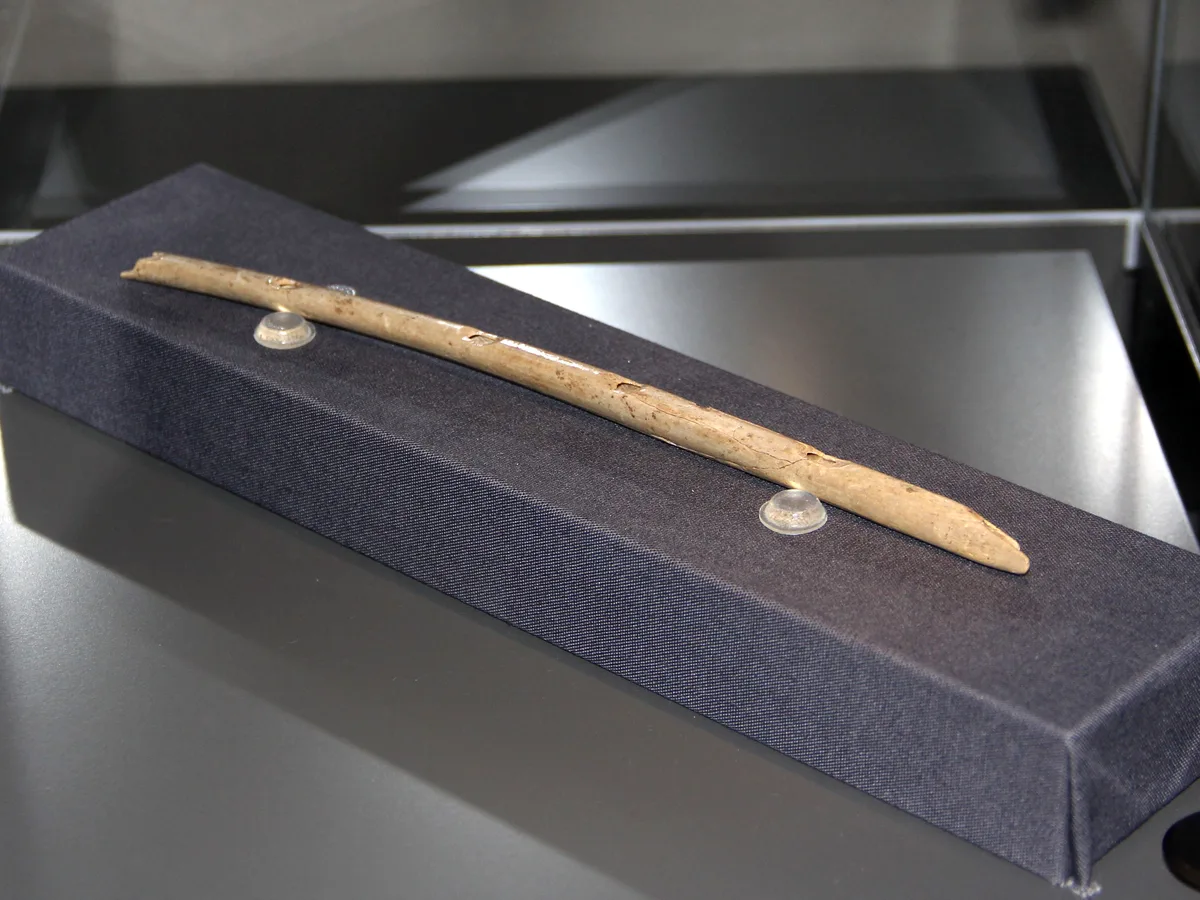
Yet within this conventional timeline lingered a profound evolutionary paradox. Crafting a functional wind instrument that adheres to musical intervals requires an extraordinarily sophisticated mental template of tonal pitch and acoustic harmonics. The Aurignacian flutes do not resemble crude, tentative trials; they represent the pinnacle of skilled craftsmanship. As musicologists frequently note, postulating that musicality suddenly popped into existence alongside these ivory flutes is as scientifically implausible as asserting that complex spoken language began with the invention of the printing press.
The apparent historical silence before 40,000 years ago is an artifact of taphonomic preservation. The foundational instruments of our ancestors—the human vocal folds, cupped hands, stomping feet on resonant cave floors, dried sinew cordage, and hollowed wood—decayed into dust. Recognizing this limitation, a research team led by cognitive biologists Oliver T. Bellmann, Melina Witt, and Marisa Hoeschele from the University of Vienna and the Austrian Academy of Sciences turned to an empirical methodology: the genomic lower-bound heuristic.
Genomic Lower Bounds: What the Human Tree Reveals About Musicality
The conceptual breakthrough of Bellmann and colleagues hinges on the established phylogeographic branching of anatomically modern Homo sapiens. Archaeological and genomic consensus indicates that the deepest known genetic divergence among living human populations occurred roughly 135,000 years ago in Africa, separating the ancestors of Southern African hunter-gatherer groups (such as the Khoisan) from other human lineages. Following this split, these populations remained demographically isolated for tens of millennia.
If musical aptitude had evolved as a sporadic mutation or an idiosyncratic cultural fad among Eurasian hunter-gatherers 40,000 years ago, contemporary humanity would exhibit widespread cognitive variation in basic musical perception. Anthropologists would expect to discover isolated communities completely devoid of musical structures, tonality, or rhythm. Yet comprehensive ethnomusicological surveys across hundreds of diverse cultures demonstrate the exact opposite: music is a bona fide human universal.
“Every studied human population across the globe shares core perceptual building blocks: the recognition of octave equivalence, the processing of discrete pitch intervals, and the instinctive drive to synchronize movement with an external rhythmic pulse,” the authors explain. Consequently, the cognitive and biological apparatus required for full-blown musicality must have been fully intact in the ancestral gene pool prior to the 135,000-year divergence. In fact, comparative primatology suggests these evolutionary roots may stretch back several million years into earlier hominin grades, including Homo erectus.
«Musicality is not merely a late cultural ornament that coincided with the carving of Upper Paleolithic bone flutes. It is a foundational neurobiological architecture encompassing discrete pitch perception, tonal scaling, and rhythmic entrainment that was fully operational in Homo sapiens long before the initial divergence of African lineages.»
Oliver T. Bellmann, Cognitive Biologist at the Acoustic Research Institute of the Austrian Academy of Sciences
The Musilanguage Theory and Music as an Evolutionary Social Adhesive
Pioneering naturalist Charles Darwin famously argued in The Descent of Man that melodic vocalization preceded articulate speech, operating as an engine of sexual selection to signal physical stamina and reproductive vigor. In modern cognitive science, this concept has matured into the “musilanguage” hypothesis formulated by Steven Brown, which proposes that music and language evolved from an archaic acoustic communication system rich in emotional prosody.
Over evolutionary time, this protolanguage bifurcated into two specialized channels: spoken language specialized in referential semantics and syntactic propositions, while music became our species’ premier emotional transmitter and social bond. In the unforgiving environments of the Middle Pleistocene, the survival of hunter-gatherer bands depended upon radical in-group trust. Communal singing and rhythmic dances around the embers stimulated widespread releases of oxytocin and beta-endorphins, aligning the affective states of band members and buffering collective stress.
Comparative investigations into animal behavior highlight that sophisticated motor coordination is deeply intertwined with the evolution of cognitive motor skills and tool mastery. In humans, however, this manifested uniquely as rhythmic entrainment—the automatic coupling of auditory perception to neuromuscular motor output—which provided the behavioral foundation for collective hunting, cooperative labor, and defense ceremonies.
The deepest human lineage split—represented by the Khoisan peoples of Southern Africa—dates to ~135,000 years ago. Universal musical cognition across all modern ethnicities proves musicality predates this split.
The neurological capacity to synchronize motor cortex commands with external acoustic pulses is virtually unique among primates, serving as humanity’s primary social adhesive.
Melody and syntax trace back to a shared ancestral communication substrate of expressive pitch contours used by early hominins for bonding, danger alerts, and infant care.
Singing voices, hand clapping, dancing feet, and hide-covered wooden drums leave no fossilized traces. Surviving 40,000-year-old bone flutes represent a technological culmination, not an origin.
The Neanderthal Flute Debate: Did Archaic Humans Make Music?
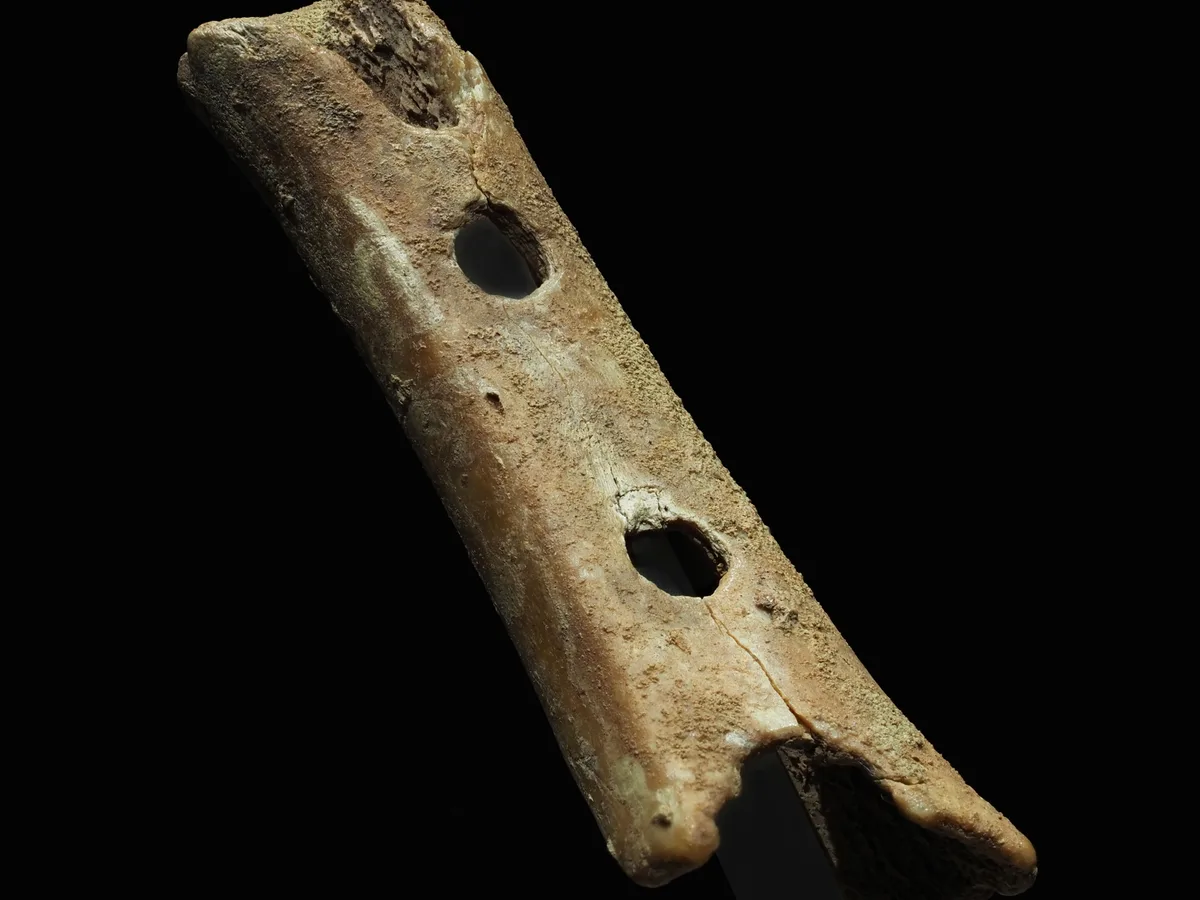
Pushing the timeline of human musicality past 135,000 years casts new light upon one of the most contentious debates in paleoanthropology: the enigmatic artifact recovered from Divje Babe I cave in Slovenia. Discovered in 1995 by archaeologist Ivan Turk, this perforated femur of a juvenile cave bear (Ursus spelaeus) dates to between 50,000 and 60,000 years ago—firmly within the Mousterian toolmaking epoch dominated exclusively by Neanderthals.
Skeptics have long attributed the puncture holes to gnawing carnivores such as Pleistocene spotted hyenas. However, high-resolution CT imaging and experimental archeoacoustic reconstructions by researchers like Ljubomir Dimitrijević reveal that the hole margins exhibit circular chipping consistent with stone drill bits, producing four distinct diatonic notes when blown. If Homo sapiens possessed rich musicality 135,000 years ago, our shared ancestor with Neanderthals—Homo heidelbergensis, who lived over 500,000 years ago—very likely possessed the vocal and acoustic foundations of music as well.
Paleogenetic analyses show that Neanderthals possessed the derived human-like variant of the FOXP2 gene, critical for rapid oro-facial vocal motor coordination, while middle-ear ossicle reconstructions prove their auditory system was finely tuned to the 2 to 5 kHz frequencies essential for human speech and song. Music was undoubtedly weaving through the European wilderness long before Cro-Magnons stepped onto the continent.
Early hominin groups navigated shifting climatic landscapes across thousands of miles, mirroring the migrations of early Homo sapiens populations through lush prehistoric savannahs. Throughout these grueling journeys, communal songs served as living sonic maps, mnemonic navigational guides to waterholes, and spiritual anthems that knit disparate clans into resilient social tapestries.
- Acoustic Universals: Every isolated ethnic group on Earth perceives octaves, harmonic consonances, and hierarchical meter without exception.
- Vocal Tract Evolution: Laryngeal descent and hyoid bone morphology were functionally established over 300,000 years ago in ancestors shared with Neanderthals.
- Mirror Neurons and Endorphin Surges: Synchronous choral vocalization triggers neurochemical bonding, dampening intragroup violence and boosting collaborative survival.
- Overcoming Archaeological Invisibility: Bioacoustic modeling and population genetics establish that instruments from Hohle Fels and Divje Babe built upon thousands of years of oral heritage.
The Future of Paleoacoustics: Reconstructing Humanity’s First Songs
Contemporary neuroimaging affirms that music is woven into the very substrate of human identity. Functional MRI scans demonstrate that listening to and creating musical rhythms activates primordial subcortical networks, including the basal ganglia, amygdala, and cerebellum, far deeper within the brain than the cortical regions dedicated to formal grammar. Our nervous systems are literally wired to resonate with acoustic harmony.
The work of Bellmann, Witt, and Hoeschele in Frontiers in Psychology provides an incontrovertible benchmark: 135,000 years is the absolute lower boundary for the origin of human musical capacity. As ancient DNA sequencing continues to advance and computer simulations recreate the vocal tracts of archaic hominins, this date will likely be pushed back even further. Music was not an afterthought in our evolution; it was the very cradle in which our humanity was forged.