

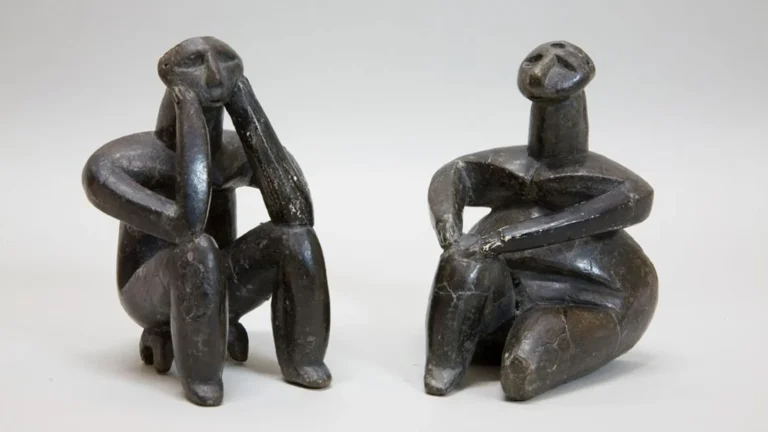

When mid-20th-century archaeologists carefully uncovered an unassuming prehistoric grave overlooking the Danube River, they unearthed one of the most intellectually profound artistic discoveries in human history: the enigmatic Thinkers of Cernavoda became an instant sensation in global archaeology. Crafted roughly 7,000 years ago during the Late Neolithic, these two blackened terracotta figurines—a man seated in sorrowful existential contemplation and a calm woman seated beside him upon the bare earth—predated Auguste Rodin’s celebrated bronze sculpture by five millennia. Originating from the Balkan Hamangia culture, this extraordinary duo proves that Stone Age humanity possessed advanced symbolic cognition, extraordinary plastic artistry, and a deep philosophical awareness of mortality.
Discovery on Columbia Hill: How the Thinkers of Cernavoda Were Unearthed
The saga of this astonishing discovery commenced in 1956, when prominent Romanian archaeologist Dumitru Berciu led a rescue excavation team at Columbia Hill (Dealul Sofia / Columbia D) near the town of Cernavodă in the Dobruja region. Archaeological fieldwork proceeded under urgent deadlines, driven by extensive civil engineering projects constructing rail lines and canal infrastructure along the lower Danube. On an elevated limestone terrace above the river valley, Berciu’s team struck an extensive Late Neolithic necropolis containing over 400 prehistoric graves.
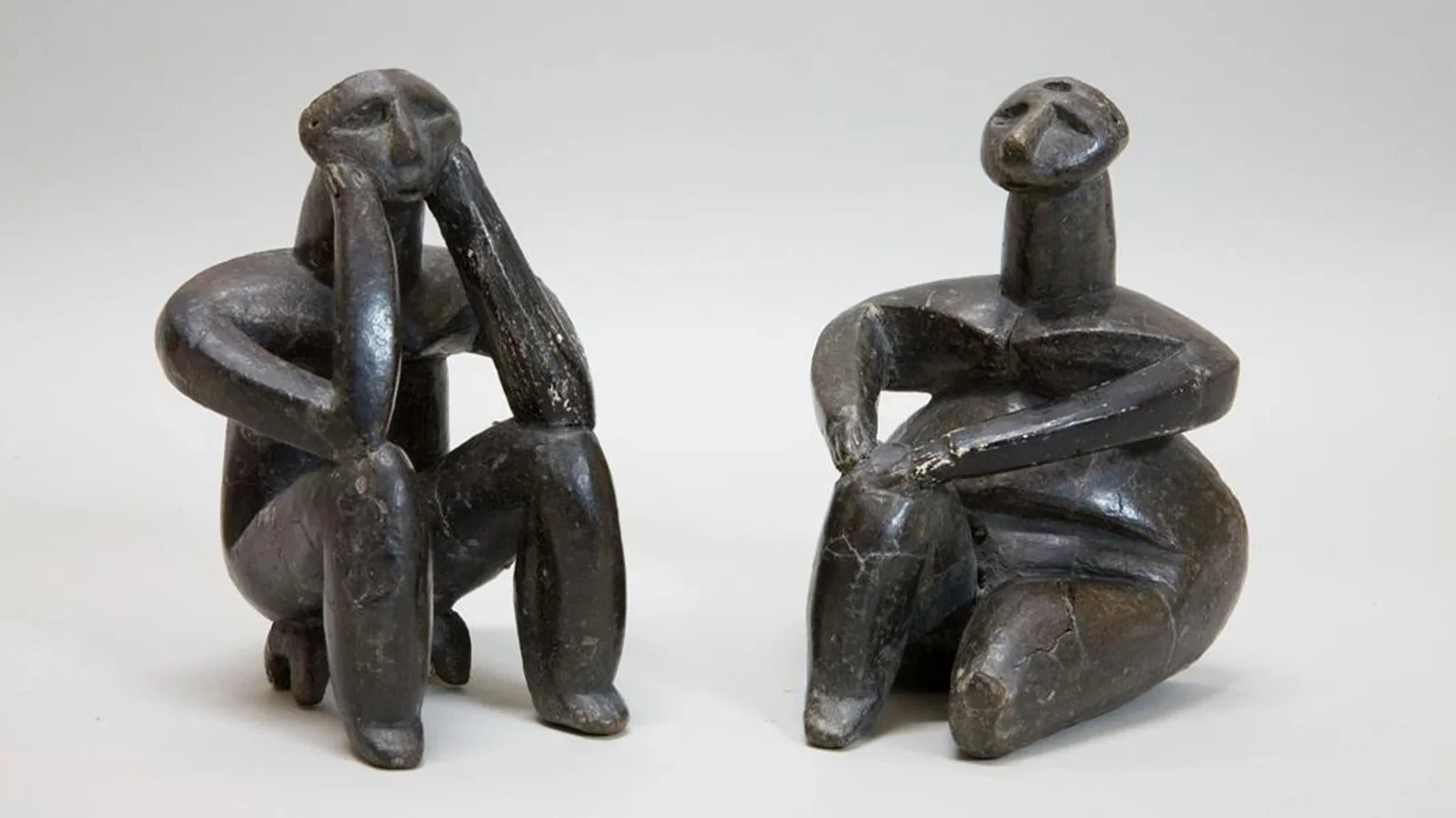
Among hundreds of cataloged burials, Grave 115 captured immediate scholarly intrigue due to its conspicuous absence of customary burial furnishings. The deceased adult had been laid out in an extended supine posture without flint arrowheads, polished adzes, or storage ceramic pots. Instead, resting quietly beside the skeletal remains lay two burnished, dark-fired terracotta figurines. Earlier, we examined how forensic and archaeological analyses continually shed light on long-buried chapters of human history.
When conservators gently cleaned away the encrusted loess soil, an unprecedented sight was revealed: a male figure sat upon a delicate four-legged stool, his head cradled in his hands in an unmistakable posture of deep existential contemplation. Beside him sat a stylized female companion directly on the earth, her hands resting calmly on her bent knee. Both statuettes exuded an expressive maturity, anatomical nuance, and conceptual depth previously deemed unthinkable for Stone Age communities.
Anatomy of Meditation: The Form and Plasticity of The Thinker
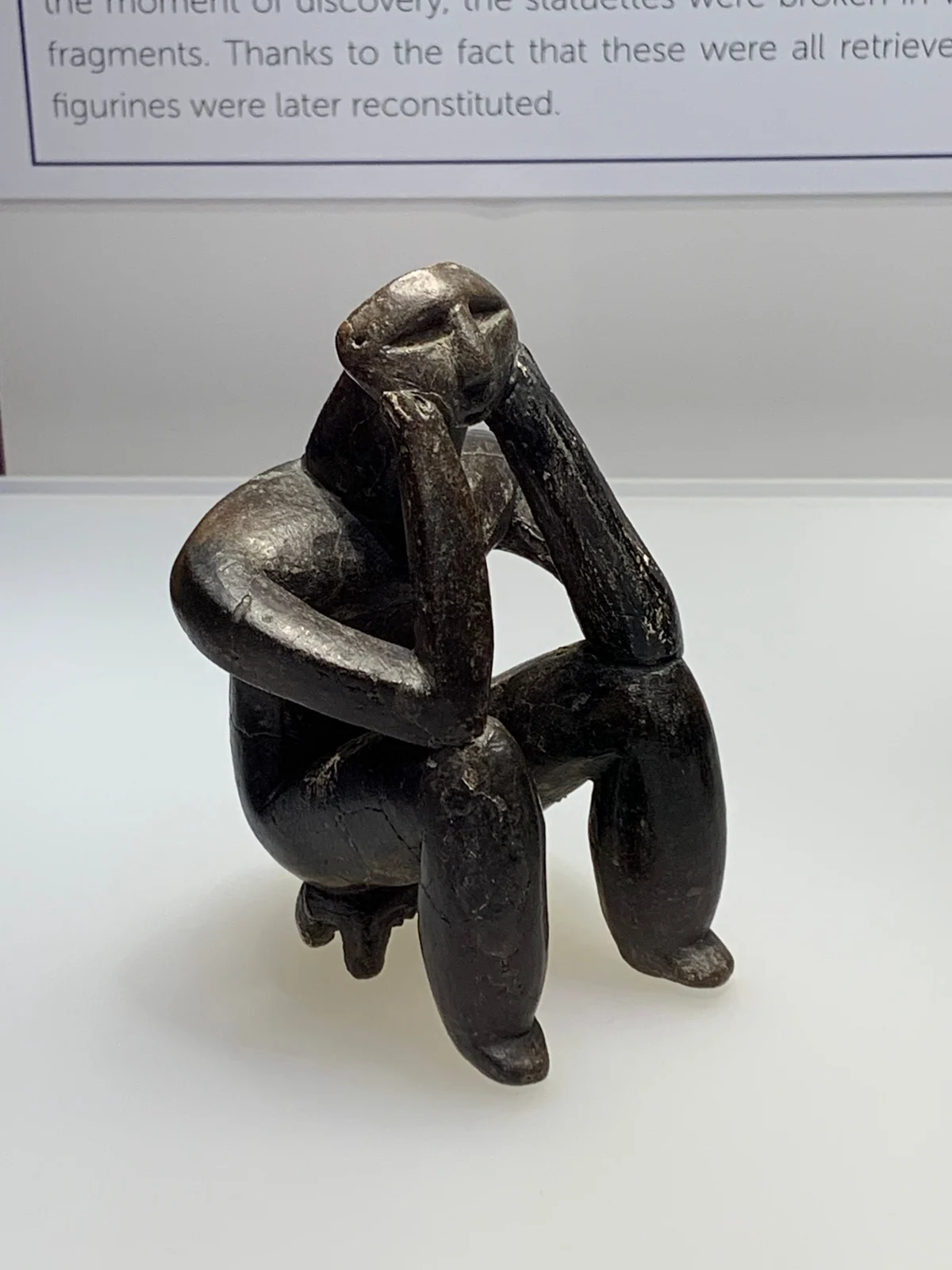
The male terracotta figurine, internationally celebrated as ‘The Thinker’ (Gânditorul de la Cernavodă), stands just 11.5 centimeters (4.5 inches) tall. Skillfully sculpted from fine-grained, quartz-tempered clay and fired in a reducing atmosphere to a lustrous dark charcoal-brown finish, it depicts a mature adult male resting on a small, backless four-legged stool.
The sculpture achieves a breathtaking equilibrium between bold geometric abstraction and human realism. The figure’s spine curves forward in a pronounced hunch, its cylindrical neck extends outward, and its elbows rest firmly upon splayed knees. The forearms angle sharply upward, with both hands cupping the chin and lower jaw. The facial features are deliberately minimalist: deep triangular depressions evoke deep-set eyes, an angular crest forms the nose, and a simple horizontal slit denotes the mouth. Despite this spare geometry, the statue radiates intense cognitive tension.
It was precisely this iconic pose that compelled art historians to name the relic after Auguste Rodin’s 1904 bronze masterpiece. Astonishingly, an anonymous Stone Age sculptor dwelling along the Danube River managed to distill the essence of human intellectual introspection five millennia before the titans of modern European sculpture.
Petrographic and X-ray fluorescence (XRF) examinations of The Thinker’s ceramic fabric revealed an advanced level of pyrotechnological sophistication. To withstand shrinkage without fracturing, the riverine illite clay was tempered with meticulously sieved quartz sand and crushed grog. The firing was executed in pit kilns at approximately 750°C, concluding with an oxygen-starved reducing reduction phase that saturated the ceramic matrix with elemental carbon, yielding its celebrated burnished graphite patina.
«The Thinker of Cernavodă is not merely an ancient fertility talisman. It is the earliest psychological portrait in the history of art—capturing the human spirit awakening to the reality of its own mortality.»
From scientific monographs by Romanian archaeologist Dumitru Berciu and curators of the National Museum of Romanian History
The Seated Woman: Grounded Stability and the Sacred Feminine
The female figurine—known as ‘The Seated Woman’ (Femeie șezând)—functions as a profound compositional and spiritual counterpoint to her male counterpart. Unlike The Thinker, she requires no artificial stool; she sits grounded directly upon the soil, her left leg extended and her right leg folded beneath her. Her hands rest peacefully on her knee, projecting complete serenity, rootedness, and stability.
The artisan deliberately emphasized volumetric feminine anatomy: voluptuous hips, heavy thighs, and pronounced breasts evoke the widespread Neolithic archetype of the Mother Goddess, associated with agricultural fecundity, herd proliferation, and the regenerative forces of nature. Yet her upper torso and elongated neck share the identical geometric abstraction of the male figure, binding both artifacts into an undeniable, unified ritual liturgy.
Anthropologists hypothesize that the pair embodies the fundamental cosmological duality of the Neolithic worldview: the male archetype reflects intellectual contemplation, celestial scrutiny, and defensive vigilance, while the female archetype signifies the terrestrial bedrock, biological birth, seasonal continuity, and the nurturing Earth.
Hamangia culture artifacts dating to 5000–4600 BC, predating classical antiquity and Renaissance masterpieces.
The Thinker sits on a stool with head in hands in deep contemplation, 5,000 years before Rodin’s sculpture.
The male embodies celestial reflection and vigilance, while the seated woman represents fertility and the nurturing Earth.
Excavated from Grave 115 at Cernavodă, the figurines are conserved in the National Museum of Romanian History in Bucharest.
The Hamangia Culture: Creators of Prehistoric Masterpieces
The Hamangia culture flourished between approximately 5250 and 4550 BC across the modern Dobruja region of southeastern Romania and northeastern Bulgaria, flanking the Black Sea coast and lower Danube basin. Originating from Anatolian migrant farming communities that expanded into the Balkans during the early Neolithic dispersals, the Hamangia people were sedentary pioneers.
They cultivated emmer wheat, einkorn, and legumes, maintained domesticated herds of cattle, sheep, and swine, and harvested abundant sturgeon from the Danube. However, their crowning legacy in world archaeology is their extraordinary anthropomorphic ceramic sculpture. While neighboring European Neolithic cultures (such as Vinča and Cucuteni-Trypillia) predominantly created upright or flat schematic idols, Hamangia artisans were the very first in Europe to master three-dimensional seated poses depicting realistic human postures.
Their ceramic mastery extended to burnished, thin-walled pottery decorated with intricate spiral fluting and white limestone paste inlay, reflecting a sophisticated society featuring specialized craft guild traditions.
- Unprecedented cognitive depth: proving that Stone Age artisans sought to depict internal psychological states rather than mere external forms.
- Earliest representation of furniture: the inclusion of a four-legged stool provides direct evidence of sophisticated Neolithic domestic culture.
- Balanced gender cosmology: the harmonious duality of Grave 115 reflects a mature, complementary social mythology.
- Pristine conservation: exceptional clay tempering and anaerobic firing techniques preserved these fragile terracotta works across 70 centuries.
Sacred Meaning: Funerary Mourning or Astronomical Vigil?
The ultimate purpose of the Thinkers of Cernavodă continues to inspire intense academic inquiry. The dominant hypothesis interprets the figures through the lens of funerary eschatology. Discovered undisturbed in an adult burial, the statuettes likely served as ritual psychopomps or eternal mourners, tasked with accompanying the deceased’s spirit and perpetually embodying the grief of the surviving clan.
A compelling alternative theory arises from archaeoastronomy. Scholars observe that The Thinker’s posture tilts slightly upward, his abstracted eyes directed toward the sky. For agrarian communities utterly dependent upon seasonal rainfall and celestial calendar cycles, skywatching was vital for tribal survival. The Thinker may portray a tribal shaman or astronomer-priest deciphering planetary constellations and solstice alignments.
Today, both original statuettes are preserved in the National Museum of Romanian History in Bucharest as Grade-A national cultural treasures. Formally inscribed in the UNESCO register of remarkable human artifacts, they stand as immortal proof of the timeless philosophical depth of the human mind at the very dawn of European civilization.