

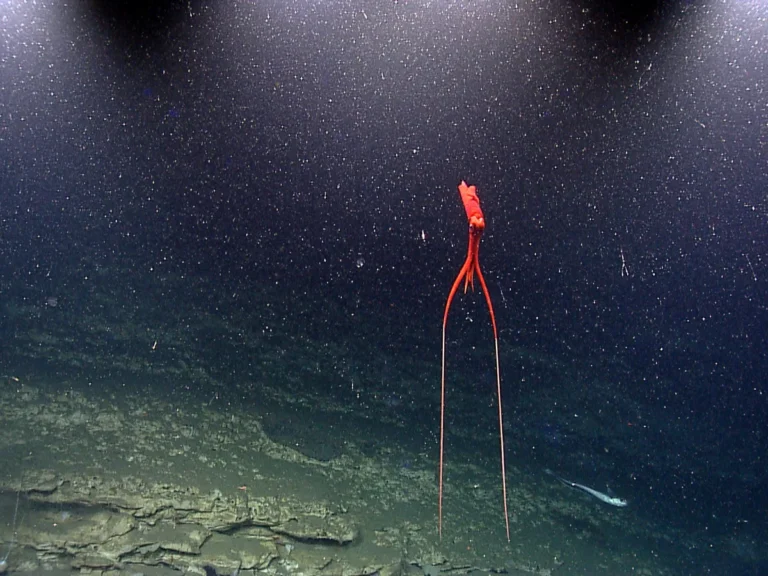

In the perpetual ink-black abyss of the central Pacific Ocean, where crushing hydrostatic pressure exceeds 400 atmospheres, deep-sea marine biologists have documented an extraordinary biological phenomenon previously thought impossible for decapod cephalopods. During an exploratory benthic expedition into the polymetallic Clarion-Clipperton Zone, the robotic submersible ROV Isis captured unprecedented 4K footage: a squid at 4,000 meters depth plunged vertically headfirst into the abyssal sediment, concealing its entire mantle while leaving two filamentous tentacles waving in the ocean current like the stalk of a glass sponge.
Descent into the Abyss: The Historic Expedition of ROV Isis
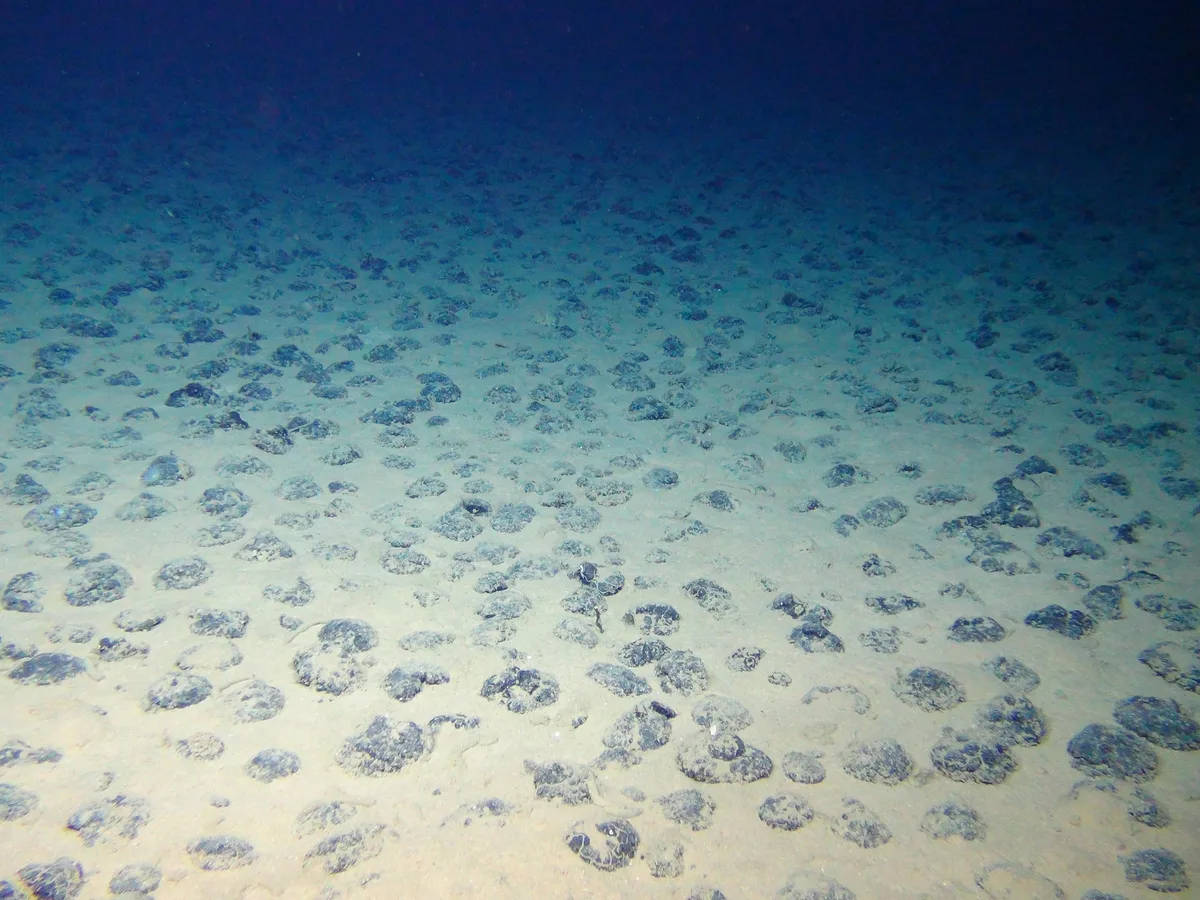
The Clarion-Clipperton Fracture Zone (CCZ) spans over 4.5 million square kilometers across the central Pacific Ocean. It is a realm of absolute darkness where four vertical kilometers of seawater exert a crushing pressure of four hundred atmospheres upon every square centimeter of the seabed. Across this vast abyssal plain lie billions of tons of potato-sized polymetallic nodules rich in nickel, cobalt, copper, and rare-earth elements. To assess the ecological baseline of this mineral expanse before deep-sea mining commences, the UK National Oceanography Centre (NOC) and the Scottish Association for Marine Science (SAMS) deployed an intensive oceanographic mission.
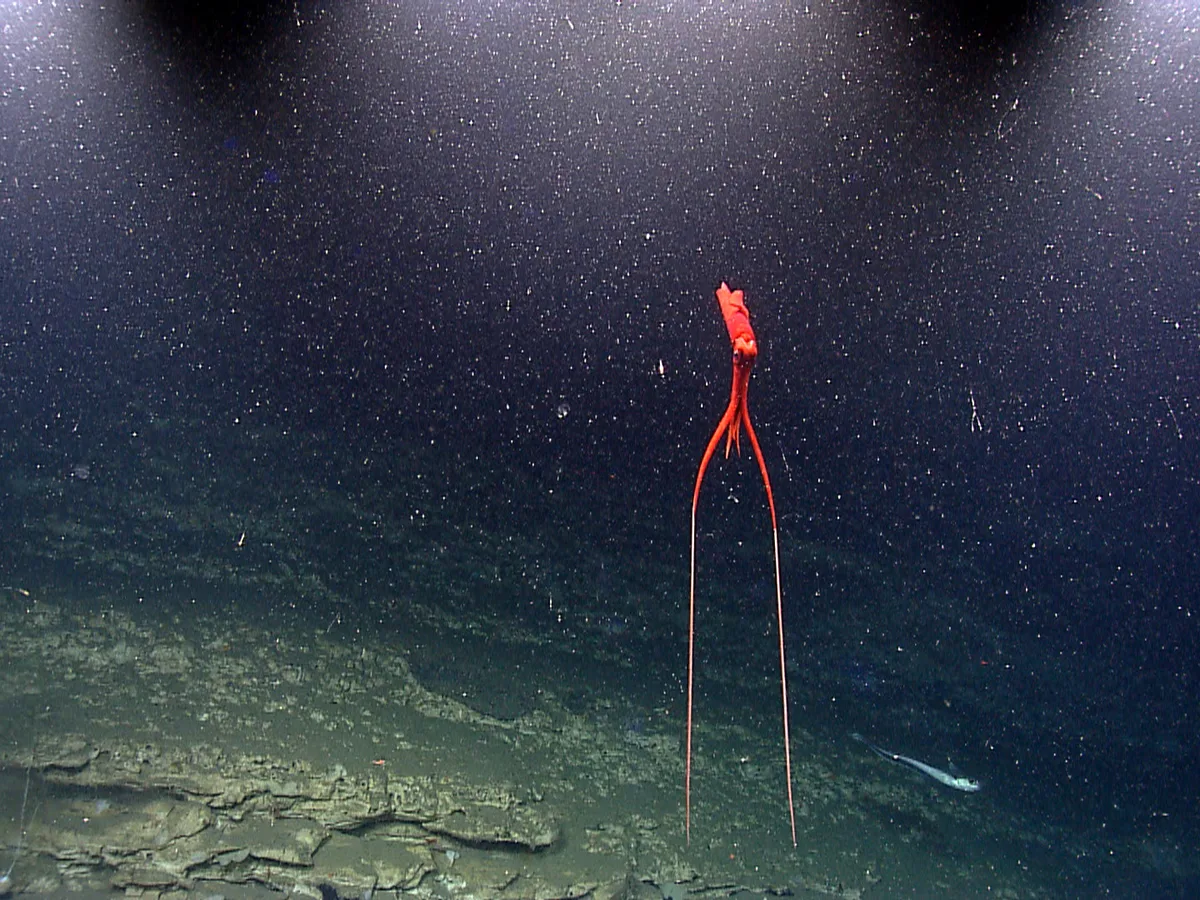
Lowered from the research vessel into the abyss, the remotely operated vehicle ROV Isis traversed the soft pelagic ooze using ultra-high-definition optical suites and intense LED illumination arrays. As the vehicle scanned the seabed, pilots in the control container noticed an unusual silhouette projecting from the flat sediment. Maneuvering the robotic arms closer, the high-magnification camera resolved an astonishing sight: two delicate, iridescent filaments swaying gently in the slow benthic drift.
Closer examination revealed that the filaments were the elongated feeding tentacles of a substantial deep-sea squid. The mollusk had driven its torpedo-shaped mantle, head, and muscular fins entirely into the soft sediment, adopting a rigid vertical posture upside down. The discovery, meticulously documented in the peer-reviewed journal Ecology, sent shockwaves through the global cephalopod biology community.
Anatomy of the ‘Muddy Squid’: Mastigoteuthidae’s Radical Adaptations
Taxonomic analysis identified the animal as a member of the whiplash squid family (Mastigoteuthidae)—one of the most enigmatic clades in the ocean. Mastigoteuthids typically inhabit bathypelagic depths where they hover in the water column in a distinctive “parachute” or “tuning-fork” posture. Their defining hallmark is the fourth pair of arms: whip-like tentacles that can extend multiple times their mantle length, carpeted with thousands of microscopic suckers that act like living flypaper.
Never before, however, had any teuthologist observed a squid employing its mantle as an excavating drill. While infaunal burrowing is a hallmark of shallow-water octopuses and sepiolids, the streamlined anatomy of squids—optimized for high-speed jet propulsion and pelagic agility—was long deemed structurally unsuited for subterranean locomotion.
Biologists attribute this feat to the exquisite biomechanical flexibility of the cephalopod muscular hydrostat. This aligns directly with the remarkable biomechanics of marine cephalopods that enable drastic morphological deformations. In this instance, the whiplash squid collapsed its fins tightly against the mantle, using targeted retrograde pulses from its funnel siphon to displace the silt and anchor itself headfirst into the benthic substrate.
«We are accustomed to benthic octopuses and cuttlefishes burrowing into coarse sand, but among pelagic squids, this is an absolute first. This animal literally transformed its hydrodynamic body into a stationary, plant-like ambush lure amid the barren abyssal mud.»
Dr. Jeffrey Drazen, Professor of Deep-Sea Oceanography at the University of Hawaii at Manoa
Mimicking Glass Sponges: The Ultimate Abyssal Ambush
Why would a pelagic predator bury itself in freezing abyssal mud? Behavioral analysis conducted by marine ethologists suggests a sophisticated dual strategy: passive predator evasion and aggressive predatory mimicry.
The abyssal plain of the CCZ is an open, featureless landscape virtually devoid of physical shelter. In this exposed expanse, a free-swimming squid is readily detected by the lateral lines and sensitive eyes of deep-sea grenadiers, slickheads, and sleeper sharks. By burying its reflective mantle beneath the sediment, the squid effectively vanishes from optical and acoustic detection. Only two thread-like tentacles remain exposed, generating virtually zero acoustic signature.
Simultaneously, the elevated tentacles closely mimic the long siliceous stalks of hexactinellid glass sponges that naturally colonize manganese nodules. Abyssal scavenging amphipods, mysids, and isopods instinctively navigate toward sponge stalks seeking food particles and shelter from currents. As soon as an unsuspecting crustacean brushes against the faux stalk, the adhesive micro-suckers snap shut, reeling the prey directly beneath the mud into the squid’s chitinous beak. In an environment where meals occur weeks apart, this motionless ambush eliminates the immense metabolic cost of active foraging.
The Clarion-Clipperton Zone (CCZ) abyssal plain between Hawaii and Mexico is an extreme oceanic habitat with near-freezing seawater (+1.5 °C) and immense pressure.
Whiplash squids possess extraordinarily long fourth tentacles lined with microscopic adhesive suckers designed to ensnare bathypelagic crustacean swarms.
By concealing its reflective eyes and muscular mantle in mud, the squid poses its tentacles vertically, perfectly imitating the stalk of a hexactinellid glass sponge.
The CCZ is targeted for industrial extraction of battery-critical manganese nodules, threatening fragile abyssal benthic communities before they can be scientifically cataloged.
Siphonal Fluid Dynamics: Breathing Beneath Deep-Sea Silt
A critical physiological question centered on respiration. Pelagic squids breathe through continuous inhalation of seawater through mantle apertures and forceful exhalation through the funnel. Inhaling loose abyssal mud would instantly coat the delicate microscopic lamellae of their gills (ctenidia), causing asphyxiation within minutes.
Fluid dynamics modeling of the ROV video footage revealed that the squid secretes a lubricating mucus layer that stabilizes the silt cavity around its mantle. Meanwhile, the tip of its flexible funnel siphon remained exposed through a tiny venting chimney, drawing uncontaminated water and expelling exhaust away from the burrow.
These fluid mechanics are governed by the physical fluid dynamics of the open ocean, where pressure, density, and kinematic viscosity alter boundary layer behavior. Under 400 atmospheres and near-freezing temperatures, seawater viscosity is elevated, requiring refined muscular control of respiratory cavities to ensure sustained gas exchange.
- First Verified Infaunal Behavior in Squids: Historically, the jet-propelled anatomy of teuthoids was considered biomechanically incompatible with burrowing.
- Metabolic Energy Conservation: At abyssal depths where food is exceedingly scarce, motionless ambush saves critical metabolic calories over active cruising.
- Respiratory Isolation: The squid maintains a specialized siphonal orientation to circulate oxygenated seawater over its ctenidia without clogging gill lamellae with silt.
- Sediment Plume Vulnerability: Commercial deep-sea harvester machinery generates extensive benthic turbidity clouds that blind delicate sensory suckers.
The Clarion-Clipperton Zone at a Crossroads: Science vs Deep-Sea Mining
The discovery of this astonishing behavioral adaptation arrives at an urgent juncture in international ocean diplomacy. The International Seabed Authority (ISA) is currently finalizing mining exploitation codes that could open the Clarion-Clipperton Zone to commercial heavy extraction. Industrial consortia have developed massive seafloor mining crawlers designed to scrape nodules from the top layers of sediment.
Marine scientists caution that these operations will obliterate habitats that have required millions of years to stabilize. Heavy tracked vehicles will compact the sediment and kick up expansive particulate plumes that travel hundreds of kilometers before settling, smothering filter-feeders and devastating the benthic food web. Burrowing squids and countless yet-undiscovered endemic species risk extinction before their biology can be understood.
“Every expedition to the Clarion-Clipperton Zone demonstrates how fundamentally incomplete our understanding of the deep ocean remains. The behavior of this whiplash squid proves that the abyss is not a barren desert, but a sophisticated, dynamic biosphere harboring intricate evolutionary adaptations,” the researchers concluded in Ecology. Preserving these abyssal wonders demands robust environmental safeguards and independent science-based governance.