

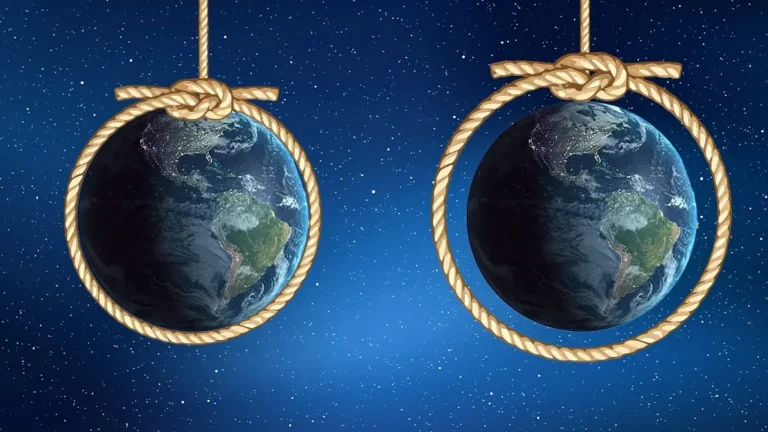

Among the most captivating puzzles in classical mathematics lies a deceptively simple geometric conundrum known as the rope around the Earth paradox. Imagine wrapping a colossal, perfectly non-stretchable cable snugly around the equator of a smooth planetary sphere—spanning an astonishing 40,000 kilometers with zero slack. If you were then tasked with elevating this massive loop uniformly by exactly one meter above the ground across the entire globe, human intuition immediately screams that thousands of kilometers of extra cable would be required. Yet, unyielding Euclidean mathematics delivers a breathtaking revelation: you need only about 6.28 meters of extra rope—the exact same amount needed to elevate a string encircling a tennis ball or a coffee mug.
The Planetary Riddle: How Astronomical Scales Blind Human Intuition
The classic puzzle known in academic circles as the String Girdling Earth problem, recently revisited by science author James Felton on IFLScience, provides an extraordinary case study in cognitive bias. The equatorial circumference of planet Earth measures approximately 40,075 kilometers—more than 40 million meters. Wrapping an imaginary, unyielding cable around the equator forms an unbroken loop girdling oceans, continents, mountain chains, and deserts.
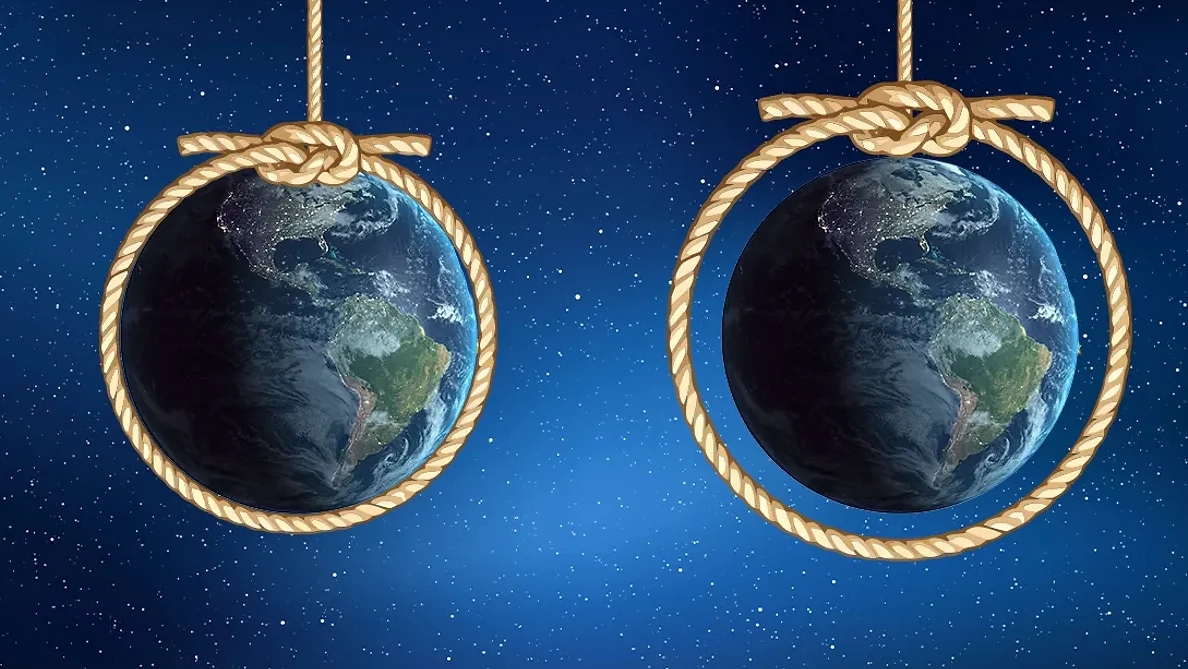
When presented with the question: «How much extra rope must be spliced into this cable to lift the entire 40,000-kilometer loop exactly one meter off the ground all the way around?», virtually every layperson guesses hundreds or thousands of kilometers. It feels intuitively obvious that an object of astronomical proportions should demand astronomical quantities of material to achieve any noticeable separation.
Yet Euclidean geometry delivers a stunning mathematical verdict: you need only about 6.28 meters of extra cable (precisely 2π meters). This counterintuitive result sparks widespread disbelief, because our brains struggle to accept that a piece of rope shorter than a city bus could elevate a planetary-scale loop around the entire globe.
The Elegant Algebra: Why Earth’s Radius Vanishes From the Equation
The mathematical derivation of this phenomenon is wonderfully straightforward. The circumference of any Euclidean circle is defined by the classical equation C = 2πr, where r is the radius and π is the mathematical constant (~3.14159265). Taking Earth’s equatorial radius r (roughly 6,378,137 meters), the initial length of the fitted cable is C₁ = 2πr.
When the cable is uniformly elevated by height h = 1 meter, the new circle has a radius of r₂ = r + h. Substituting this into the circumference formula gives C₂ = 2π(r + h). Expanding the terms yields C₂ = 2πr + 2πh. To find the required extra length (ΔC), we subtract the original circumference from the new one: ΔC = C₂ – C₁ = (2πr + 2πh) – 2πr = 2πh.
Notice the crucial mathematical revelation: the variable r—the radius of Earth itself—completely cancels out! The change in circumference ΔC depends exclusively on the elevation height h multiplied by 2π. For h = 1 meter, ΔC = 2π × 1 ≈ 6.28318 meters. Whether girdling an atom, a basketball, or Jupiter, raising the perimeter by one meter universally requires exactly 6.28 meters of extra material.
«Human intuition evolved to navigate local three-dimensional environments where larger objects demand proportionally monumental resources. But pure geometry is free from biological bias: it demonstrates that circumference expansion is completely invariant to the baseline radius of the sphere.»
Martin Gardner, legendary science writer and pioneer of recreational mathematics
The Reverse Riddle: A Cat Strolling Under a Planetary Cable
The reciprocal formulation of this riddle is even more astonishing. Suppose that instead of lifting the cable by a set height, we slice open the tight 40,000-kilometer rope, insert exactly one additional meter of length, and redistribute the slack symmetrically around the globe. Question: how high will the rope hover above the ground?
Intuition suggests that one meter diluted across 40 million meters of perimeter would yield an invisible microscopic gap—fractions of an angstrom. In reality, rearranging the formula gives h = ΔC / (2π) = 1 / (2 × 3.14159…) ≈ 0.15915 meters, or nearly 16 centimeters! That creates ample clearance for a domestic cat, a rabbit, or a small dog to stroll underneath without touching the rope.
This mathematical paradox echoes broader debates in the history of science. Just as thermodynamics challenged geological intuitions regarding the age of the Earth, rigorous calculations often expose the fallibility of common sense. Modern space exploration demands similar precision, as demonstrated when autonomous robotics successfully constructed space structures in orbit.
A 40,000-km steel cable expands by roughly 480 meters for every 1°C increase in temperature. Day-night solar cycles across the equator would instantly overwhelm any theoretical one-meter gap.
No physical cable can form a freestanding concentric ring without continuous support. Between suspension pillars, Earth’s gravitational field pulls the cable into deep hyperbolic catenary curves.
Even carbon nanotubes possess a finite breaking length under their own weight. The immense tensile load of a 40,000-km structure would cause spontaneous structural snapping.
Earth’s rotational velocity at the equator (~1,670 km/h) combined with high-altitude jet streams exceeding 300 km/h would induce catastrophic aeroelastic flutter and destructive resonance.
Cognitive Illusion: Why the Human Brain Confuses Linear and Exponential Scaling
Cognitive psychologists attribute our misjudgment of this problem to the Weber-Fechner law of human perception. Human sensory systems gauge magnitude proportionally rather than additively. Adding one meter to a two-meter rope represents a dramatic 50% increase. In contrast, adding one meter to 40,000,000 meters constitutes a negligible 0.0000025% change. Our minds mistakenly presume that the resulting physical displacement must be equally negligible.
Furthermore, humans routinely conflate linear circumference with area and volume. The surface area of a sphere scales with the square of the radius (S = 4πr²), while volume scales with the cube (V = 4/3πr³). Enclosing Earth in a continuous one-meter-thick atmospheric shell would require over 510 billion cubic meters of air. By unconsciously projecting three-dimensional volumetric inertia onto a one-dimensional line, our intuition commits a major category error.
Nineteenth-century mathematician William Chauvenet famously cited this problem to demonstrate why formal algebraic deduction must always supersede intuitive mental visualization. While our minds easily stumble into optical illusions, algebraic formulas remain perfectly objective across every conceivable scale.
- Linearity of circle geometry: the required length difference depends solely on radial elevation (Δr) multiplied by 2π, completely independent of the starting sphere size.
- The feline clearance riddle: adding just 1 meter of extra rope to a 40,000-km equatorial tether creates a uniform gap of ~15.9 cm, easily allowing a domestic cat to stroll underneath.
- Cognitive scale distortion: human perception instinctively conflates linear length with quadratic area and cubic volume, falsely expecting astronomical costs for linear offsets.
- Universal invariant mathematics: this elegant scaling principle holds universally true across all scales, from subatomic nuclei to the event horizon of supermassive black holes.
Physical Reality: What Happens to a Real Steel Cable Girdling the Globe
While the 6.28-meter result is mathematically unimpeachable in idealized Euclidean space, constructing such a physical cable around real-world Earth would encounter insurmountable engineering obstacles.
First, Earth is an oblate spheroid scarred by rugged topography. The equator crosses the Andes at elevations exceeding 4,600 meters before plunging into the Pacific Ocean trenches. Following the actual terrestrial terrain would exponentially increase cable length beyond idealized geometric models.
Second, material science imposes severe constraints. A 40,000-kilometer steel cable undergoes immense thermal expansion: a temperature shift of just 1°C alters its length by roughly 480 meters, utterly dwarfing the theoretical one-meter gap. As highlighted in IFLScience’s exploration of the rope paradox, the riddle remains an enduring celebration of pure geometric truth standing in contrast with physical engineering complexities.