

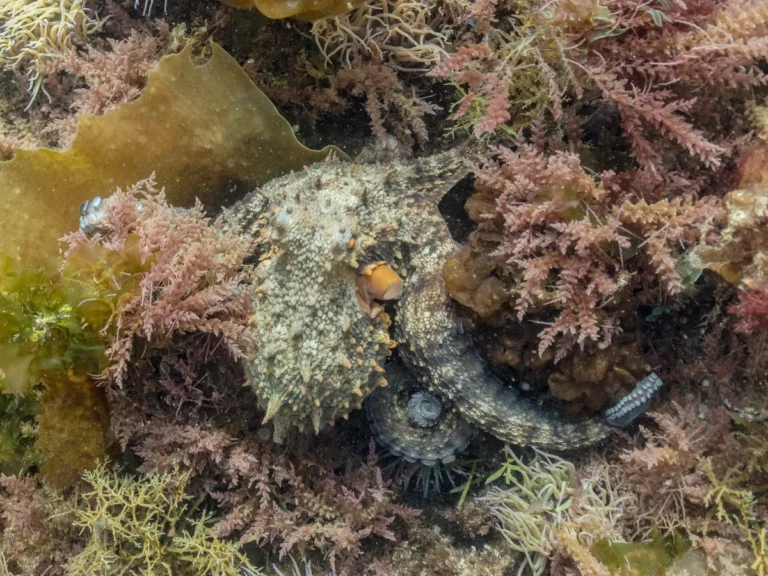

Marine biologists and robotics engineers have long marvelled at the uncanny ability of cephalopods to vanish from sealed aquarium enclosures and slip through narrow bilge drainage pipes on fishing vessels. Yet the precise kinematics governing these feats remained an unsolved puzzle. A rigorous biomechanical investigation published in the Journal of Experimental Biology has finally resolved the mystery of how octopuses squeeze through small holes far narrower than their own body dimensions. Far from amorphous gelatinous blobs randomly oozing through gaps, common octopuses execute calculated, multi-stage locomotor protocols specifically tailored to navigate the rigid constraints of their anatomical framework.
The Anatomical Paradox: Non-Compressible Boundaries in a Soft Organism
In the natural kingdom, octopuses represent the absolute pinnacle of soft-bodied hydrostatic evolutionary engineering. Entirely devoid of rigid internal skeletons, bony vertebrae, or protective mineralized carapaces, their morphology operates as a sophisticated muscular hydrostat. Because biological fluid and dense muscle fibers cannot be compressed, the total volume of their tissue remains constant: contraction in one dimension immediately forces elongation in another, governed by physical constraints akin to the way ocean currents interface with the physics of surface tension in waves.
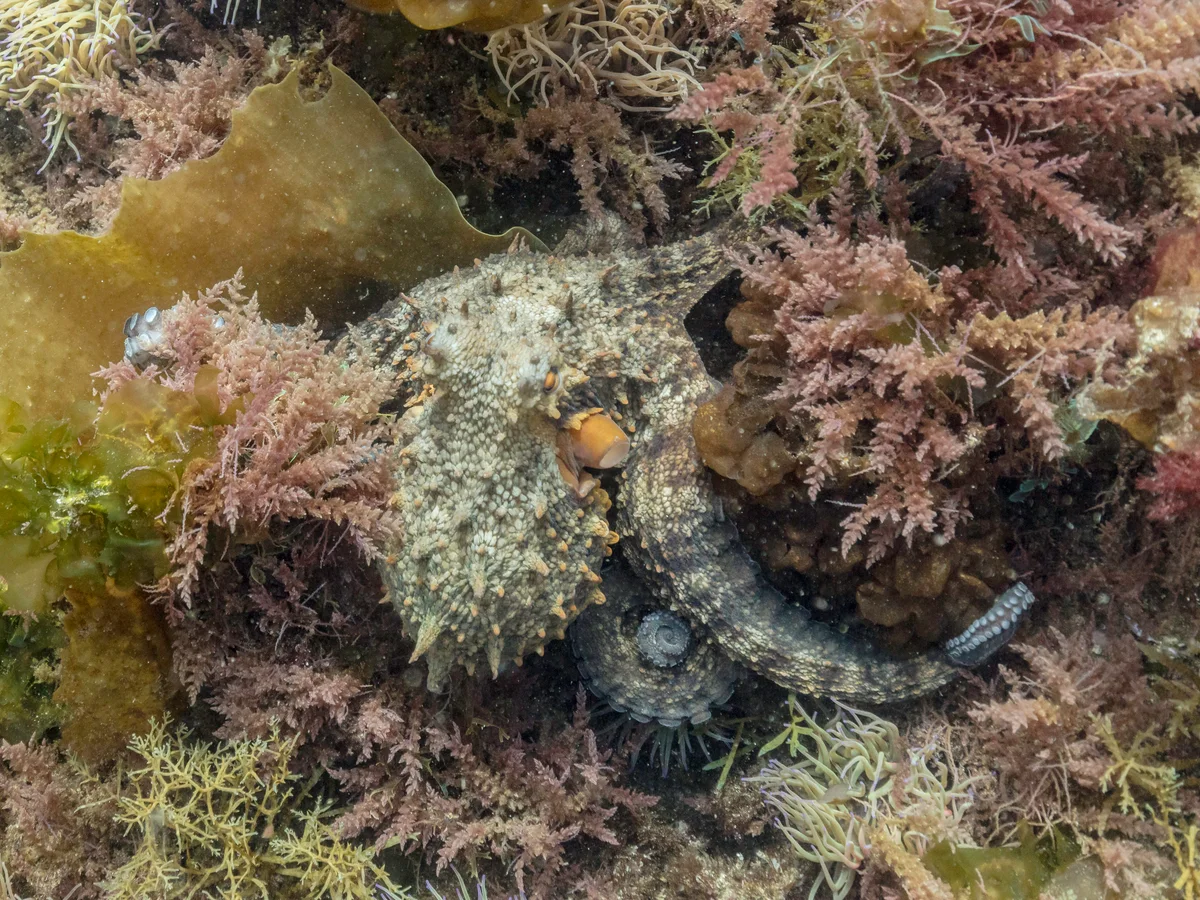
However, the widespread folklore asserting that an octopus can flow through any microscopic pinhole is contradicted by cephalopod anatomy. The animal contains two distinctly rigid structural components. The first is its sharp chitinous beak, nestled at the center of the radial arm crown, used to crack crab carapaces and mollusc shells. The second, far less appreciated by the public, is the dense cartilaginous cranial capsule that shields the circular central brain and optical lobes positioned squarely between the eyes.
Consequently, the distance between the octopus’s eyes has long been regarded by functional morphologists as the absolute physical threshold limiting its traversal capacity. While the beak is relatively compact, the central nervous system cannot be squashed without causing catastrophic neurological trauma.
To investigate how the common octopus (Octopus vulgaris) mathematically resolves this spatial obstacle, a collaborative team of researchers from the National University of Singapore and the Singapore-MIT Alliance for Research and Technology (SMART) devised a precision experimental arena.
Spearheaded by bioengineer Taylor Ryan and soft-robotics pioneer Professor Cecilia Laschi, the team designed custom transparent Perspex enclosures connected by circular apertures of varying diameters, spanning from comfortably wide openings to extremely narrow gaps measuring substantially smaller than the animals’ interocular span.
Step-by-Step Traversal Protocols: Three- and Four-Stage Locomotor Strategies
Utilizing high-speed infrared cinematography, the researchers deconstructed the locomotion into discrete kinematic segments. The findings, documented in the primary literature (Journal of Experimental Biology, 2026), demonstrated that octopuses do not push blindly; instead, they selectively deploy two distinct behavioral motor programs based on geometric ratios.
When the aperture diameter exceeded the distance between their eyes, the octopuses executed a streamlined three-step routine. First, the animal extended one or two exploratory arms through the port, anchoring suckers onto the exterior wall to generate forward tensile force. Second, it pulled its head and eyes straight through without significant cranial tilt. Third, coordinated longitudinal contractions of the mantle squeezed the visceral mass through the opening.
The critical revelation emerged when the hole diameter was manufactured smaller than the interocular distance. In these high-compression trials, the octopuses instantly shifted to an intricate four-stage protocol.
Rather than advancing head-first, the animal sequentially pushed all eight flexible arms through the hole, establishing a massive tensile anchor on the other side. Next, it rotated its head precisely 90 degrees along its longitudinal axis, orienting the cranial cartilage diagonally across the opening.
Capitalizing on the compliant connective tissues surrounding its orbital sockets, the octopus threaded its braincase through the narrow gap with minimal cross-sectional drag. Once the rigid cranial core cleared the barrier, the animal relaxed its visceral mantle, drawing it out into an elongated cylindrical band.
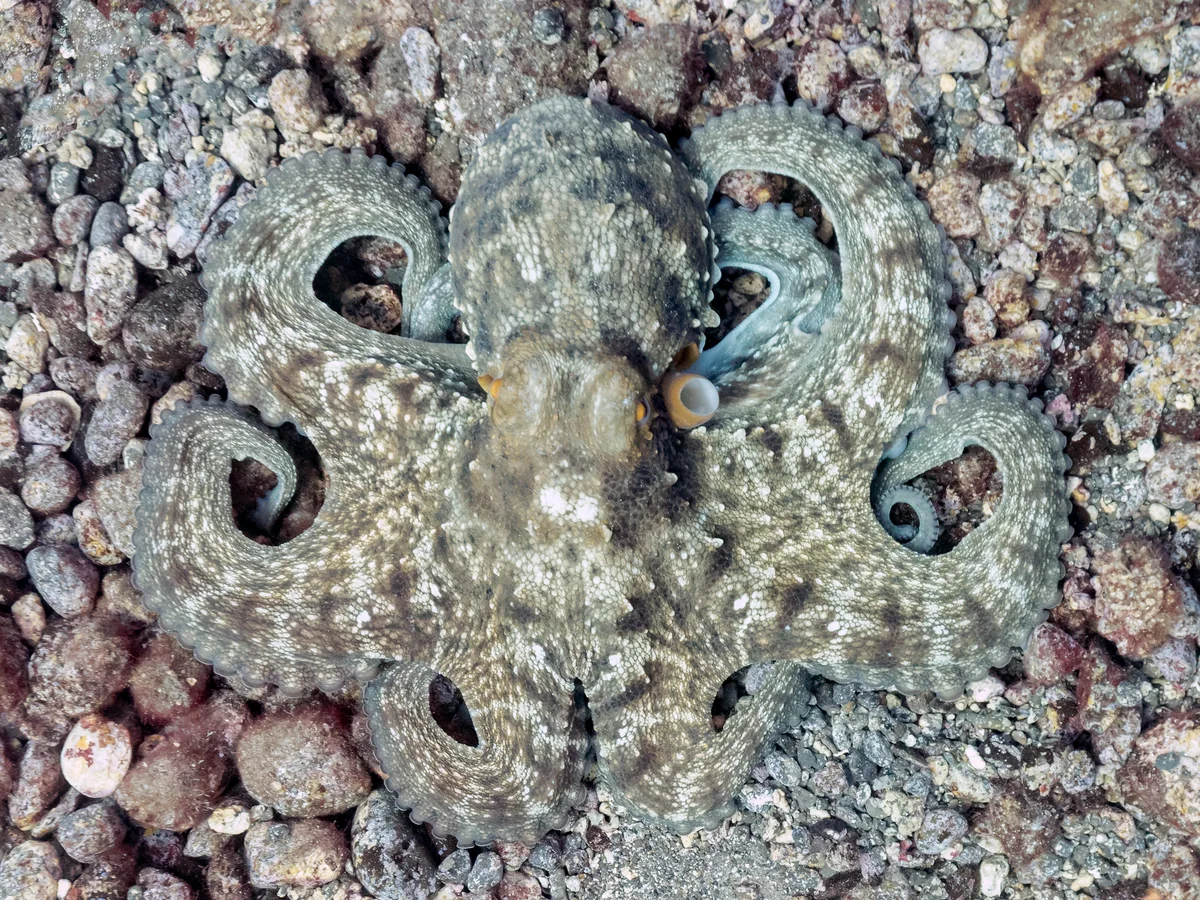
«Popular culture views the octopus as a completely formless creature that can dissolve through any crack, but physically that is incorrect. It possesses two non-compressible structures: a hard keratinous beak and a dense cartilaginous brain capsule between its eyes. Our study proved that the animal carefully gauges the aperture diameter against its interocular distance and switches its movement protocol accordingly.»
Dr. Cecilia Laschi, Professor of Bio-Robotics and study co-author
Distributed Tactile Intelligence: Sensor-Driven Locomotion
The success of these biomechanical maneuvers relies fundamentally on the decentralized architecture of the cephalopod nervous system. Of an octopus’s approximately 500 million neurons, over two-thirds reside not in the central brain, but within extensive neural networks distributed throughout its eight arms. Each limb operates as a semi-autonomous computational cluster, capable of making localized motor and tactile assessments.
As the arms probe the constriction, hundreds of suckers continuously stream tactile and chemotactile telemetry to the peripheral ganglia, mapping the aperture’s perimeter in sub-millimeter detail. If the suckers encounter abrasive edges or sharp burrs, the arms instinctively adjust their gripping posture, protecting the delicate epithelial mantle from lacerations.
This seamless fusion of sensory feedback and distributed tension regulation enables the octopus to execute maneuvers rivalling complex tool manipulation in wildlife. The animal generates tractive forces exceeding its own body weight tenfold while fluidly redistributing internal coelomic fluids from one anatomical chamber to another.
Cephalopod tissue maintains constant volume: lateral compression inevitably forces longitudinal extension without density loss.
The cartilaginous brain capsule encasing the central nervous system between the eyes represents the ultimate physical aperture threshold.
In narrow gaps, the octopus feeds all 8 arms through first, rotates its head 90 degrees diagonally, and pulls the elongated mantle.
Kinematic data from cephalopod locomotion directly informs the creation of compliant elastomer rescue robots for disaster rubble.
From Marine Trenches to Soft Robotics: Disaster Response Innovation
Deciphering the quantitative mechanics of octopus deformation provides vital blueprints for next-generation robotics. Conventional rigid-jointed search robots, assembled from titanium linkages and fixed servos, struggle immensely in collapsed disaster zones, subterranean pipeline networks, and underwater wreckage. Any minor variation in fissure geometry causes them to become hopelessly wedged.
Engineering teams are already leveraging these biological kinematic data to fabricate octopus-inspired search-and-rescue platforms. Constructed from silicone elastomers embedded with microfluidic pneumatic actuation channels and flexible optical strain sensors, these soft robots mimic cephalopod compliance.
A bio-inspired robot utilizing the octopus’s four-stage traversal protocol can slip flexible sensory tentacles through rubble crevices, inspect void spaces with micro-cameras, and subsequently compress its core electronics pod through narrow openings, delivering critical medical supplies and communication links to trapped survivors where rigid machinery cannot venture.
- The chitinous beak and cranial cartilage are the sole non-compressible structures in the octopus anatomy.
- When confronting gaps narrower than eye distance, the animal deploys a 90-degree diagonal head rotation.
- Over two-thirds of the octopus’s 500 million neurons reside in the arms, guiding independent tactile positioning.
- Autonomous suckers dynamically detect microscopic wall abrasions to prevent visceral mantle tearing.
- Quantitative kinematic models are driving breakthroughs in soft-bodied disaster search-and-rescue robotics.
Evolutionary Triumph: The Advantages of Abandoning the Shell
From an evolutionary perspective, the extraordinary deformability of octopuses emerged as the direct consequence of a profound macroevolutionary gamble. Hundreds of millions of years ago, ancestral cephalopods were encased within heavy external calcified shells, similar to contemporary nautiluses or extinct ammonites. While shells offered defense against marine predators, they imposed severe energetic and locomotor constraints.
During the Mesozoic Era, the ancestors of octopuses discarded their cumbersome armor entirely, adopting a radical adaptive strategy centered on total morphological malleability, dynamic chromatophore camouflage, and the exploitation of inaccessible reef crevices.
The capacity to retreat into micro-apertures barred to predatory sharks and moray eels secured their evolutionary lineage. Today, cephalopod biomechanics proves that a soft, hydrostatic body coupled with distributed intelligence represents one of the most resilient and versatile locomotor architectures on planet Earth.