



Groundbreaking planetary stratigraphic findings confirm that the Perseverance rover Jezero crater water dynamic sustained an expansive, deep-water paleolake and delta network on ancient Mars for millions of years. Analysis of core samples retrieved by NASA flagship robotic explorer along the scalloped scarps of the Shenandoah sedimentary formation revealed finely laminated mudstones and iron-magnesium carbonates. On Earth, these lacustrine geochemical environments represent optimal repositories for preserving fossilized microbial biofilms and complex organic matter, fundamentally dismantling earlier theories that Mars was an eternally arid, frozen wasteland.
Paleohydrology of Jezero: How an Impact Basin Transformed into a Lake
Roughly 3.8 to 4 billion years ago, during the late Noachian and early Hesperian epochs, Mars was shielded by a dense carbon dioxide and water-vapor atmosphere capable of driving greenhouse surface temperatures. Jezero Crater — a 45-kilometer-wide impact scar along the western edge of the Isidis Planitia impact basin — transformed into an open-basin lake system.
Fed by two vigorous incoming fluvial channels known as Neretva Vallis and Sava Vallis, ancestral river systems carved through volcanic highlands, carrying dissolved ions and suspended sediment into the standing body of water. As river velocities dissipated upon entering the calm lacustrine basin, the sediment fell out of suspension, building up a classic fan-shaped river delta.
Since executing its sky-crane landing in February 2021, the Perseverance rover has been ascending these terraced delta deposits. Utilizing its ground-penetrating radar instrument, RIMFAX (Radar Imager for Mars’ Subsurface Experiment), planetary geophysicists probed up to 20 meters beneath the Martian regolith, mapping tilted cross-bedding strata that form exclusively in energetic aqueous environments.
Geochemistry of Smectite Clays: The Ultimate Matrix for Biosignature Capture
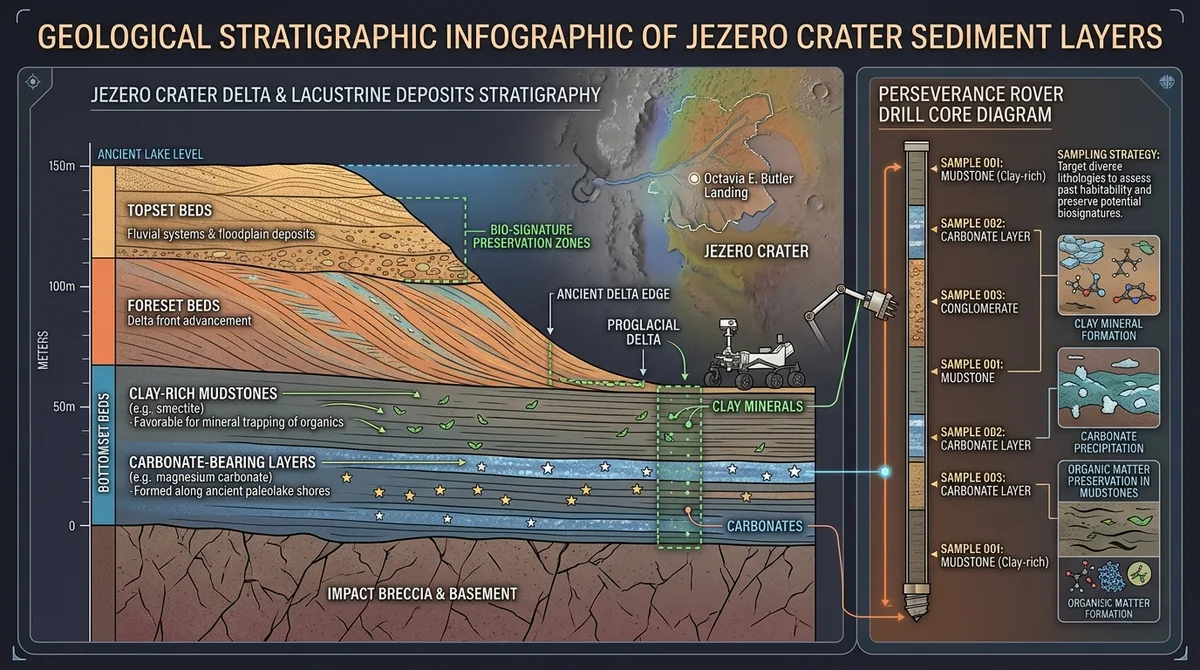
The core scientific breakthrough of the mission stems from the rover onboard analytical laboratories. The PIXL (Planetary Instrument for X-ray Lithochemistry) and SHERLOC (Scanning Habitable Environments with Raman & Luminescence for Organics & Chemicals) instruments detected high concentrations of smectite clays, microcrystalline silica, and carbonates.
In terrestrial sedimentology, phyllosilicate clay sheets act as macromolecular cages. As clay particles precipitate out of lacustrine water, they electrostatically bind organic carbon compounds, isolating them from oxidative breakdown and solar ultraviolet photolysis over billions of years.
Within rock cores collected at the Wildcat Ridge formation, SHERLOC recorded definitive spectral signatures consistent with polycyclic aromatic hydrocarbons and associated sulfate minerals. While abiotic meteoritic processes can generate organic molecules, this geochemical micro-environment mirrors the conditions found in Archean terrestrial stromatolite beds.
3.8 billion years ago, a 45-km impact crater hosted a deep freshwater lake fed by Neretva and Sava rivers.
Phyllosilicate clays and carbonates preserve organic molecules and microbial biosignatures for billions of years.
Ground-penetrating radar imaged aqueous sedimentary cross-bedding down to 20 meters beneath the surface.
Sealed titanium sample tubes await retrieval by NASA/ESA landers for atomic-scale analysis on Earth.
Climatic Collapse: How Martian Water Evaporated into History
The geological succession at Jezero presents a dramatic record of Martian climate evolution. The lowest stratigraphic layers consist of tranquil mudstones deposited over millions of years of stable lacustrine activity.
However, the upper strata transition abruptly into coarse conglomerate beds embedded with rounded boulders exceeding one meter in diameter. This coarse sediment marks the arrival of high-energy torrents, triggered as the planet climate destabilized. As Mars lost its internal dynamo and global protective magnetosphere, solar wind stripped away its atmosphere.
Atmospheric pressure plummeted below the triple point of water, forcing the remaining surface water to freeze or sublimate into space, with vast volumes retreating into deep cryospheric aquifers — a planetary evolutionary mystery frequently highlighted in planetary and astrophysical research.
«What we are observing in the exposed cliffs of Jezero Crater is not the remnant of a fleeting catastrophic flash flood. It is the textbook, tranquil depositional stratigraphy of a persistent freshwater lake basin characterized by the slow settling of fine suspended clay minerals. If microbial life ever gained a foothold on ancient Mars, these deltaic strata represent the most compelling sanctuary in the solar system to uncover it.»
Ken Farley, geochemist at the California Institute of Technology (Caltech) and Project Scientist for the Mars 2020 mission
Mars Sample Return: Preparing Martian Cores for Terrestrial Laboratories
Perseverance is more than an in-situ analytical probe; it is the cornerstone of the first interplanetary sample return campaign. To date, the rover has drilled, cataloged, and hermetically sealed dozens of ultra-pure titanium sample tubes filled with intact sediment cores.
A cache of backup tubes was deposited at the Three Forks depot on the crater floor, while the primary collection remains housed within the rover belly. NASA and the European Space Agency (ESA) are advancing mission architectures for the Mars Sample Return (MSR) campaign, featuring a Sample Retrieval Lander and a Mars Ascent Vehicle (MAV).
Only in terrestrial cleanroom facilities, equipped with synchrotron X-ray beamlines, secondary-ion mass spectrometers, and cryo-electron microscopes, can scientists determine whether these Martian clays contain microfossils or isotopic metabolic signatures.
- NASA Perseverance rover touched down in Jezero Crater in February 2021.
- Sedimentary delta deposits demonstrate millions of years of continuous lacustrine deposition.
- The SHERLOC instrument detected complex aromatic organic compounds at Wildcat Ridge.
- Returning these samples to Earth will provide definitive proof regarding ancient Martian habitability.
Planetary Significance: Mars as an Ancient Habitable World
The telemetry gathered by Perseverance establishes that Mars was once a dynamic, hydrologically active world. For hundreds of millions of years, the planet possessed rainfall, river networks, lakes, and stable geochemical gradients concurrent with the emergence of life on Earth.
If abiogenesis is a natural thermodynamic consequence of organic chemistry within aqueous environments, Mars possessed the required ingredients. For in-depth scientific analysis of the latest planetary discoveries, explore reporting on IFLScience.
The stratigraphic record of Jezero Crater brings humanity closer to answering whether life is a rare terrestrial anomaly or a common feature across wet rocky worlds in our galaxy.