

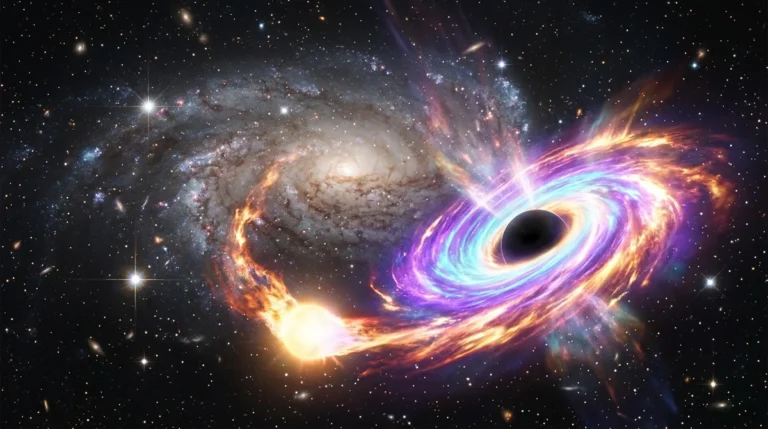

For decades, astrophysicists operated on the foundational axiom that supermassive gravitational monsters reside exclusively in the dense cores of galaxies, anchoring billions of orbiting stars. However, the discovery of the unprecedented cosmic cataclysm AT2024tvd has upended existing models of galactic architecture. Located 600 million light-years away in the constellation Hercules, an intermediate-to-supermassive black hole weighing approximately one million times the mass of the Sun violently ripped apart a passing star 2,600 light-years away from the galactic nucleus. This marks the first optically selected offset tidal disruption event ever documented in observational astronomy.
Anatomy of Destruction: How Automated Surveys Caught Gravitational Spaghettification
The cataclysmic event AT2024tvd was first detected by the wide-field camera of the Zwicky Transient Facility (ZTF) atop Palomar Mountain in California. Automated transient classification pipelines flagged a rapid, exceptionally bright blue thermal flare characteristic of a tidal disruption event (TDE)—a scenario where an unlucky star wanders inside the black hole’s tidal radius.
At this boundary, the differential gravitational field across the star overcomes its self-gravity. The hemisphere facing the event horizon experiences immense gravitational acceleration compared to the far side. Within hours, the spherical stellar body is stretched into an elongated plasma filament—a physical process known as spaghettification.
Roughly half of the stellar debris is flung outwards into the interstellar medium along unbound hyperbolic orbits, while the remaining 50% cascades inward to form a super-hot relativistic accretion disk. As gas collides with itself, temperatures soar into millions of kelvins, unleashing a torrent of optical, ultraviolet, and soft X-ray radiation.
Shocking 2,600 Light-Year Offset: A Black Hole Drifting in the Stellar Halo
The true anomaly emerged when the Hubble Space Telescope, the James Webb Space Telescope (JWST), and the Chandra X-ray Observatory performed deep follow-up imaging. Precision astrometry revealed that the blue point source did not align with the host galaxy’s core.
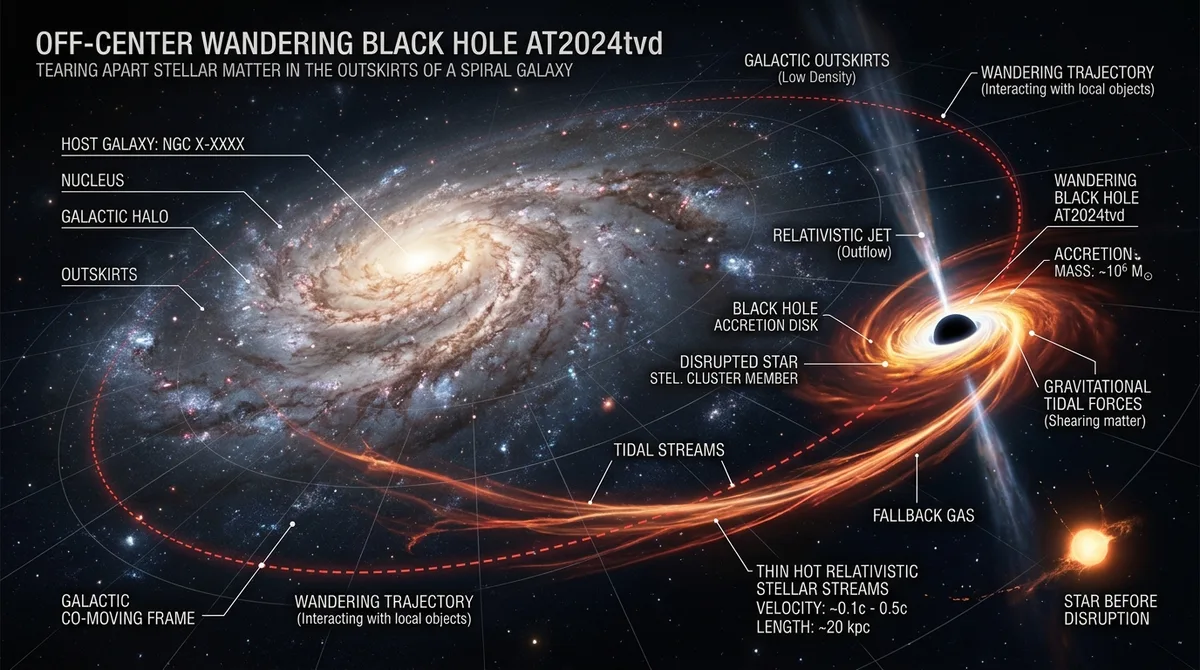
The host galaxy harbors its own 100-million-solar-mass supermassive black hole at its center, but the AT2024tvd flare occurred roughly 0.8 kiloparsecs (approximately 2,600 light-years) off-center in the galaxy’s outer outskirts. This represents a staggering spatial displacement for a one-million-solar-mass black hole, confirming it is drifting untethered through the stellar halo.
Among approximately 100 optical TDEs discovered over the past two decades, every single event originated precisely from the host galaxy’s core. AT2024tvd represents the very first observational proof of a wandering black hole consuming matter away from the galactic center.
The flare erupted 0.8 kpc from the host core, where a separate 100-million-solar-mass supermassive black hole resides.
Tidal forces stretched the doomed star into a plasma stream, feeding a scorching multi-million-degree accretion disk.
Asymmetric gravitational wave emission during an ancient black hole merger ejected the remnant into the stellar halo.
VLA radiotelescopes recorded fast synchrotron emission from relativistic outflows plowing through interstellar gas.
Gravitational Recoil Kick: The Relic of Violent Ancient Mergers
How does a black hole possessing the mass of a million suns end up cast out into the galactic suburbs? Theoretical models of cosmic hierarchy have long predicted the existence of “wandering” or rogue black holes born from chaotic galaxy mergers.
When two massive galaxies collide, dynamical friction causes their respective central black holes to sink toward the new center of mass, eventually forming a bound binary system. If a third galaxy joins the collision before coalescence, chaotic three-body gravitational interactions can slingshot one of the black holes out of the nucleus at extreme velocity.
Furthermore, as two black holes merge, the emission of gravitational waves is rarely symmetric. This anisotropic radiation imparts a powerful gravitational recoil kick that can propel the newly formed remnant at hundreds of kilometers per second—easily ejecting it from the galactic nucleus into a wandering orbital path lasting billions of years.
«The AT2024tvd flare was an astonishing surprise. We traditionally hunt for stellar tidal disruptions strictly within the optical centers of galaxies. But when the Zwicky Transient Facility alerted us to a fierce blue flare significantly displaced from the galactic nucleus, it became clear: we caught a wandering black hole actively feeding, kicked out into the stellar halo by the gravitational recoil of an ancient merger.»
Matthew Graham, lead astrophysicist for the Zwicky Transient Facility (ZTF) at Palomar Observatory
Double-Peaked Radio Transients and VLA Data: Relativistic Outflows Unveiled
Following the optical peak, astronomers pointed the Karl G. Jansky Very Large Array (VLA) in New Mexico at AT2024tvd. Radio observations revealed a remarkable synchrotron spectrum that evolved far faster than typical central TDEs and displayed a distinctive double-peaked light curve.
This signature reveals that the disruption event generated relativistic plasma jets or fast-moving outflows slamming into the surrounding interstellar medium. The shock front accelerates electrons to near-light speed, emitting intense synchrotron radio waves tracked by astrophysicists over months.
Investigating such extreme galactic outskirts phenomena parallels recent discoveries such as how the James Webb Telescope discovered the oldest black hole in the universe, reshaping how scientists model black hole accretion and dynamics across cosmic time.
- The wandering black hole possesses an estimated mass of ~1 million solar masses (intermediate-to-supermassive class).
- The host galaxy is situated 600 million light-years away within the constellation Hercules.
- AT2024tvd represents the first optically confirmed offset tidal disruption event in history.
- The discovery validates predictions that large galaxies harbor dozens of invisible wandering rogue black holes.
A New Era of Rogue Black Hole Hunting Across the Universe
Astrophysical simulations suggest that in a typical spiral galaxy like our Milky Way, dozens of wandering intermediate-mass black holes may silently roam the stellar halo. Because they rarely encounter dense gas reservoirs, they remain completely dark and undetectable.
Tidal disruption events like AT2024tvd provide astronomers with an invaluable cosmic flashlight: the only way to uncover an elusive wandering monster is when it tears apart an unsuspecting star. The luminous flare illuminates the invisible gravitational trap and reveals its physical mass.
With next-generation observatories like the Vera C. Rubin Observatory coming online, astronomers anticipate uncovering dozens of offset TDEs every year. This will allow researchers to construct the first comprehensive census of rogue black holes and decode the violent history of galactic evolution.