

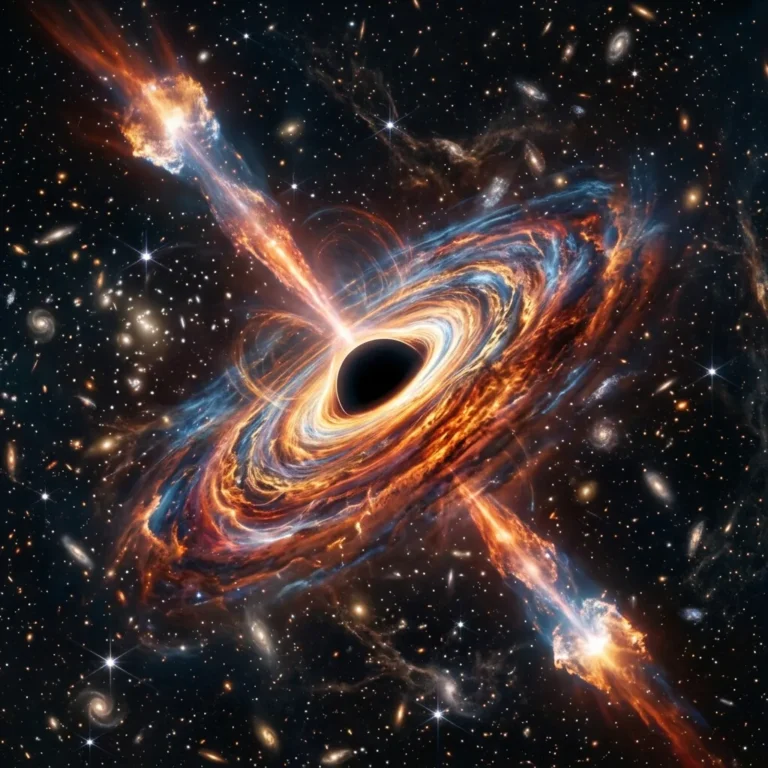

The James Webb Space Telescope (JWST) has made yet another historic discovery that could completely rewrite astrophysics textbooks. Astronomers have discovered the oldest supermassive black hole known to science. It existed just 400 million years after the Big Bang, baffling scientists: according to current cosmological models, it simply did not have enough time to grow to such colossal proportions.
A Monster at the Dawn of Time
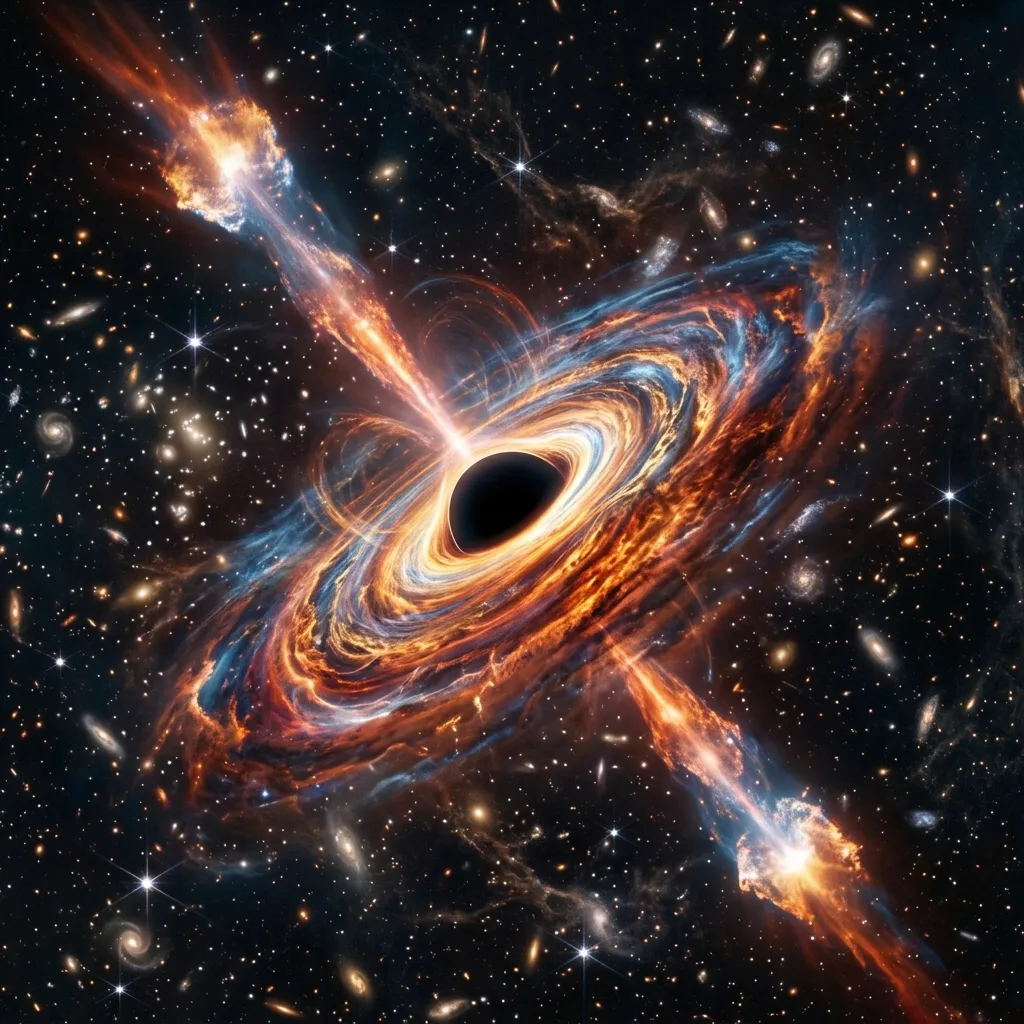
The newly discovered black hole resides at the center of the galaxy GN-z11—one of the most distant and ancient galaxies ever observed by humanity. The mass of this cosmic monster exceeds that of our Sun by several million times. For comparison, the Sagittarius A* black hole at the center of our Milky Way has a similar mass, but it took billions of years to form.
As astrophysicists point out, finding such a massive object at such an early stage in the Universe’s development is like finding a newborn baby weighing 100 kilograms. Just as some exoplanets defy the laws of physics, this black hole challenges our understanding of gravity and matter accretion.
How Could It Grow So Fast?
Prior to this discovery, it was believed that supermassive black holes grew gradually, absorbing gas, dust, and stars over billions of years. However, the age of the Universe at the time GN-z11 existed was less than 3% of its current age (13.8 billion years).
“The fact that this black hole is already so massive at such an early epoch suggests that we need to revise our theories of their formation. Either they are born large, or they can accrete matter at a rate five times higher than the theoretical Eddington limit”
Roberto Maiolino, Professor of Astrophysics at the University of Cambridge
Two Scenarios of the Impossible
Scientists propose two main hypotheses to explain this phenomenon:
- The Heavy Seed Scenario: The black hole did not form from an exploding star (as usual) but resulted from the direct collapse of a giant cloud of primordial gas, immediately acquiring the mass of tens of thousands of suns.
- Super-Eddington Accretion: The black hole absorbed surrounding matter at an incredible rate, ignoring the radiation pressure that usually pushes gas away when it falls in too quickly.
The near-infrared cameras of the James Webb Telescope (NIRCam) were able to detect the powerful radiation of the accretion disk around this black hole, which turned out to be so bright that it outshines the light of billions of stars in the GN-z11 galaxy itself.
A New Era of Astronomy
This discovery is just the beginning. Thanks to the incredible sensitivity of the JWST, astronomers expect to find even older black hole “seeds” in the coming years. These data will help humanity piece together how the first structures formed after the Big Bang and finally solve the mystery of what came first: the galaxy or the supermassive black hole at its center.
Sources: Press release by the University of Cambridge, NASA data.