

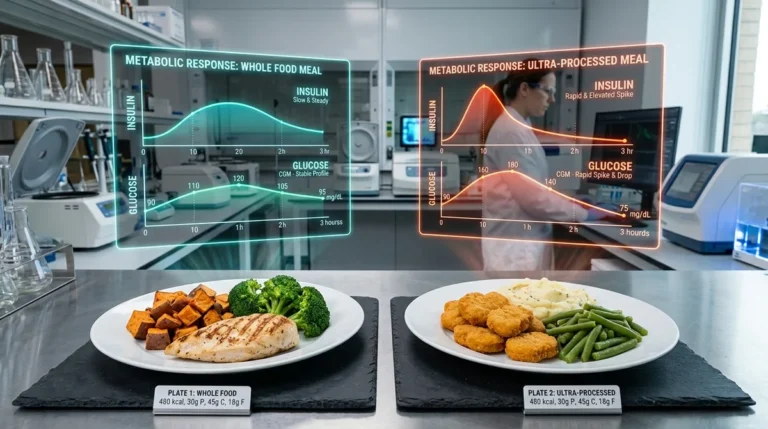

For decades, nutritional science has been anchored to a strict thermodynamic dogma: body composition and metabolic health are determined exclusively by the mathematical balance of calories consumed versus calories expended. However, a landmark controlled feeding trial published in Nature Metabolism by researchers at Virginia Tech has upended that foundational paradigm. Scientists formulated experimental diets matched within tenths of a percent for calories, carbohydrates, fats, proteins, dietary fiber, sodium, and glycemic load. The clinical results were striking: ultra-processed foods (UPFs) provoked a drastic pancreatic insulin surge and disrupted energy oxidation solely because industrial manufacturing dismantled the natural food matrix.
Meticulous Experimental Design: Laboratory Precision Matched to Single Grams
The primary limitation of previous nutritional epidemiology was confounding: ultra-processed products typically contain far higher concentrations of added sugars, saturated fats, and sodium while lacking dietary fiber. To eliminate these confounding variables once and for all, Alexandra DiFeliceantonio and her clinical team engineered an unprecedented randomized crossover feeding protocol.
Human participants received two completely distinct meal plans that were mathematically identical down to a 1% to 1.6% tolerance in laboratory chemical assays. Total energy density, available carbohydrates, proteins, fats, dietary fiber, sodium, water weight, glycemic index, and glycemic load were meticulously matched.
The whole-food meal consisted entirely of minimally processed items: whole hard-boiled eggs, raw bananas, natural block cheese, whole fresh cranberries, and raw nuts. The ultra-processed meal consisted of industrially formulated staples: deli turkey cold cuts, instant dehydrated mashed potatoes, frosted breakfast cereal, packaged chocolate chip cookies, and refined white bread with commercial peanut butter.
The Insulin Surge: Endocrine Systems Forced into Overdrive
Although both meals were biochemically identical on nutritional databases, the physiological responses of the volunteers diverged drastically. Continuous glucose monitoring combined with frequent postprandial venous blood draws exposed profound endocrine disparities.
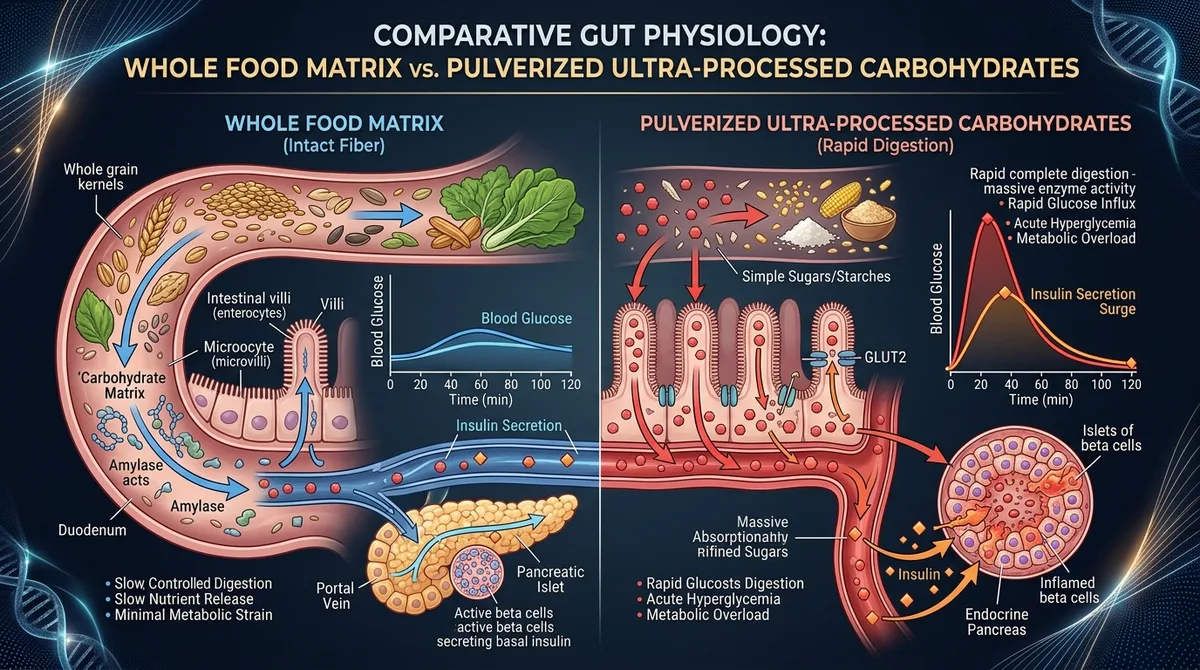
Following consumption of the ultra-processed meal, plasma insulin concentrations skyrocketed to significantly higher peak amplitudes and remained elevated on a prolonged pathological plateau compared to the whole-food meal. The endocrine pancreas was forced to hypersecrete insulin to buffer the abrupt, rapid wave of free monosaccharides entering systemic circulation.
Chronic sustained hyperinsulinemia of this magnitude serves as the direct physiological precursor to insulin resistance, metabolic syndrome, and type 2 diabetes. Furthermore, sustained high insulin levels inhibit hormone-sensitive lipase, effectively locking cellular fat stores and promoting visceral adiposity even in the absence of a caloric surplus.
Both trial meals matched calories, proteins, fats, fiber, and glycemic load within a strict 1% tolerance.
Ultra-processed food drove extreme pancreatic insulin secretion and extended postprandial hyperinsulinemia.
Industrial extrusion dismantles protective cell walls, transforming food into a rapidly dumped slurry.
Premature proximal absorption fails to stimulate ileal satiety hormones while hyperactivating brain reward centers.
The Power of the Food Matrix: Why Cellular Walls Tame Glycemic Absorption
The biological driver behind this metabolic anomaly is the concept of the “food matrix”—the natural, three-dimensional physical arrangement of macronutrients within intact plant and animal cell structures.
In unprocessed whole foods, nutrients are encapsulated within fibrous cellular walls composed of insoluble cellulose, hemicellulose, and pectin scaffolds. The human stomach and duodenum must exert prolonged mechanical churning and steady enzymatic cleavage to liberate these molecules. Nutrients diffuse gradually across the full length of the small intestine, producing a stable, dampened metabolic curve.
In contrast, industrial ultra-processing—involving high-pressure extrusion, micro-pulverization, homogenization, and chemical fractioning—obliterates this protective structural matrix. Once swallowed, ultra-processed food dissolves into a pre-digested liquid slurry that rapidly empties into the duodenum. Glucose and lipids flood the bloodstream at unnatural absorption velocities that outpace normal physiological regulatory systems.
«Our clinical findings demonstrate unequivocally that the human body does not respond to nutritional equations printed on a label; it responds to the physical architecture of the food we consume. When industrial processing pulverizes cellular walls and denatures structural matrices, the gut absorbs nutrients like a flash flood. This forces the endocrine system into an emergency hyperinsulinemic state even when calories and macronutrients are strictly matched.»
Alexandra DiFeliceantonio, Assistant Professor at the Fralin Biomedical Research Institute at Virginia Tech
Blunted Satiety and fMRI Brain Imaging: GLP-1 Disruption and Dopaminergic Traps
The adverse consequences of structural matrix destruction extend beyond peripheral insulin spikes into the central nervous system. Functional magnetic resonance imaging (fMRI) scans performed on trial participants demonstrated hyperactivation within core mesolimbic reward centers, specifically the ventral striatum and nucleus accumbens.
The unnatural velocity of nutrient delivery triggers an intense dopaminergic reward surge, mimicking the neural signatures observed in addictive substance reinforcement. Crucially, canonical gut satiety peptides—such as glucagon-like peptide-1 (GLP-1) and peptide YY (PYY) secreted by ileal L-cells—are blunted or delayed because nutrients are absorbed prematurely in the proximal gut rather than reaching the distal ileum.
This deep connection between structural architecture and biological function echoes monumental milestones in molecular science—reminiscent of how Rosalind Franklin deciphered DNA’s helical structure, proving that spatial geometry governs all fundamental mechanisms of life.
- Ultra-processed meals trigger an exaggerated insulin surge even when carbohydrates and sugars are strictly identical.
- Intact cellular plant and animal matrices physically slow digestion, moderating endocrine responses.
- UPF consumption alters energy substrate oxidation, impairing efficient carbohydrate utilization.
- The thermodynamic premise that all calories are biologically equivalent is definitively disproven by clinical evidence.
Beyond Calorie Counting: The Paradigm Shift in Modern Metabolic Health
The findings from Virginia Tech represent a permanent paradigm shift in modern human nutrition. The long-standing dogma of “calories in, calories out” (CICO) is fundamentally incomplete: two dietary regimens containing identical mathematical calories can steer human physiology toward opposite metabolic fates.
An individual consuming 2,000 calories derived from ultra-processed meal replacement bars, refined cereals, and convenience foods subjects their pancreas and cardiovascular system to relentless insulin spikes, blunted fat oxidation, and impaired satiety signaling. Conversely, 2,000 calories locked inside whole grains, eggs, legumes, vegetables, and fish sustains steady hormonal equilibrium and cellular insulin sensitivity.
The practical takeaway for clinicians and consumers is unmistakable: evaluating food solely by its macronutrient profile is obsolete. Prioritizing intact, minimally processed food matrices is essential for defending metabolic health, optimizing body composition, and preventing chronic metabolic disease.