

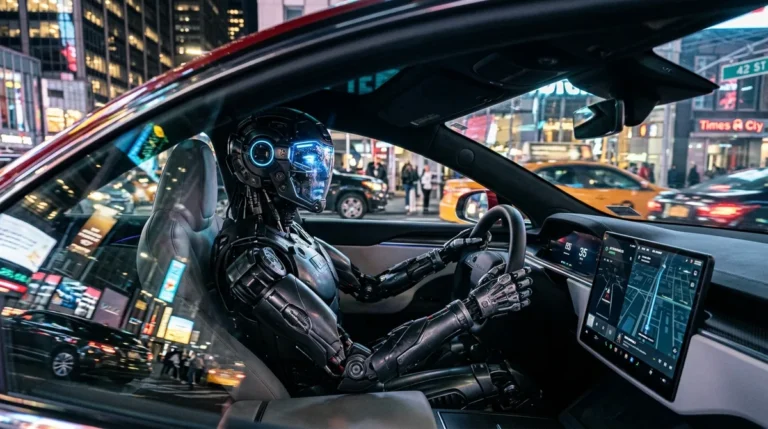

A provocative and high-stakes robotics trial put AI behind the wheel multimodal driving test systems on a closed experimental circuit, exposing severe operational limitations in state-of-the-art generative models. Researchers interfaced prominent Vision-Language Models (VLMs) — including flagship iterations of OpenAI GPT-4o, xAI Grok, and open-weights models — directly to the steering and pedal actuators of a production road vehicle, feeding real-time camera imagery into the networks. While these models display encyclopedic comprehension of traffic statutes, catastrophic sensor latency and spatial hallucinations make general-purpose AI lethally hazardous drivers.
Experimental Architecture: Connecting a Frontier Chatbot to the Steering Rack
Contemporary autonomous driving leaders (such as Waymo and Tesla FSD) rely on tightly decoupled modular stacks: dedicated convolutional networks detect bounding boxes, SLAM pipelines construct point-cloud maps, and deterministic motion planners compute vehicle dynamics. Conversely, frontier AI labs have pursued end-to-end vision-to-action architectures where an unconstrained multimodal model interprets pixels and immediately actuates vehicular controls.
To test this paradigm, engineers retrofitted an electric automobile with high-precision drive-by-wire servo actuators governing steering, acceleration, and regenerative braking. High-framerate forward-facing stereoscopic cameras captured the driving corridor, transmitting frames via high-throughput API gateways directly to cloud-hosted VLM endpoints.
The prompt mandated a rigid structured JSON output on every visual cycle, detailing precise steering angles in degrees and throttle/brake percentages. The trials occurred across an enclosed proving ground populated with obstacle pylons, foam pedestrian dummies, sudden road cut-ins, and complex chicane maneuvers.
The Latency Bottleneck: Why Milliseconds Determine Survival
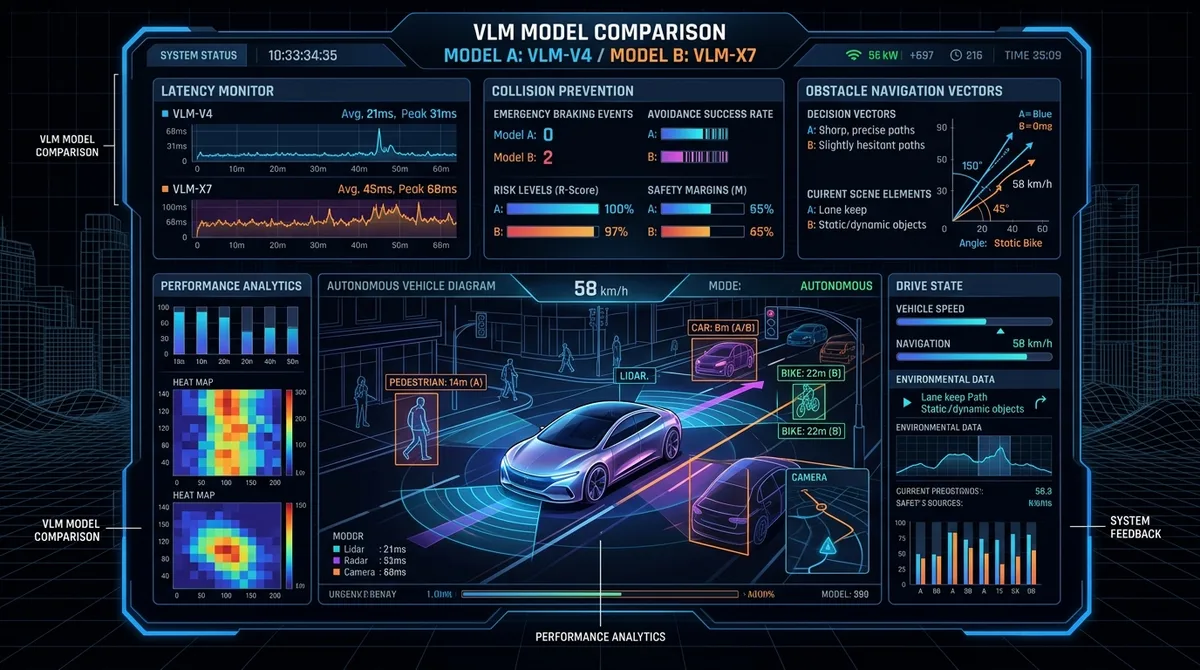
The primary failure mode proved to be perceptual latency. A biological human driver typically registers an unexpected hazard and begins foot movement toward the brake pedal in 200 to 250 milliseconds, while dedicated automotive microcontrollers execute avoidance maneuvers in 15 to 30 milliseconds. In stark contrast, multimodal models took between 800 and 2,500 milliseconds to parse each image frame and return motor control parameters.
Traveling at a moderate urban speed of 60 km/h (37 mph), a vehicle covers roughly 17 meters every second. During the prolonged window in which the neural model processed pixel rasters, generated tokens of internal reasoning, and dispatched network packets, the car traveled blind, colliding with obstacles before braking commands arrived.
Deploying smaller, quantized local models directly onto onboard GPUs alleviated transmission lags but introduced computational throttling. Complex intersection layouts triggered sudden compute spikes, inducing brief software freezes that sent the test vehicle drifting across lane boundaries.
Vision-language model inference is up to 50 times slower than dedicated automotive ECUs and human drivers.
The AI frequently mistook harmless road shadows and 2D billboard posters for physical pedestrians.
Lack of native metric depth perception caused recurring errors in distance and obstacle elevation estimation.
Engineers advocate restricting VLMs to high-level strategic reasoning rather than real-time steering actuation.
Spatial Blindness: The Peril of Flat Dimensional Hallucinations
Beyond temporal lag, the trials laid bare the models inability to form true three-dimensional spatial representations. Trained predominantly on vast corpuses of static two-dimensional internet photographs, vision-language architectures consistently miscalculated metric depth and distance gradients.
The AI-driven vehicle frequently executed panic emergency stops when encountering dark asphalt shadows cast by highway overpasses or roadside advertising billboards depicting humans, mistaking flat planar images for living pedestrians. Conversely, when approaching low-profile concrete barriers, the network sustained throttle, failing to perceive threats to vehicle undercarriage integrity.
Even more precarious was the phenomenon of attention diversion: when presented with a regulatory stop sign alongside a visually vibrant storefront promotion, the attention heads often latched onto reading storefront signage, completely disregarding the regulatory traffic marker.
«Large language models can pass any written driver licensing examination with flying colors, but their total absence of embodied spatial intuition turns them into catastrophic hazards at speeds above twenty kilometers per hour. On a public roadway, survival hinges on milliseconds, whereas a large multimodal model requires seconds just to parse a single frame.»
Matthew McCarthy, Principal Robotics Systems Engineer and Lead Coordinator for Closed-Course VLM Driving Benchmarks
Model Comparison: GPT-4o Versus Grok on the Test Track
Comparative telemetry unmasked noticeable behavioral discrepancies between frontier architectures. GPT-4o demonstrated exceptional semantic accuracy when deciphering complex road signage and hand gestures from crossing guards, yet suffered from paralyzing timidity, regularly stranding the vehicle motionless inside roundabouts.
Conversely, Grok exhibited an aggressive driving cadence with lower token generation latency, but displayed higher variance in lane-centering, frequently clipping apex curbs and drifting into simulated opposing lanes during slalom exercises.
Researchers unanimously concluded that frontier foundation models are fundamentally ill-suited for low-level mechanical actuation. Their proper role should be confined to high-level tactical mission routing, leaving deterministic microsecond trajectory tracking to hardened autonomous sensor interfaces.
- Conducted on an enclosed proving ground with drive-by-wire controls linked to GPT-4o and Grok via API.
- The models output steering angles and pedal inputs in structured JSON directly from camera video feeds.
- Core vulnerabilities included excessive inference latency and spatial attention dispersion.
- Global transportation safety boards are moving to restrict uncertified generative models from vehicular control loops.
The Road Ahead: Safeguarding Autonomous Mobility Standards
These real-world physical trials define clear boundaries for general artificial intelligence. Until transformer models can guarantee zero-latency deterministic reasoning while respecting the inviolable laws of Newtonian mechanics, licensing them to operate motor vehicles on public roadways poses unacceptable risks.
Regulatory authorities across the globe are codifying safety mandates that prohibit uncertified generative models from interfacing directly with automotive drive systems. For extensive technical coverage of the experiment, review updates on IFLScience.
These tests serve as an essential reminder: navigating the physical world requires more than verbal fluency — it demands instantaneous reflex and unwavering spatial truth.