



Contrary to persistent claims that an offshore wind farm inevitably disrupts fragile marine ecosystems, preliminary research points to a startling opposite effect. Scientists have discovered that the low-frequency underwater hum generated by spinning turbines can accelerate the growth of phytoplankton—the foundation of the ocean food web—by more than fivefold.
Why an Offshore Wind Farm Generates Underwater Sound
Onshore wind turbines often face local pushback over fears of excessive noise, even though acoustic measurements consistently show those concerns are overstated. Still, public resistance—paired with stronger, steadier winds at sea—has propelled rapid expansion of wind power into coastal and deep-water sites. Out at sea, there are no nearby neighbors to complain, yet underwater acoustics behave very differently from sound in air.

As massive rotor blades turn, mechanical vibrations travel down the steel tower and concrete foundation directly into the surrounding water column. Consequently, every operating offshore wind farm radiates a continuous, low-frequency acoustic hum beneath the waves. Because sound propagates much faster and farther through dense seawater than through air, marine organisms living near turbines experience elevated underwater soundscapes.
Curious about what this acoustic footprint does to ocean life, Dr. Justine Courboulès of the Norwegian University of Science and Technology (NTNU) and her colleagues designed a controlled field test. As reported by IFLScience based on their open-access paper in Scientific Reports, the team examined the very base of the marine food chain.
The Norwegian Lagoon Experiment With Belwind Turbine Audio
To ensure acoustic realism, the researchers recorded genuine underwater sound from Belgium’s Belwind offshore wind farm in the North Sea. They then brought those recordings to Hopavågen, a coastal lagoon in Norway naturally split by a sandbar. Because the sandbar blocked sound waves from crossing to the opposite side, the lagoon offered a rare natural control environment.
The team played back the turbine hum so that wild plankton communities experienced sound levels of either 94 decibels (dB) or 106 dB, while the control group remained at ambient lagoon levels around 80 dB. Over just 22 hours, the researchers measured dramatic differences in microscopic algae productivity.
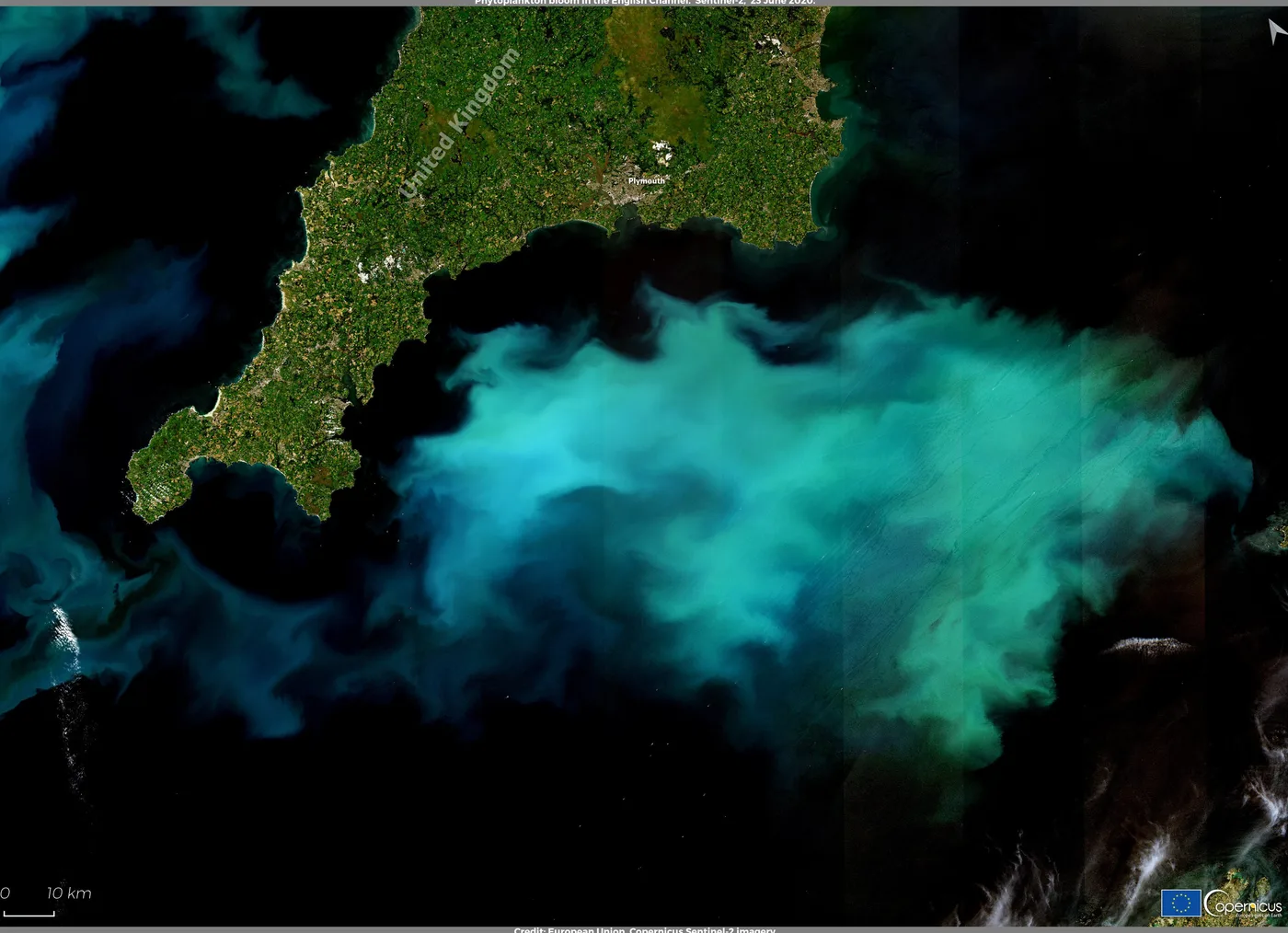
Tracking chlorophyll b—a primary pigment used in photosynthesis—the team observed a 521 percent surge in phytoplankton growth at the moderate 94 dB level compared with the control. Even at the louder 106 dB exposure, chlorophyll b rose by 369 percent. Oxygen production climbed alongside the pigment spike, and fucoxanthin, a molecule produced by another major group of phytoplankton, also showed a smaller yet clear upward trend.
«It’s possible that specific combinations of frequency and sound level stimulate cells in a way that affects their metabolism – either positively or negatively.»
Dr. Justine Courboulès, Norwegian University of Science and Technology (NTNU)
The Puzzling Mechanism Behind Acoustic Algae Stimulation
The magnitude of the bloom surprised the scientists themselves, and the exact biological mechanism remains an open question. One leading hypothesis is that there is an optimal acoustic window of frequency and intensity where vibrations stimulate cellular processes without inducing physical stress—explaining why 94 dB outperformed 106 dB.
At first glance, sound helping plants grow sounds reminiscent of folklore about singing to houseplants. Yet microscopic phytoplankton suspended in seawater have no rigid stems and sit directly inside a fluid medium carrying pressure waves. Earlier laboratory work playing sound waves near algae tanks had already hinted at faster division rates and higher biomass yields.
Low-frequency micro-vibrations may thin the boundary layer of water surrounding each cell, speeding up the exchange of dissolved nutrients and carbon dioxide, or subtly altering cell membrane permeability. Understanding how ocean organisms respond to shifting physical conditions is also central to broader climate research, such as how record ocean warming is acting as a planetary climate stress test.
Researchers recorded actual underwater sound from Belgium’s Belwind offshore wind farm in the North Sea.
At 94 dB, phytoplankton chlorophyll b levels jumped more than fivefold over 22 hours compared to controls.
Louder 106 dB sound produced a 369% gain, suggesting an optimal frequency-intensity window.
A longer 18-day experiment has been completed to track zooplankton response and species diversity.
Ripples Through the Food Web, Carbon Capture, and Biodiversity
If these preliminary findings hold true on a larger scale in open ocean waters, an offshore wind farm could act as an unexpected engine of marine productivity. Phytoplankton generate roughly half of Earth’s oxygen and pull vast quantities of carbon dioxide out of the atmosphere, locking carbon into organic matter.
More phytoplankton means a richer food supply for zooplankton—tiny drifting animals and krill—which in turn feed commercially vital fish stocks, seabirds, and endangered marine mammals. Alongside this acoustic effect, concrete foundations and submerged steel towers also function as artificial reefs where mussels, corals, and invertebrates colonize.
Still, the authors urge caution before declaring an unqualified ecological win. During the brief 22-hour trial, zooplankton activity did not increase, likely due to the natural time lag between trophic levels. Furthermore, overall biomass growth could mask declines in individual sensitive species, potentially altering biodiversity. To test these longer-term dynamics, the team has already completed an 18-day follow-up experiment, though full results await publication.
- Low-frequency vibrations from submerged wind turbine towers travel efficiently underwater without necessarily harming plankton.
- Boosted phytoplankton growth increases oxygen output and carbon dioxide uptake at the base of the marine food web.
- Publication of the completed 18-day trial will clarify whether zooplankton, fish, and overall biodiversity benefit long term.
What This Means for Offshore Renewable Energy
Critics of marine wind development frequently allege harm to whales and commercial fisheries despite a lack of strong supporting evidence. Together, artificial reef formation and acoustic phytoplankton stimulation suggest that turbines may interact with ocean ecosystems in far more nuanced—and potentially beneficial—ways than previously assumed.
While artificial reefs can be built independently by sinking concrete structures, generating a vast, continuous low-frequency sound field across coastal waters would require enormous energy on its own—unless an offshore wind farm is already spinning above it. If the upcoming 18-day data confirm sustained benefits without harming species diversity, offshore wind could deliver clean electricity while quietly energizing marine food webs.