



The US Federal Communications Commission (FCC) has granted SpaceX conditional permission to deploy an unprecedented constellation of up to a million satellites in low Earth orbit. Dubbed Starmind, the project envisions solar-powered AI data centers circling the planet, yet astronomers and environmental experts warn the decision could trigger orbital catastrophe and permanently erase the natural night sky.
Why the FCC Authorized a Million Satellites for Starmind
The license was approved on November 25 despite formal opposition from astronomical societies, environmental advocates, and rival satellite operators. FCC Chairman Brendan Carr, appointed by President Donald Trump, announced the authorization in a post on X and an accompanying statement. As The New York Times has documented, Carr is a long-standing ally and supporter of Elon Musk.

Under SpaceX’s filing, the Starmind constellation would operate at altitudes between 500 and 1,002 kilometers (311 to 623 miles), turning each spacecraft into an orbiting solar-powered computer handling heavy artificial intelligence workloads. License milestones require SpaceX to begin deployment by 2033, reach 100,000 spacecraft by 2035, and scale up to a million satellites by 2040.
Carr praised the decision as a milestone toward “super intelligence,” a phrase favored by the Trump administration to describe generative AI. In its order, the FCC explicitly dismissed objections “over which the Commission has no authority, including environmental concerns” and impacts on “optical astronomy.” As IFLScience reports, scientists responded with alarm.
Kessler Syndrome and Maneuvers Every 0.03 Seconds
The foremost concern among orbital dynamics specialists is Kessler syndrome, a runaway collision cascade first described by NASA scientist Donald Kessler in 1978. Because objects in low Earth orbit travel at several kilometers per second, a single impact shatters spacecraft into hypervelocity shrapnel that strikes neighboring satellites, multiplying debris exponentially.
As of July 2026, nearly 18,000 artificial objects orbited Earth. Adding a million satellites would expand that population more than 50-fold—and over 100 times compared with a decade ago. Space debris researcher Hugh Lewis calculated that a constellation of that density would have to execute a collision-avoidance maneuver every 0.03 seconds.
In a worst-case cascade, entire orbital shells could become impassable, cutting off humanity from GPS, weather forecasting, and crewed spaceflight. Astrophysicist Adam Becker told CNBC the plan risks a catastrophic chain reaction of space junk collisions. We previously examined how vulnerable orbital infrastructure is in our analysis of how space infrastructure could be crippled within days.
«We consider this proposal to be the single greatest threat to space sustainability in history.»
Dr. John C. Barentine, Astronomer & Co-founder, Center for Space Environmentalism
Atmospheric Pollution and the End of the Night Sky
Beyond collision hazards, astronomer Dr. John C. Barentine, co-founder of the Center for Space Environmentalism, highlights severe atmospheric consequences. Launching and replenishing a million satellites would demand dozens of rocket launches every single day for years, injecting black carbon, water vapor, and metallic re-entry ash into fragile upper atmospheric layers.
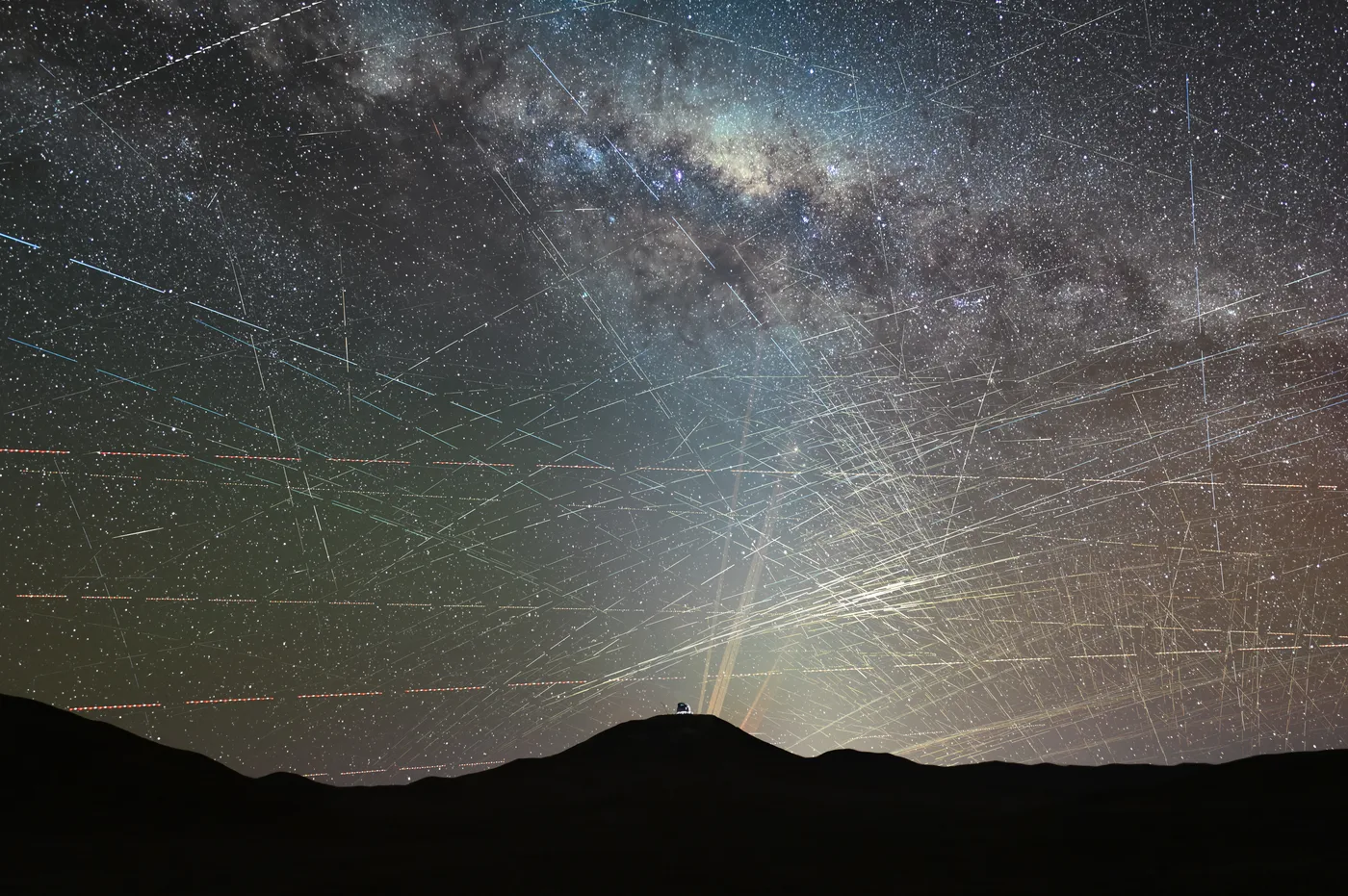
Light pollution poses an equally dire threat. Existing megaconstellations are already brightening the night sky even over remote areas devoid of ground lighting. In a July study, European Southern Observatory (ESO) astronomer Olivier Hainaut modeled how many satellites telescopes can tolerate: science could cope with up to 100,000, but only if they remained invisible to the unaided eye.
Starmind’s large solar arrays and thermal radiators would make them far brighter than current spacecraft. Hainaut warned that launching even a fraction of such constellations could cause observatories to lose 100 percent of usable data—effectively killing telescopes. That is why DarkSky International, the American Astronomical Society (AAS), and Earthjustice opposed the license. Protecting dark skies is vital for breakthroughs like JWST and Euclid discovering the earliest known quasar.
Deployment starts by 2033, hits 100,000 satellites by 2035, and scales to 1 million by 2040.
Debris specialist Hugh Lewis warns the fleet would need avoidance maneuvers every 0.03 seconds.
ESO astronomer Olivier Hainaut warns bright megaconstellations could wipe out 100% of data.
Without air or water in vacuum, AI satellites require huge radiative panels to shed heat.
Do Space-Based AI Data Centers Even Make Sense?
Many physicists and aerospace engineers question the fundamental engineering premise of orbital AI farms. While sunlight is abundant in orbit, spacecraft cannot escape the laws of thermodynamics. On Earth, hyperscale data centers shed massive heat loads using air chillers and vast quantities of cooling water.
In the vacuum of space, convection does not exist; heat can only escape via thermal radiation, forcing every Starmind satellite to carry sprawling, heavy radiator wings. Those structures inflate launch mass, collision cross-sections, and sunlight reflection back toward Earth.
By contrast, China is testing a far narrower concept: in May 2025, it launched the first 12 satellites of its Three-Body Computing Constellation. As spacecraft systems engineer Russell Hills explained to IFLScience, that effort focuses on processing space-collected sensor data in orbit to save radio bandwidth—not replacing terrestrial cloud computing.
- The FCC bypassed environmental review and dismissed optical astronomy impacts as outside its jurisdiction.
- Dozens of daily rocket launches and satellite re-entries threaten upper-atmosphere chemistry.
- Unprecedented night-sky brightening endangers astronomy, wildlife, human health, and Indigenous traditions.
Why Invoke a Kardashev Type II Civilization?
Both SpaceX’s application and the FCC’s statement frame the million satellites plan as a “first step towards becoming a Kardashev II-level civilization.” Proposed by Soviet astronomer Nikolai Kardashev in 1964, the scale ranks civilizations by energy consumption: Type I harnesses a planet’s energy, Type II captures a star’s entire output (such as via a Dyson Sphere), and Type III commands a galaxy.
Humanity currently sits at roughly 0.72 on the Kardashev scale. Reaching Type II would require harvesting 10 trillion times more energy than our entire planet uses today—meaning even a million solar-powered satellites would capture only an infinitesimal fraction of the Sun’s power.