

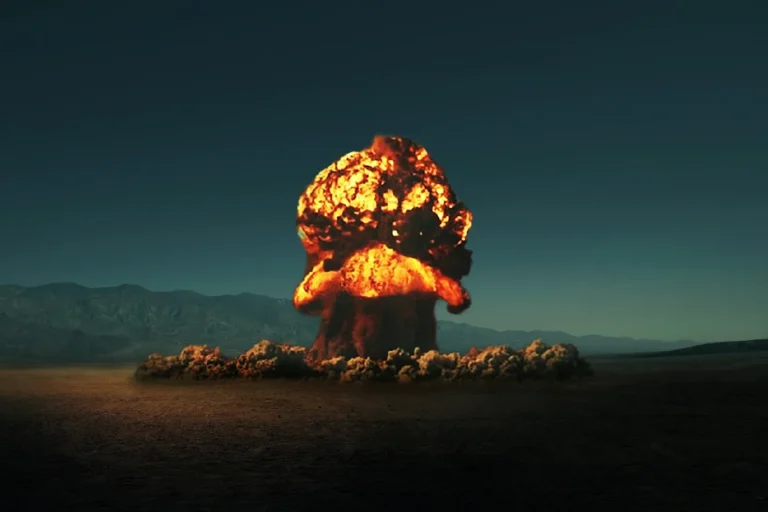

A single 1-megaton nuclear explosion in space detonated 500 kilometers above Earth could disable 98 percent of low Earth orbit satellites within one week, triggering global disruptions to communications, navigation, and financial networks.
Nuclear Explosion in Space: A Cold War Threat Magnified by Modern Orbit
When people picture nuclear weapons, they imagine blinding fireballs, blast waves, and mushroom clouds over cities. Above Earth’s atmosphere, however, the physics of detonation behaves completely differently. A new physics simulation by researchers at the University of Wisconsin-Madison and Princeton University, led by Zachary Petersen, reveals just how fragile modern orbital infrastructure has become.
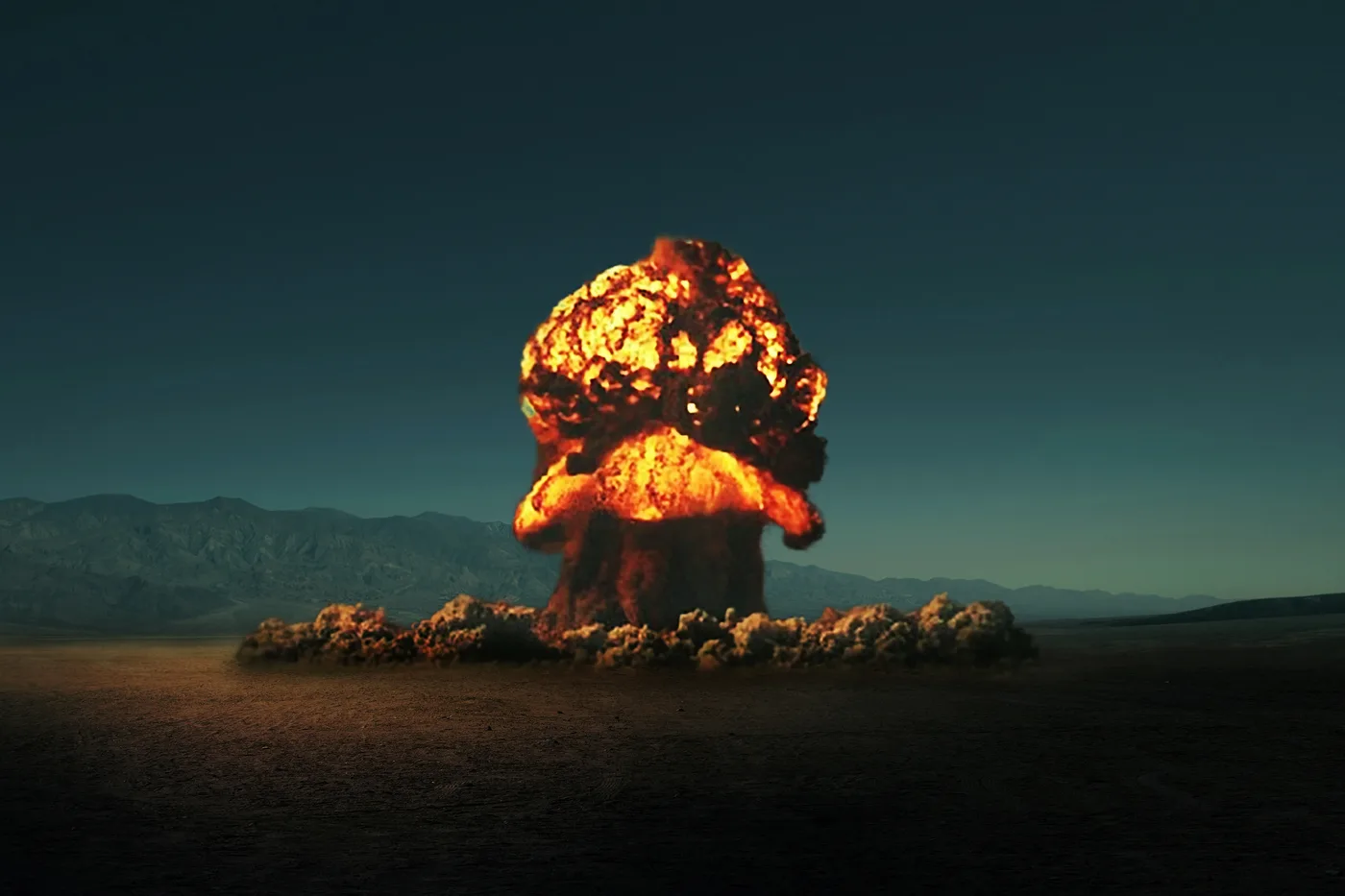
In a preprint posted to arXiv (2611.09827), the team modeled a 1-megaton nuclear detonation at an altitude of 500 kilometers (311 miles) over the South Atlantic. Their findings are stark: one blast is enough to cripple nearly the entire fleet of commercial, weather, and communications satellites circling in low Earth orbit.
The primary killer is neither the initial flash nor a shockwave—which cannot propagate in vacuum—but an intense artificial radiation belt trapped inside Earth’s magnetic field.
The Mechanics of Destruction: Trapped Electrons in the Magnetosphere
Nuclear fission releases vast swarms of high-energy electrons. On the ground, air molecules quickly absorb them; at 500 kilometers up, Earth’s geomagnetic field lines snag those charged particles and bounce them back and forth between the planet’s poles.
This creates a dense, long-lived artificial radiation belt far more intense than the natural Van Allen belts. Every satellite in low Earth orbit—including thousands of broadband, Earth-observation, and navigation spacecraft—passes repeatedly through this lethal zone roughly every 90 minutes.
Cumulative ionizing radiation rapidly degrades solar arrays, corrupts onboard memory, and fries semiconductor microchips. As demonstrated in modern physics experiments, shielding delicate electronics against relativistic particle fluxes is orders of magnitude harder than surviving routine space weather.

«The Outer Space Treaty does not prohibit conventional weapons in Earth orbit. Article IV draws a very specific line: it prohibits placing nuclear weapons or other weapons of mass destruction in orbit or otherwise stationing them in outer space.»
Professor Michelle Hanlon, University of Mississippi
Timeline of Collapse: Why Radiation Hardening Falls Short
Petersen’s simulation maps out a startlingly fast orbital breakdown. Within 24 hours of the explosion, 25 percent of low Earth orbit satellites fail. By day three, 78 percent are knocked offline. Within seven days, 98 percent are disabled, climbing to 99.4 percent by day 15.
Even when the researchers modeled spacecraft equipped with advanced radiation hardening, roughly 99 percent of the fleet still failed within a month. The sheer density of trapped fission electrons overwhelms conventional shielding.
Once disabled, thousands of dead satellites lose station-keeping thrusters and become unguided projectiles moving at 7.8 kilometers per second—raising the specter of cascading orbital collisions that could block space access for decades.
Modeling a 1-megaton blast above the South Atlantic shows fission electrons immediately trapped by Earth’s magnetic field.
Repeated passes through the artificial radiation belt knock out nearly the entire low Earth orbit fleet in 7 days.
Even radiation-hardened spacecraft suffer ~99% failure rates within 30 days under intense relativistic electron flux.
Thousands of unmaneuverable dead satellites create a persistent orbital collision and debris hazard.
Lessons from Starfish Prime and the 1967 Outer Space Treaty
History offers a clear warning. On July 9, 1962, the United States conducted the 1.4-megaton Starfish Prime test at 400 kilometers altitude over the Pacific. The resulting electromagnetic pulse knocked out streetlights in Hawaii, while the artificial radiation belt crippled a third of all satellites then in orbit, including the pioneering Telstar communications satellite.
Today, more than ten thousand active satellites underpin global aviation, maritime shipping, weather forecasting, and precision GPS timing for banking networks. Losing them simultaneously would trigger unprecedented global chaos.
University of Mississippi law professor Michelle Hanlon emphasizes that Article IV of the 1967 Outer Space Treaty explicitly bans placing nuclear weapons or weapons of mass destruction in orbit. The new study underscores why upholding that treaty remains essential for modern civilization.
- Lead author Zachary Petersen and colleagues simulated a 1-megaton detonation at 500 km altitude.
- Historical precedent: the 1962 Starfish Prime test (1.4 Mt at 400 km) disabled a third of satellites then in orbit.
- The resulting radiation belt persists for months to years, threatening future launches.
- The authors stress that preventing nuclear weapons in space is essential for global infrastructure.
Down-to-Earth Chaos: From Aviation and Banking to Decade-Long Orbital Recovery
Losing 98 percent of low Earth orbit satellites within a single week would ripple far beyond disrupted broadband internet in remote regions. Modern civilization relies on continuous real-time orbital data: weather satellites track developing hurricanes and severe storms, Earth-observation constellations monitor wildfires and crop yields, and transoceanic flights and maritime shipping depend on satellite relays.
Equally vulnerable is precision timing synchronization. Financial clearinghouses, electrical power grids, 5G telecom towers, and automated ports rely on nanosecond-accurate satellite timing signals. Even though higher-altitude navigation and geostationary spacecraft sit farther from the modeled 500-kilometer blast zone, losing the low Earth orbit layer would overload terrestrial backup networks and disrupt global logistics.
Replacing the lost fleet would not be quick or simple. Trapped fission electrons in the artificial radiation belt can linger for months or years, degrading newly launched replacements, while thousands of defunct satellites turn into high-speed debris. As the 2004 US Congressional EMP Commission and the new UW-Madison and Princeton study both warn, preventing nuclear detonations in space is the only viable defense.
Beyond crippling communications and commerce, a persistent artificial radiation belt would also jeopardize human spaceflight. Astronauts aboard orbital stations or crews launching toward the Moon would face severe radiation hazards while traversing low Earth orbit—meaning a single orbital detonation could effectively close humanity’s gateway to space for years.