


An international oceanographic expedition has documented evidence of an explosive pyroclastic flow more than six kilometers beneath the ocean surface in Challenger Deep—proving that a volcanic eruption Mariana Trench environments generate can occur even under crushing abyssal pressure.
Volcanic Eruption Mariana Trench: A Discovery That Defies Marine Geology
For decades, marine geology textbooks maintained that explosive volcanism in the deepest parts of the ocean was physically impossible. Conventional models held that the immense weight of miles of seawater acts like a planetary clamp, keeping volatile gases dissolved inside magma so that molten rock can only ooze quietly onto the seafloor. Now, a peer-reviewed study published in Frontiers in Earth Science is forcing geophysicists to rewrite those assumptions.
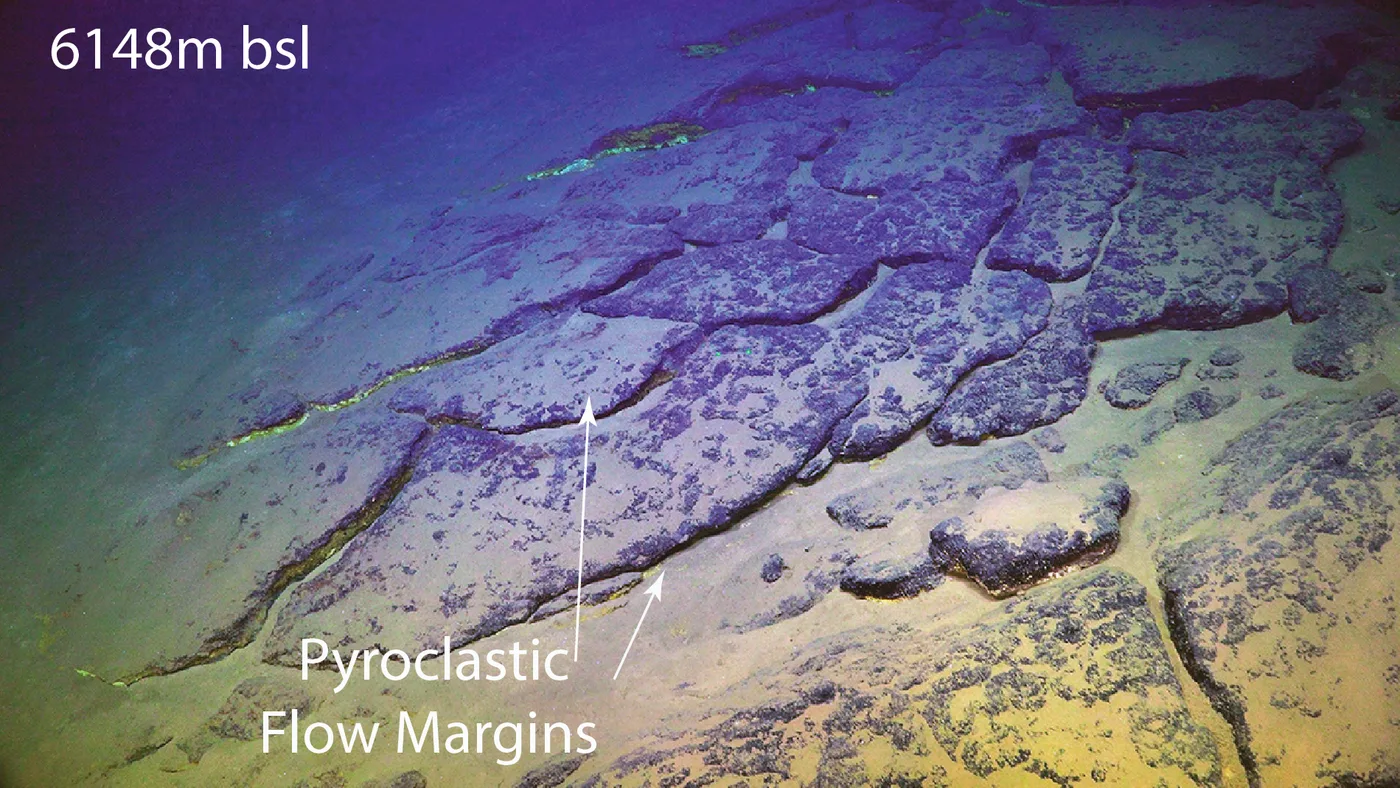
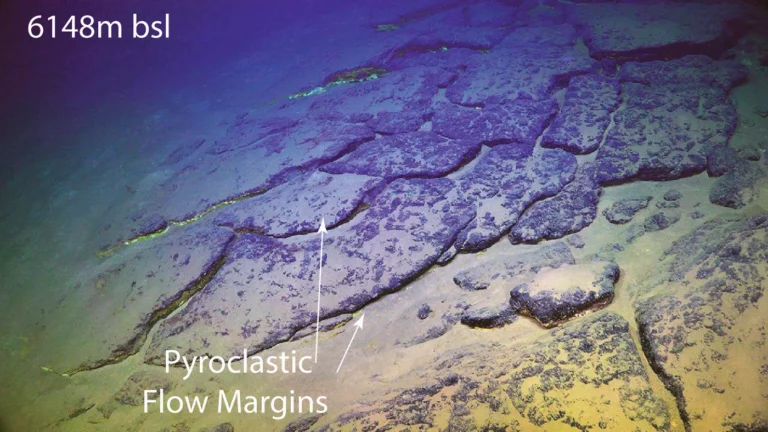
Led by geosciences professor emeritus Robert Stern at the University of Texas at Dallas, alongside Tomoyo Okumura and an international team from the United States and Japan, researchers explored the northern wall of Challenger Deep during Cruise TN438 supported by the National Science Foundation (NSF). Using the remotely operated vehicle Jason/Medea, the team captured imagery at 20,170 feet (6,148 meters) below sea level showing layered volcanic glass and fragmented rock—the unmistakable signature of a turbulent pyroclastic flow.
On land, pyroclastic flows are among the deadliest volcanic phenomena, consisting of superheated gas, ash, and rock racing down mountain slopes at highway speeds. Finding the same violent signature under nearly 600 atmospheres of ocean pressure caught the global geoscience community completely off guard.
Why Crushing Ocean Pressure Should Have Prevented an Explosion
To appreciate why the discovery is so perplexing, it helps to examine how volcanic eruptions work. Explosive blasts on land or in shallow water happen when rising magma experiences falling pressure. Dissolved volatiles—primarily water vapor and carbon dioxide—rapidly expand into gas bubbles, tearing the molten rock apart into ash and pumice.
At 6,148 meters below the Pacific surface, hydrostatic pressure approaches 60 megapascals, roughly 592 times sea-level atmospheric pressure. Under standard thermodynamic equations, that crushing load suppresses bubble nucleation entirely. Even when seawater touches incandescent lava, it should not flash into an explosive steam cloud.
Comparing these findings with other extreme deep-ocean phenomena highlights how extraordinary the depth is: prior to this expedition, the deepest suspected explosive volcanic deposits sat near 4,000 meters, and even those were considered outliers. Challenger Deep pushes the boundary more than two kilometers deeper.
«It is not something that as a geoscientist I would have said would be predicted. Very far from it.»
Sune Nielsen, Geochemist at the University of Lorraine, France
The Mechanics Behind the Mystery: Supercritical Fluids and Magma Chemistry
The research team proposes that the answer may lie in the exotic physics of supercritical fluids. Above water’s critical point—374 °C and 22.1 megapascals for pure water, and slightly higher for seawater—the boundary between liquid and gas vanishes. Supercritical water possesses the density of a liquid while retaining the diffusivity and mobility of a gas.
Where the Pacific Plate subducts beneath the Philippine Sea Plate at the Mariana Trench, volatile-rich magma rising toward the trench wall encounters seawater already primed near or above its critical threshold. Rapid thermal exchange and unusual magma chemistry may trigger turbulent fragmentation, propelling dense clouds of volcanic glass down the steep slope.
Although exact radiometric dating still awaits laboratory analysis, the crisp edges of the flow margins and thin sediment cover suggest the event is geologically recent. As Robert Stern noted, the deposits did not form yesterday, yet they are clearly far younger than a million years old.
The deepest pyroclastic volcanic flow deposit ever documented in Earth’s oceans, shattering previous depth limits.
Crushing hydrostatic pressure at Challenger Deep should theoretically prevent volatile gas expansion.
Above 374 °C and 22.1 MPa, seawater loses its liquid-gas boundary, enabling exotic magma fragmentation.
Where the Pacific Plate dives beneath the Philippine Plate, volatile-rich melts challenge deep-sea physics.
Life at the Edge of the Abyss and Future Hazard Implications
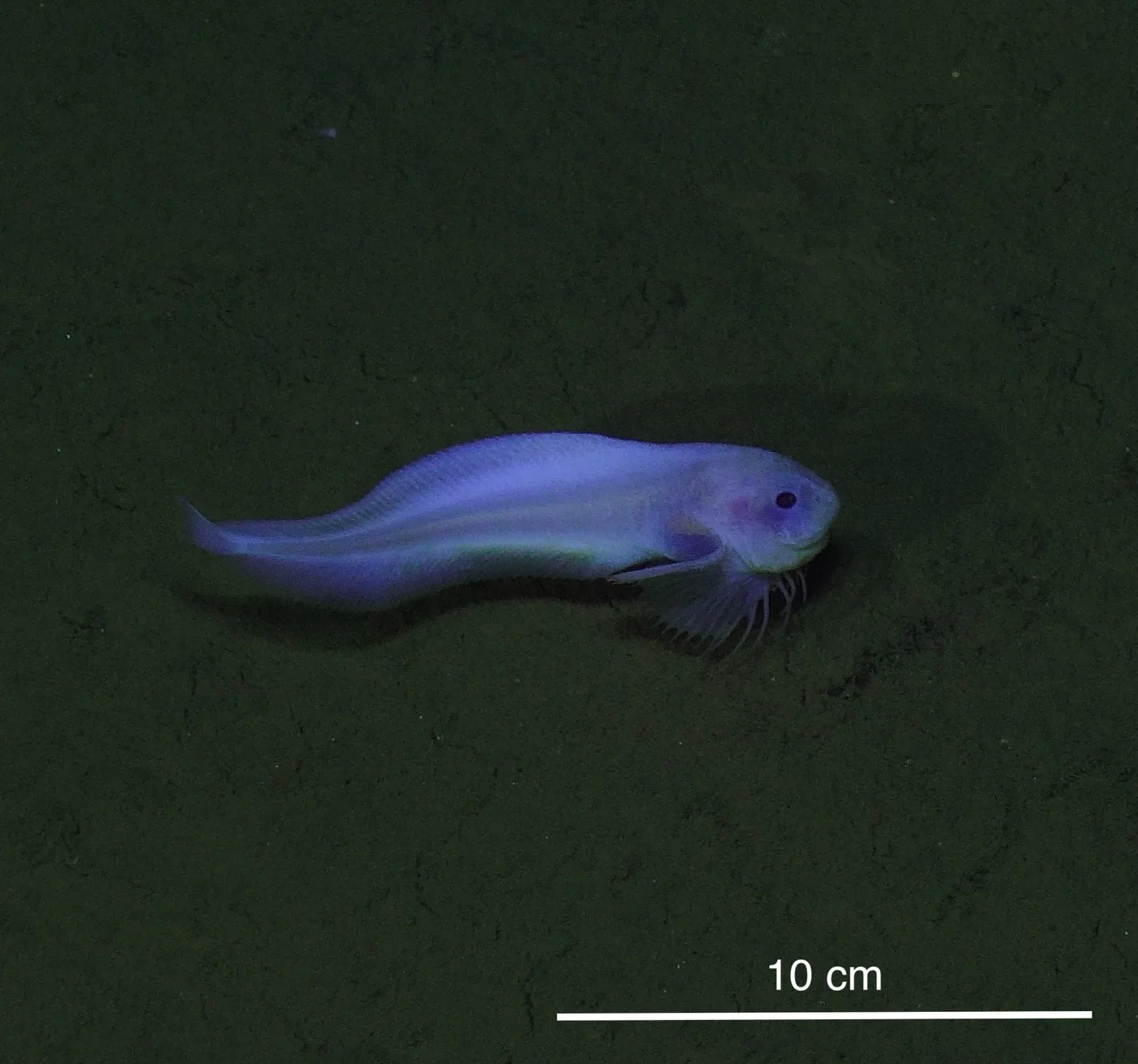
Cruise TN438 also delivered remarkable biological observations alongside its geological breakthrough. At 20,659 feet (6,297 meters)—just 150 meters deeper than the pyroclastic flow margins—the Jason/Medea ROV photographed a deep-sea snailfish of the genus Pseudoliparis, one of the deepest-living vertebrates ever documented. Higher up the trench wall at 12,726 feet (3,879 meters), cameras recorded sea cucumbers thriving on the seafloor.
The proximity of resilient hadal wildlife to violent volcanic deposits underscores how geothermal energy and mineral fluxes shape deep-ocean habitats. Nutrients released during seafloor eruptions can fuel chemosynthetic microbes that anchor food webs far beyond the reach of sunlight.
As UC Berkeley volcanologist Stephen Self emphasized, scientists still do not fully understand how magmas behave under hadal water depths. Investigating Challenger Deep’s hidden volcanism will refine models of subduction-zone dynamics, seafloor landslides, and tsunami generation across the Pacific Rim.
- Cruise TN438 led by Robert Stern and Tomoyo Okumura imaged pyroclastic flow margins at 6,148 m in Challenger Deep.
- UC Berkeley volcanologist Stephen Self noted that magma behavior at hadal depths remains poorly understood.
- Fresh flow margins indicate the eruption occurred relatively recently in geological terms—far under one million years ago.
- At 6,297 m nearby, the Jason/Medea ROV also filmed a deep-sea Pseudoliparis snailfish.
Comparing Abyssal Volcanoes and Planning Future Hadal Expeditions
Prior to Cruise TN438, documented cases of deep-sea explosive volcanism were sparse and far shallower. Researchers had filmed gas-rich eruptions along the Mariana arc near 1,200 meters depth and identified ash layers along the Arctic’s Gakkel Ridge around 4,000 meters. Yet neither setting approaches the extreme physics of Challenger Deep, where an additional two kilometers of seawater adds more than 200 atmospheres of crushing hydrostatic load.
Future dives will focus on recovering intact cores of volcanic glass and measuring trapped volatile isotopes—particularly helium, sulfur, and carbon—to reconstruct the exact temperature and chemistry of the melt when it met frigid bottom water. High concentrations of halogens such as chlorine and fluorine in subduction-zone magmas can dramatically lower melt viscosity, potentially aiding rapid fragmentation even at extreme pressures.
Geophysicists also plan to re-examine high-resolution sonar surveys from other hadal trenches, including the Tonga, Kermadec, and Kuril-Kamchatka trenches. If pyroclastic flows below 6,000 meters prove to be a recurring feature of subduction zones rather than a one-off anomaly, scientists will need to revise both marine volcanology textbooks and global models of deep-Earth carbon cycling.