



Inside the historic Parnell Building at the University of Queensland, an extraordinary physical milestone has been achieved that challenges the limits of wireless data transmission: physicists have successfully demonstrated unblockable gravitational communication through a solid brick wall using a vintage 1950s elevator and an ultra-sensitive geophysical gravimeter. While standard electromagnetic transmissions—from Wi-Fi and 5G cellular frequencies to satellite downlinks—are effortlessly screened, absorbed, or jammed by metallic Faraday shields, reinforced concrete bunkers, and ocean depths, gravity casts no shadows. Gravitational fields permeate every corner of the universe without attenuation. By coordinating the vertical shifts of an elevator’s 1.8-tonne counterweight, researchers transmitted and decoded the binary word «GRAVITY» through a barrier that would defeat conventional wireless signals, ushering in the era of gravitational wireless telemetry.
Physical Foundation: Why Gravity Casts No Shadows
Humanity’s entire digital communications infrastructure is anchored to electromagnetic radiation. Radio waves, cellular 5G networks, optical fibers, satellite transceivers, and local Wi-Fi hotspots move petabytes of data each second using photons. However, electromagnetism has an inherent vulnerability dictated by the laws of electrodynamics: photons interact strongly with charged matter. Metallic Faraday shielding, reinforced concrete walls, dense bedrock, and conductive seawater rapidly absorb and dissipate electromagnetic signals, creating dead zones in subway tunnels, underground mines, and submarine fleets.

Gravity operates under radically different physical principles. Under Albert Einstein’s general theory of relativity, gravity is not a traditional force but the geometric curvature of spacetime induced by mass and energy. Because nature features no «negative mass» to generate opposing repulsive fields, gravitational fields cannot be screened, absorbed, or neutralized. Physicists describe this unique attribute with a striking adage: «gravity casts no shadows». The gravitational pull of an object passes unimpeded through planets, mountains, lead vaults, and cosmic voids without attenuation.
As reported by astrophysicist Dr. Alfredo Carpineti in an IFLScience feature, a team of physicists at the University of Queensland led by Dr. Charles Woffinden and Dr. Andrew Groszek set out to transform this cosmological law into a functional communication prototype, constructing a wireless transmitter out of a vintage elevator.
The Parnell Building: An Unconventional Physics Testbed
The research was conducted within the University of Queensland’s historic Parnell Building in Brisbane. This legendary academic landmark is already globally renowned for hosting the longest-running laboratory study in human history: the famous Pitch Drop experiment, which has monitored dripping bitumen since 1927. However, the team—which also included Professor Andrew White and Professor Matthew Davis—focused on another venerable mechanical artifact inside the building: a passenger elevator dating back to the 1950s.
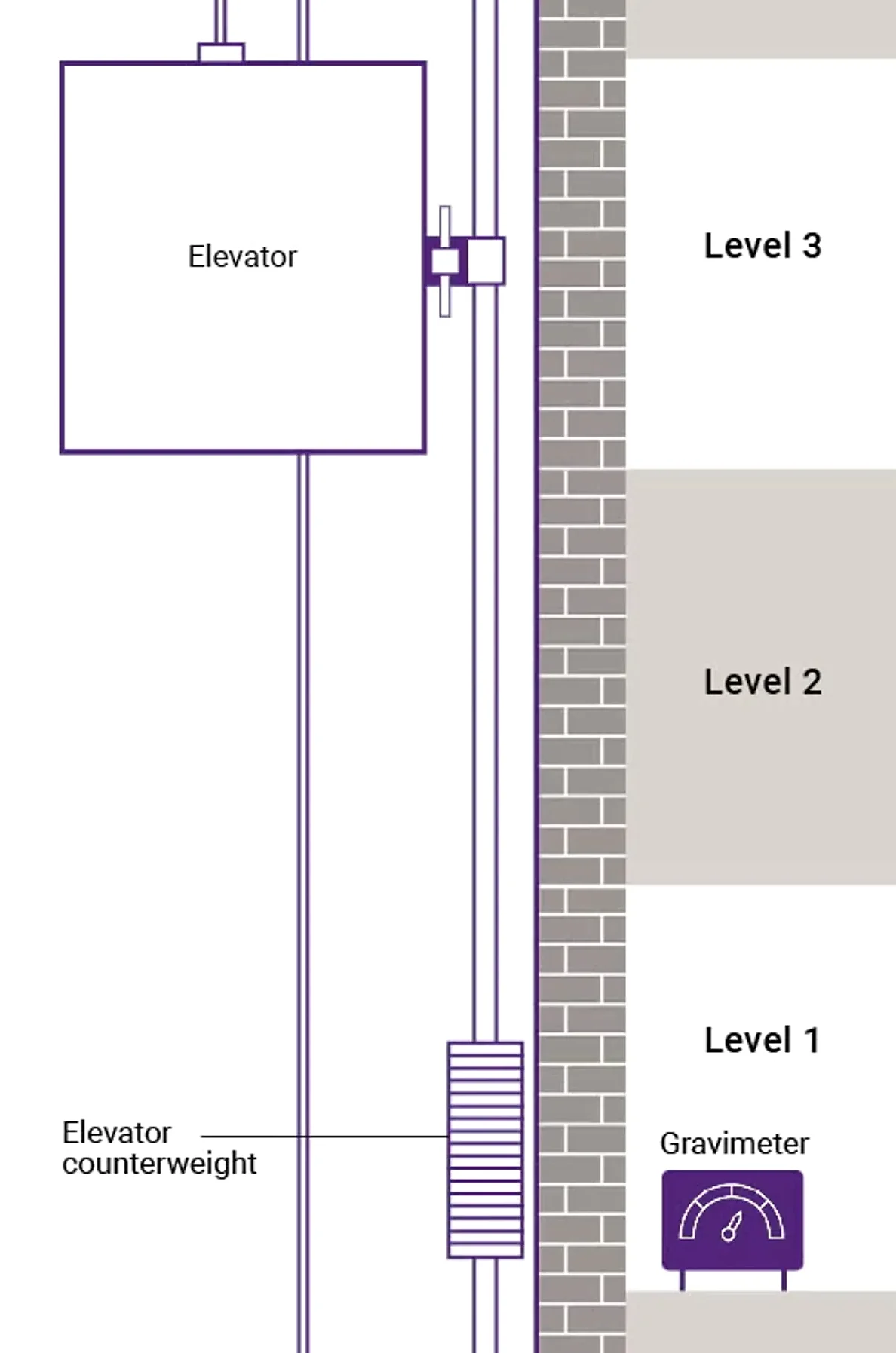
The vintage elevator shaft provided the ideal physical platform for generating localized gravitational fluctuations. The elevator carriage is balanced by an enormous 1.8-tonne counterweight (1,800 kilograms) composed of cast iron blocks. As the elevator ascends or descends between floors, this concentrated mass shifts vertically through the building, altering the surrounding gravitational potential.
Approximately 0.7 meters away on the opposite side of a solid brick wall—inside an adjacent restroom facility—the researchers positioned their receiver: a precision LaCoste and Romberg Model D spring-based gravimeter. This specialized geophysical device uses a zero-length quartz spring mechanism capable of measuring micro-gal shifts in gravitational acceleration (1 microgal = 10⁻⁸ m/s²).
«Gravity is fundamentally unique among physical interactions: it cannot be shielded, blocked, or reflected. If you place a solid lead vault or an entire mountain between the source and the detector, the gravitational modulation passes right through as if the barrier did not exist. Our experiment proves that an inherently unblockable communication channel is physically possible.»
Dr. Charles Woffinden, physicist at the University of Queensland and lead author of the landmark study
Encoding the Signal: Spelling Out «GRAVITY» Through Brick
The central technical challenge involved isolating the intentional signal from background seismic and anthropogenic noise. Foot traffic in the hallways, door slams, and wind-induced building sway create microscopic vibrational interference. However, alternating the 1.8-tonne counterweight between levels 1 and 3 produced a pronounced gravitational shift of approximately 2 microgals, clearly distinguishable in the gravimeter’s telemetry.
The team utilized a binary amplitude-shift keying protocol. Positioning the counterweight at the top level encoded a logical «1», while dropping it to the lower level encoded a logical «0». Because the elevator required time to transit and the gravimeter’s mechanical spring needed to settle, the transmission speed was calibrated to exactly 1 bit per minute.
The scientists encoded the English word «GRAVITY» into standard 7-bit ASCII binary code (49 bits total). For roughly an hour, the elevator moved in strict synchronization with the encoding schedule. On the other side of the brick partition, the gravimeter logged the gravitational peaks and valleys. The decoding software processed the data and reconstructed the word «GRAVITY» with perfect fidelity and zero bit errors.
Gravitational signals cannot be jammed, spoofed, or deflected by electronic countermeasures. Signals pass freely through bedrock, ocean abysses, and nuclear-hardened command posts.
Moving the massive elevator ballast vertically shifted the local gravitational acceleration g by roughly 2 microgals, generating clean amplitude-shift-keyed binary states.
Transmitting the 49 bits of the word «GRAVITY» took roughly one hour due to elevator mechanical travel times. High-frequency mass oscillators represent the key to higher bandwidth.
Next-generation implementations will leverage Bose-Einstein condensates and atom interferometry, capable of detecting nano-gal spacetime fluctuations with atomic precision.
Bandwidth Constraints and the Gravitational Coupling Barrier
While transmitting at 1 bit per minute is obviously insufficient for modern broadband internet, the primary objective was establishing proof of principle. The bandwidth limitation stems from gravity being by far the weakest of the four fundamental forces. The electrostatic repulsion between two electrons exceeds their mutual gravitational attraction by a factor of 10⁴², meaning immense quantities of mass must be accelerated to produce detectable field variations.
Nevertheless, in high-stakes survival scenarios, even low-bandwidth telemetry is invaluable. Applications include sending emergency distress coordinates to trapped miners through collapsed bedrock shafts, communicating with nuclear submarines operating at deep diving depths without raising antennas, and maintaining command links during high-altitude electromagnetic pulse (EMP) warfare.
Just as our research into how gravitational forces continuously shape biological systems explores macro-scale gravity, cutting-edge breakthroughs where physicists cool matter to trillionths of a degree illustrate how quantum mechanics is providing ultra-sensitive new instruments.
- The unshieldable force: gravitational attraction is the only fundamental interaction without negative charges, making it impossible to cancel out or screen using barrier materials.
- Historic venue: the experiment took place inside UQ’s Parnell Building, world-famous home of the Pitch Drop experiment running continuously since 1927.
- The historic transmission: researchers transmitted the 7-letter word «GRAVITY» encoded in standard 7-bit ASCII binary through a 70-centimeter solid brick wall with zero bit errors.
- A new communication horizon: published in Science Advances, this breakthrough provides a physical blueprint for deep submarine signaling and subterranean disaster communications.
Quantum Horizons: From Elevators to Atom Interferometry
The future of unblockable gravitational wireless communication lies in transitioning from bulky mechanical elevators to quantum cold-atom gravimeters and high-frequency mass oscillators. Advanced laboratories worldwide are developing atomic gravimeters based on Bose-Einstein condensates, where laser pulses split and recombine rubidium or cesium atom matter waves to measure gravitational shifts down to the nano-gal level (10⁻¹¹ m/s²).
Pairing these ultra-sensitive quantum sensors with high-speed, dense rotating flywheels made of tungsten or depleted uranium could raise modulation frequencies into the tens of hertz, enabling real-time textual data transmission through arbitrary geological barriers.
As documented in the team’s publication in Science Advances and detailed in the IFLScience feature on gravitational elevator signaling, the University of Queensland experiment has transformed gravitational communication from a speculative thought experiment into an empirically validated scientific reality.