


When the Dutch East India Company (VOC) flagship Batavia struck a coral reef off the uncharted coast of Western Australia in June 1629, more than two hundred and fifty castaways believed their survival depended on the disciplined hierarchy of the world’s first multinational corporation. What unfolded instead became one of the darkest and most calculated chapters of maritime carnage in history. A groundbreaking historical study by management scholar Dr. Clive Boddy (Clive Boddy) has demonstrated that mutiny leader Jeronimus Cornelisz (Jeronimus Cornelisz) was not merely a crazed religious fanatic, but the earliest documented archetype of modern managerial toxicity. Here was the quintessential corporate psychopath batavia voc, whose swift rise to absolute dominion illuminated the inherent perils of emergent shareholder capitalism.
The Reefs of Houtman Abrolhos: Shipwreck of the Dutch East India Company Flagship
In October 1628, the brand-new Dutch East India Company (Vereenigde Oostindische Compagnie, VOC) armed merchantman Batavia set sail from the port of Texel on her maiden voyage to the spice emporium of Java. Spanning forty-five meters in length with a displacement of 1,200 tons, the galleon carried 341 passengers and crew, including merchant administrators, civilian families, soldiers, and seamen. Stowed deep within her hold was a staggering commercial fortune: twelve ironbound chests containing 250,000 newly minted silver guilders, trade jewels, and an exquisite Roman agate cameo depicting the Roman Emperor Constantine, intended to open trading privileges with Mughal imperial courts.
Command was partitioned according to standard VOC governance: ultimate administrative, commercial, and judicial power resided with Senior Merchant (opperkoopman) Francisco Pelsaert (Francisco Pelsaert), while nautical navigation was commanded by the veteran sea captain Ariaen Jacobsz (Ariaen Jacobsz). A toxic personal feud quickly festered between the aristocratic, sickly Pelsaert and the coarse, resentful Jacobsz. Exploiting this friction was the third-ranking company official on board: Under-merchant (onderkoopman) Jeronimus Cornelisz (Jeronimus Cornelisz). A bankrupt apothecary from Haarlem fleeing financial ruin and heresy accusations linked to radical antinomian sects, Cornelisz actively conspired with Jacobsz to launch a mutiny, hijack the silver, and establish an autonomous pirate enclave in the Indian Ocean.
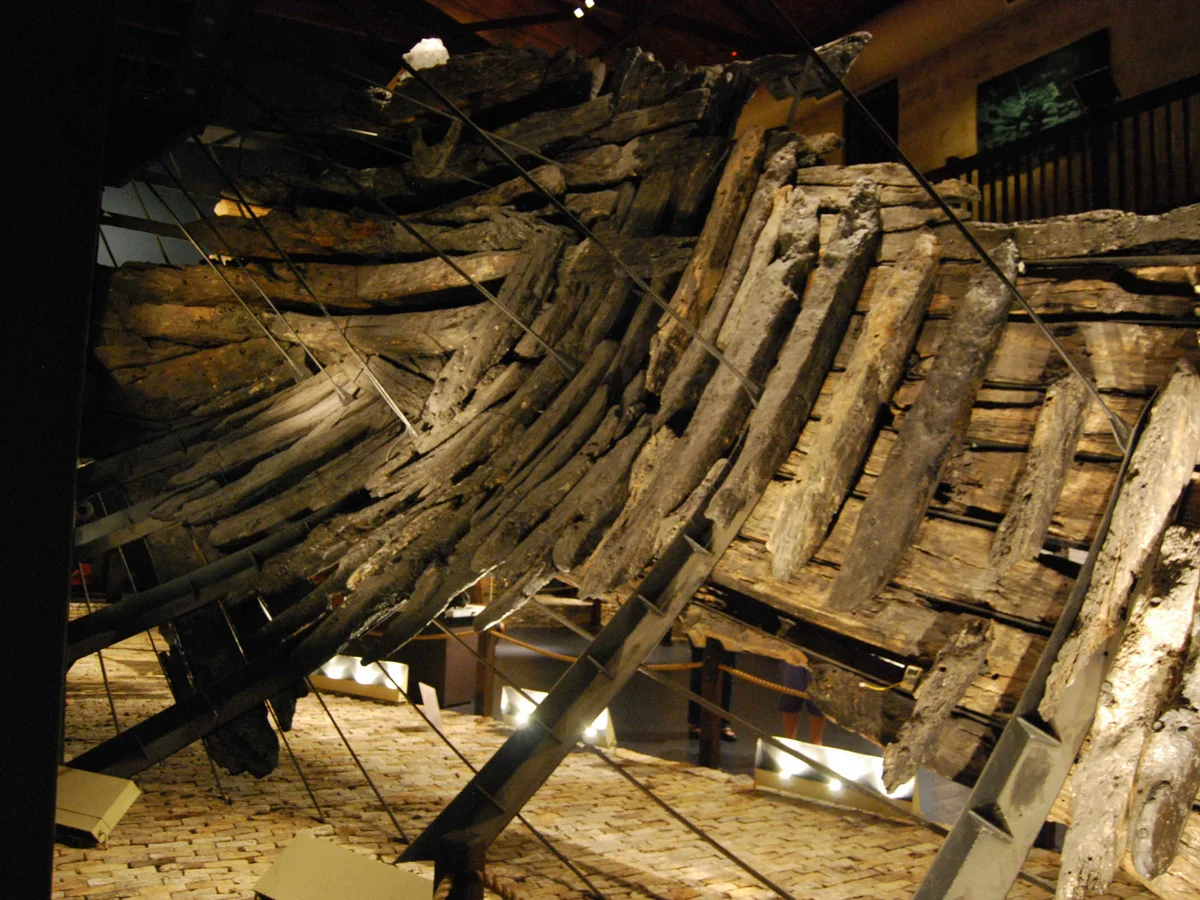
The mutinous plot was abruptly overtaken by maritime catastrophe. In the dead of night on June 4, 1629, Captain Jacobsz mistook the glistening white foam of oceanic surf for moonlit reflections on calm water. At full sail, the Batavia slammed violently into the submerged coral barrier of Morning Reef in the Houtman Abrolhos archipelago, eighty kilometers off the Western Australian coast. Heavy ocean swells pounded the stranded vessel apart. While forty individuals drowned in the immediate impact, more than 250 castaways managed to reach small, desolate coral islands devoid of freshwater springs and arable soil.
The First Corporate Psychopath Batavia VOC: Anatomy of Jeronimus Cornelisz
Confronted with the reality that available drinking water and salvaged wine would sustain the survivors for mere days, Senior Merchant Francisco Pelsaert (Francisco Pelsaert) and Captain Jacobsz executed a desperate gamble. Taking forty-eight officers and crew in a nine-meter open longboat, they set out across the open expanse of the Indian Ocean to seek rescue in Batavia (modern-day Jakarta)—a legendary 3,000-kilometer open-boat voyage that left the island survivors completely severed from central company authority.
In this leadership vacuum, Under-merchant Jeronimus Cornelisz (Jeronimus Cornelisz) stepped forward as the highest-ranking corporate representative remaining on the reef. Invoking VOC administrative hierarchy, Cornelisz appointed an emergency council under his direct control. Yet rather than mobilizing resources for mutual preservation, Cornelisz seized upon the catastrophe to fulfill his psychopathic ambitions of despotic power. Here emerged the world’s first thoroughly documented corporate psychopath batavia voc, executing a reign of terror under the veneer of commercial procedure.
Cornelisz possessed all the hallmarks of an accomplished con artist: superficial charm, intellectual eloquence, and pharmaceutical training that masked a total absence of human empathy. He adhered to extreme antinomian religious doctrines, arguing that those touched by divine enlightenment could commit no sin and that morality was an illusion invented by the weak. Exploiting collective panic, hunger, and dehydration, Cornelisz seduced a faction of dissolute soldiers and crewmen with promises of unimaginable riches once they seized the anticipated Dutch rescue vessel.
The VOC flagship Batavia carrying 250,000 guilders in silver and 341 passengers wrecked on isolated coral reefs off Western Australia in June 1629.
Under-merchant Jeronimus Cornelisz seized command after senior commander Francisco Pelsaert sailed for Java in an open boat to secure rescue.
Cornelisz systematically organized the executions of women, children, and rivals through indoctrinated mutineers without striking a single blow himself.
A band of loyal soldiers commanded by private Wiebbe Hayes repelled mutineer musket attacks from limestone forts and captured Cornelisz.
Ten Hallmarks of Executive Toxicity: Clive Boddy’s Framework Applied to VOC History
In his pioneering study in the Asian Journal of Business Ethics, management scholar Dr. Clive Boddy (Clive Boddy) systematically applied modern psychometric frameworks of corporate psychopathy to Cornelisz’s documented behavior. The historical analysis revealed that Cornelisz matched every single one of the ten diagnostic indicators used to identify toxic, destructive executives in contemporary corporate environments.
The first hallmark was superficial charm and manipulative impression management, which had enabled a failed apothecary to pass VOC screening and secure a senior overseas posting despite a scandalous past. The second was the systematic establishment of an in-group cabal: Cornelisz disarmed the general population, confiscated all salvaged weapons, and surrounded himself with sycophantic enforcers who carried out his directives without question. Third and fourth were extreme grandiosity and narcissism: on a barren limestone sandbar, Cornelisz declared himself sovereign governor, compelled tailors to fashion him flamboyant scarlet doublets trimmed with gold lace from company bolts of cloth, and formed an armed royal bodyguard.
The remaining diagnostic dimensions materialized with equal clarity: pathological mendacity, emotional coldness, absence of remorse, impulsivity, divide-and-rule manipulation, and parasitic exploitation. Cornelisz commandeered the salvaged barrels of wine, bread, and salted pork for himself and his inner circle while rationing foul water to the rest. Moreover, true to the profile of a cowardly manipulative executive, Cornelisz never engaged in physical combat himself, outsourcing the actual bloodletting to indoctrinated subordinates whom he bound through shared complicity.
«Jeronimus Cornelisz exhibited all ten fundamental characteristics of modern corporate psychopathy: superficial charm, calculated impression management, extreme narcissism, callousness, and the outsourcing of dirty deeds. The Batavia catastrophe demonstrates that corporate hierarchies have attracted destructive psychopaths since the very dawn of global commercial enterprise.»
Dr. Clive Boddy (Clive Boddy), Professor of Management at Anglia Ruskin University and corporate psychopathy theorist
Blood on Batavia’s Graveyard: Gaslighting, Purges, and the Resistance of Wiebbe Hayes
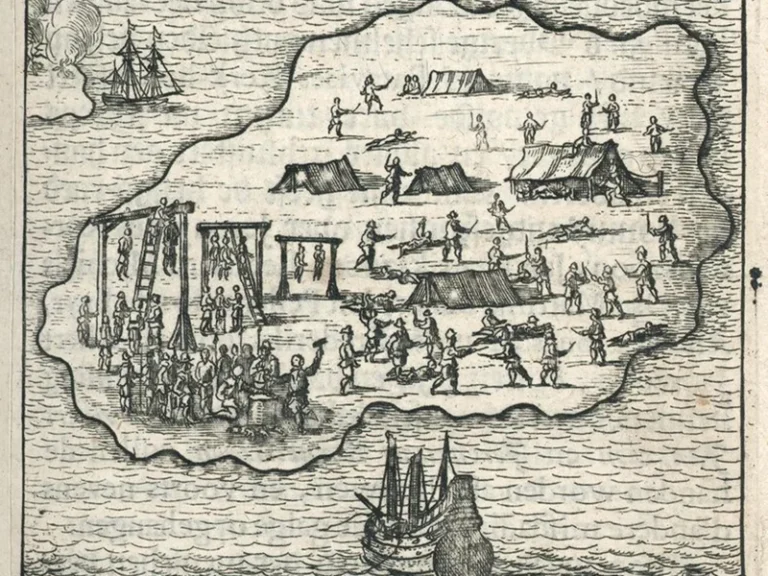
Calculating that water and food rations were insufficient to sustain the survivors until rescue arrived, Cornelisz launched a covert program of population reduction. The main camp on Beacon Island—subsequently christened “Batavia’s Graveyard”—was transformed into a totalitarian slaughterhouse. The mutineers began by surreptitiously drowning the sick, elderly, and wounded under the pretense of medical isolation. Once these vulnerable groups were eliminated, the purge expanded into open daytime butchery targeting potential leaders, clerics, and loyal senior mariners.
To ensure loyalty, Cornelisz required prospective members of his inner circle to commit murders personally, cementing their obedience through irreversible collective guilt. Over two months of unchecked terror, the mutineers massacred more than 115 men, women, and infants. Prominent Dutch noblewoman Lucretia van der Mijlen (Lucretia van der Mijlen), whose advances Cornelisz had unavailingly sought during the voyage, was forced to become his concubine under threat of death, while surviving women were treated as communal property for his inner circle.
However, the despot’s calculus failed to foresee the resistance of honest men. Early in the crisis, Cornelisz had exiled a detachment of twenty infantrymen under common soldier Wiebbe Hayes (Wiebbe Hayes) to the distant high ground of West Wallabi Island, expecting them to succumb to thirst. Instead, Hayes and his men located abundant freshwater soaks and wild wallaby populations. Alerted to the slaughter by swimming survivors, Hayes organized a defensive redoubt. Armed with makeshift pikes tipped with sharpened ship nails and sheltering behind drystone limestone forts, the defenders repulsed three separate musket assaults, counter-attacked during a fourth raid, and captured Jeronimus Cornelisz alive.
- Published in the Asian Journal of Business Ethics, Dr. Clive Boddy’s research marks the first formal application of corporate psychopathy frameworks to early colonial capitalism.
- Jeronimus Cornelisz (Jeronimus Cornelisz) bypassed early seventeenth-century corporate vetting thanks to his polished manners, pharmaceutical credentials, and superficial charm.
- Cornelisz outsourced physical executions to impressionable junior seamen, binding them in mutual guilt while preserving his veneer of executive authority.
- The historical case demonstrates that workplace psychopaths do not prioritize collective survival, but ruthlessly monopolize resources and eliminate potential rivals.
- Modern corporate governance structures that reward ruthless cost-cutting and short-term performance remain structurally vulnerable to the exact manipulative behaviors seen on the Batavia.
Four Centuries of Shareholder Capitalism: What Batavia Teaches Modern Corporate Governance
In September 1629, Senior Merchant Francisco Pelsaert (Francisco Pelsaert) returned aboard the relief yacht Sardam. Alerted by smoke signals from Wiebbe Hayes’s garrison, Pelsaert intercepted the loyalists before the mutineers could mount a surprise assault. The uprising was crushed immediately. Exercising corporate admiralty law, Pelsaert convened a military tribunal on the beach: Cornelisz had both hands chopped off before being hanged on a makeshift gallows alongside his principal lieutenants. Centuries later, forensic archaeology recovered the mass graves of the victims on Beacon Island, where blade trauma and blunt-force fractures verified historical accounts of the slaughter, reflecting how meticulous forensic science solves historical crimes much like the Lukis Anderson case and the forensic paradox of Touch DNA.
The Batavia mutiny is far more than a sensational tale of maritime piracy; it is an enduring cautionary study in corporate institutional pathology. The Dutch East India Company was the world’s pioneer joint-stock multinational enterprise, characterized by transferable shares, professional corporate bureaucracy, and an unyielding commitment to capital return. The Cornelisz affair proves that modern corporate machinery, when stripped of ethical oversight and transparency, provides fertile ground for psychopathic personalities to rise.
Dr. Clive Boddy’s (Clive Boddy) research demonstrates that the proportion of clinical psychopaths within executive suites remains dramatically higher than within the general population. Armed with charismatic charm and strategic callousness, corporate psychopaths exploit organizational silos, terrorize principled colleagues, and cannibalize institutional value for personal enrichment. Four centuries after the Batavia wrecked upon Morning Reef, its grim legacy reminds business leaders and regulators worldwide that when profitability is decoupled from human empathy and moral accountability, the consequences are invariably catastrophic.