

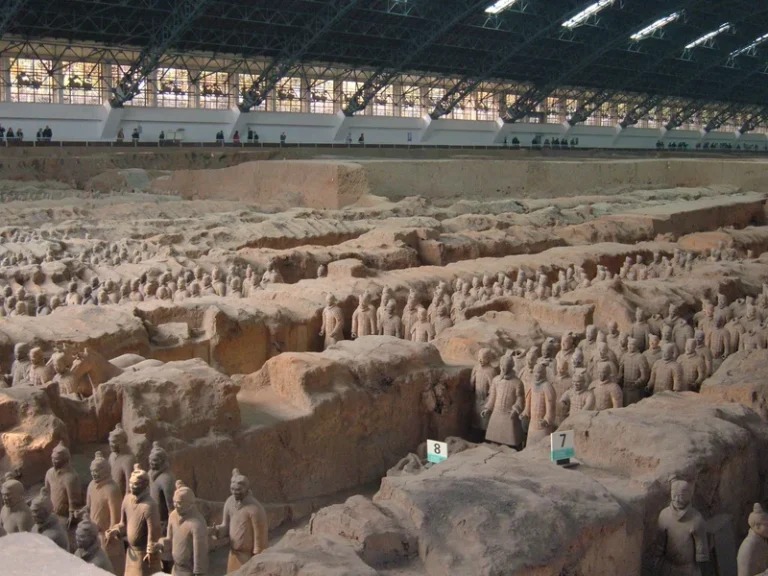

For over two millennia, the silent subterranean necropolis of China’s first emperor guarded not only the martial ambition of a newly unified empire, but also the intimate human secrets of the hands that forged it. For decades, academic dogma insisted that the eight-thousand-strong army of lifelike clay figures was manufactured exclusively by adult male conscripts, imperial soldiers, and penal laborers. However, groundbreaking forensic anthropology has completely overturned this assumption. By examining microscopic dermal ridge patterns preserved in the fired clay, researchers demonstrated that terracotta army fingerprints reveal an unexpectedly diverse labor force: approximately one-third of the artisans were adult women, and over one-fifth were child apprentices under the age of fifteen.
The Invisible Autographs of Antiquity: How Fingerprints Were Preserved in Imperial Clay
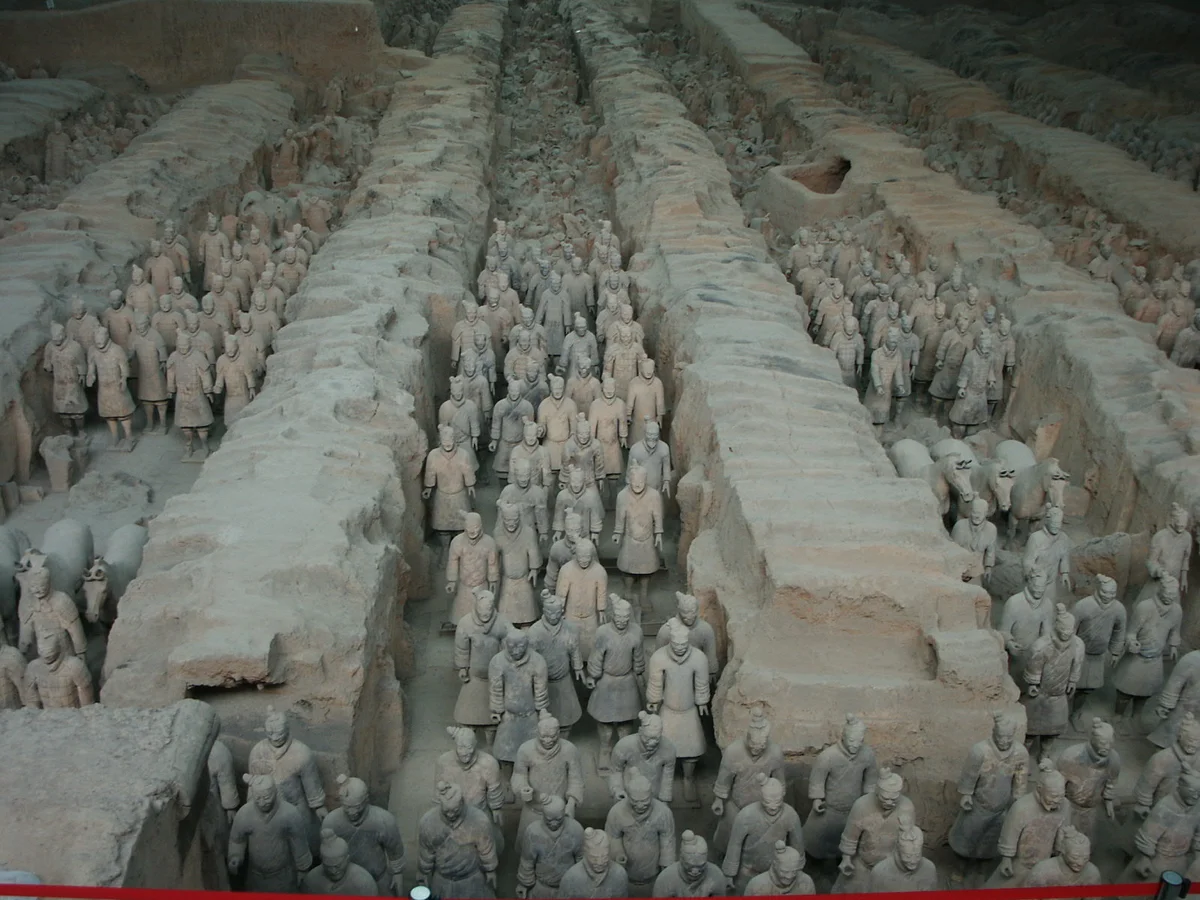
In 1974, when local farmers drilling a water well near Mount Li in Shaanxi Province broke through subterranean chambers to uncover terracotta shards, the archaeological world could hardly fathom the scope of the discovery. Beneath thick alluvial loess lay an entire subterranean vanguard: more than eight thousand life-sized infantrymen, armored archers, mounted cavalrymen, and bronze charioteers positioned to defend the unified empire’s first sovereign, Qin Shi Huang (Qin Shi Huang), across eternity. Each warrior possessed an individualized countenance, hair styling, and meticulously detailed armor, sparking centuries of debate over whether the statues represented real soldiers of the imperial guard.
Yet behind the artistic grandeur lay one of the most sophisticated mass-manufacturing operations of the ancient world. Producing thousands of hollow ceramic sculptures standing up to two meters tall and weighing over two hundred kilograms apiece required an extraordinary level of logistical coordination. Artisans utilized a modular assembly system: solid clay legs provided a heavy, stable base, while hollow torsos were built using coiled clay strips, and heads and hands were pre-cast in two-part clay molds before being individually customized with sculpted clay accents.
Crucially, in the shadowed, recessed zones of the figures where smoothing scrapers and polishing stones never reached, time encapsulated the biological traces of the workforce. Within the hollow neck sockets, beneath overlapping shoulder pauldrons, on the backs of belt buckles, and along the undersides of individual lamellar armor scales, dozens of pristine papillary dermal prints survived. Protected by layers of soot and the eventual collapse of the timber-roofed trenches, these ancient fingerprints remained undisturbed across twenty-two centuries.
Terracotta Army Fingerprints and Bayesian Biometrics: Analyzing Papillary Ridge Breadth
Unlocking the identity of these ancient creators required cutting-edge methods in paleodermatoglyphics and forensic osteoarchaeology. A specialized research team led by Dr. Li Xiaoxi (Li Xiaoxi) and Professor Jingyi Shen (Jingyi Shen) carried out extensive optical micro-profilometry and 3D laser scans on terracotta figures located in Unit T23 of Pit 1. The team focused on thirty-six exceptionally preserved warriors, identifying seventy-nine distinct, measurable epidermal friction ridge impressions suitable for quantitative biometric modeling.
The biological foundation of this analysis rests on a fundamental principle of human physical development: mean epidermal ridge breadth (MRB) expands predictably as an individual matures from infancy through adulthood. In children and young teenagers, papillary ridges are closely spaced, forming fine epidermal contours. As skeletal growth and soft-tissue mass increase, the spacing between ridges expands. Furthermore, due to greater average body size and skin thickness, adult men exhibit significantly wider ridge breadths than adult women of comparable stature.
The central scientific obstacle, however, was that ancient ceramics undergo significant physical transformation. During open-air drying and subsequent reduction firing inside imperial kilns heated to 950–1050°C, wet loess clay experiences volumetric shrinkage ranging between 10% and 12%. To eliminate classification bias—particularly in the borderline zones where small adult female prints overlap with those of adolescent males—the researchers deployed a Bayesian mixture model. This advanced probabilistic framework assessed the artisan collective as a holistic population distribution, mathematically compensating for thermal shrinkage and individual biometric variance.
Forensic investigators documented high-resolution papillary ridges across 36 figures in Unit T23, located on collars, hidden arm joints, and armor plates.
Statistical algorithms rigorously accounted for 10% to 12% clay shrinkage during open-air drying and high-temperature kiln firing (950–1050°C).
The Bayesian model revealed a workforce composed of 45% adult men, 33% adult women, and 22% youth apprentices under fifteen years old.
Qin Dynasty legal statutes determined legal majority not by birth records, but by physical height (roughly 150 cm) and reaching fifteen years of age.
Demographic Paradigm Shift in Unit T23: Shattering the Adult Male Monolith
The findings yielded by the Bayesian statistical model sent shockwaves through the field of Chinese archaeology. For decades, standard historiography maintained that the terracotta warriors were shaped solely by adult male conscripted laborers and penal work gangs. However, in their peer-reviewed study published in the Journal of Cultural Heritage, the authors revealed that adult men accounted for only roughly 45% of the analyzed prints.
The second-largest demographic cohort consisted of adult females, representing approximately 33% of the identified dermal impressions. This tangible evidence refutes the long-standing Confucian narrative that ancient Chinese women were restricted entirely to household sericulture, textile spinning, and domestic duties. In the Qin Dynasty, women were actively embedded in complex monumental craft operations, possessing advanced expertise in clay preparation, hand-molding anatomical forms, and assembling sculptural components.
Most astonishingly, the statistical model demonstrated that 22% of the prints belonged to children and adolescents under the age of fifteen. An analysis of where these juvenile prints were found revealed a rational, highly organized division of factory labor. Young apprentices were not tasked with the demanding sculptural work of carving individualized facial features or balancing heavy torsos. Instead, their prints were clustered on modular, repetitive components: stamping armor scales, pressing uniform rivets, attaching decorative waistbands, and smoothing interior seams where slender young fingers could navigate narrow structural cavities.
«The papillary ridges impressed into wet clay twenty-two hundred years ago are not mere manufacturing accidents; they are genuine biological signatures of ancient people. Our Bayesian demographic framework disproves the long-held myth of an exclusively male workforce: women and young apprentices formed a vital, structural foundation in sculpting this world wonder.»
Dr. Li Xiaoxi (Li Xiaoxi), lead archaeologist at Emperor Qinshihuang’s Mausoleum Site Museum and Shandong University
Imperial Workshops of Gong and You: Legalist Standardization and Youth Apprenticeship
To understand the legal and socio-economic framework that facilitated this multi-generational workforce, one must examine the legalist doctrine of the Qin state. Guided by Emperor Qin Shi Huang (Qin Shi Huang) and his chief advisor Li Si (Li Si), the empire instituted total societal mobilization governed by strict codified laws. Excavated legal bamboo slips from Yunmeng reveal that adulthood in the Qin Dynasty was determined primarily by physical stature rather than chronological birth records: individuals standing six Qin feet (approximately 140–150 centimeters) were deemed legally liable for taxation and state labor, a threshold typically reached around age fifteen.
Manufacturing was organized under a dual workshop network. Elite centralized workshops stamped with the mark “Gong” (Gong) operated directly under the imperial court and the Minister of Works, producing high-status figures with named master craftsman marks. Meanwhile, provincial ateliers designated as “You” (You) mobilized municipal potters and artisans across conquered feudal domains. The Han Dynasty grand historian Sima Qian (Sima Qian) recorded in his Records of the Grand Historian (Shiji) that more than 700,000 individuals were conscripted to construct the sprawling imperial mausoleum complex.
Facing uncompromising production quotas and severe legal penalties for defective craftsmanship, master artisans integrated their entire households into the workshop cycle. Under the legalist “baojia” system of mutual family accountability, craftspeople trained their wives and offspring to perform standardized sub-assembly tasks. This apprenticeship structure allowed young apprentices to master ceramic craftsmanship on the workshop floor, creating a resilient, scalable industrial labor force capable of delivering thousands of terracotta figures within tight imperial deadlines.
- The investigation was conducted by researchers from Emperor Qinshihuang’s Mausoleum Site Museum and Shandong University, led by Li Xiaoxi (Li Xiaoxi) and Jingyi Shen (Jingyi Shen).
- Mean dermal ridge breadth expands predictably during skeletal maturation and exhibits clear sexual dimorphism between adult males and females.
- Child prints were predominantly concentrated on secondary modular components, including stamped armor rivets, belts, and internal joint seams.
- Women artisans actively worked across both centralized metropolitan “Gong” workshops and decentralized provincial “You” ateliers.
- The findings corroborate a flexible family-based apprentice workshop system operating under the strict legalist mandates of the Qin Dynasty.
From Chaco Canyon Monuments to Xi’an: Collective Labor Mobilization and Forensic Anthropology
The revelation from the Qin necropolis prompts a broader re-evaluation of how monumental architecture was achieved across world antiquity. For generations, popular history envisioned ancient wonders—from Egyptian pyramids to Mesoamerican plazas—as the product of brutalized male slave armies driven purely by the whip. Contemporary archaeology paints a far more nuanced picture of complex socio-economic coordination, wherein monumental projects served as engines of community mobilization, echoing how Chaco Canyon astronomical megastructures and their solar alignments required the coordinated seasonal labor of diverse Ancestral Puebloan clans.
By marrying paleodermatoglyphics with high-resolution digital imaging, archaeological science is transitioning from the study of depersonalized artifacts to the recovery of individual biographies. Across twenty-two centuries, we can now discern the tactile reality of living human beings: skilled women meticulously refining the clay folds of heavy military tunics, and focused adolescent apprentices pressing uniform rivets into terracotta armor before each statue was wheeled into the fiery heart of the imperial kilns.
The Terracotta Army no longer stands merely as an intimidating monument to imperial megalomania. Thanks to seventy-nine microscopic fingerprints, it has recovered the voices of the unheralded artisans who brought it into being—mothers, fathers, and children whose collective sweat, discipline, and ingenuity bridged epochs. Their enduring dermal impressions prove that the greatest achievements of human civilization were wrought not by abstract imperial decrees, but by the dedicated hands of everyday families whose signatures are forever baked into the monumental clay of history.