

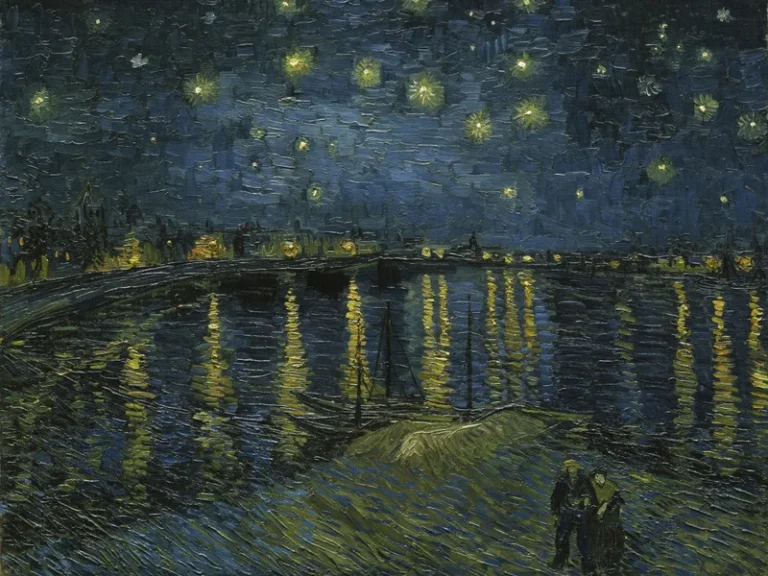

For well over a century, art historians widely dismissed the most celebrated post-impressionist masterpiece as the feverish hallucination of an isolated, tormented mind. Yet groundbreaking interdisciplinary discoveries have upended this traditional perspective: van gogh starry night astronomy and the universal mathematics of fluid dynamics converge across the canvas with astonishing scientific coherence. Rigorous forensic reconstructions by astronomers and a landmark 2024 publication in Physics of Fluids reveal that Vincent van Gogh (Vincent van Gogh) not only documented the exact celestial configuration of late July 1889 above Saint-Rémy-de-Provence, but intuitively captured the mathematical energy cascade of fluid turbulence sixty years before it was formalized by Andrey Kolmogorov (Andrey Kolmogorov).
Forensic Astronomy: What Really Shone Through the Saint-Rémy Window in 1889
In May 1889, in the wake of severe psychological breakdowns in Arles, Dutch post-impressionist painter Vincent van Gogh (Vincent van Gogh) voluntarily admitted himself to the Saint-Paul-de-Mausole asylum in the peaceful Provençal town of Saint-Rémy-de-Provence. His second-story studio bedroom looked directly east, providing an unobstructed vista across an enclosed wheat field bordered by the undulating limestone peaks of the Alpilles mountains. It was from this vantage point, staring through the iron window bars in the quiet hours before dawn, that he conceived one of the most famous paintings in human history. For almost a century, standard art-historical lore maintained that the canvas was an entirely imaginary dreamscape, reflecting religious mysticism and emotional turmoil rather than physical reality.
The first decisive crack in this orthodoxy emerged in the mid-1980s when American art historian Albert Boime (Albert Boime) applied forensic astronomy and historical ephemeris computations to the artist’s correspondence. In a letter dispatched to his art dealer brother Theo van Gogh (Theo van Gogh) in June 1889, Vincent wrote: “This morning I saw the countryside from my window a long time before sunrise, with nothing but the morning star, which looked very big.” Astronomical calculations confirmed that throughout late spring and early summer 1889, the planet Venus was approaching greatest western elongation, blazing with intense brilliance above the eastern horizon before dawn, easily outshining any fixed star in the night sky.
Directly to the right of the looming dark cypress tree on the canvas sits a massive, radiant white celestial orb haloed by concentric waves of yellow light. While early viewers frequently mistook it for an idealized star or an unearthly sun, modern astrophysical modeling leaves no ambiguity: Van Gogh faithfully recorded the brilliant apparition of Venus. Furthermore, the undulating ridgeline depicted at the horizon perfectly traces the geological topography of the Alpilles range as viewed precisely from the eastern window of his monastery cell. Van Gogh was not inventing a fantasy world; he was deeply engaged in acute naturalistic observation.
The Hyades, Venus, and Lunar Phase: Van Gogh Starry Night Astronomy and True Skies
While the presence of Venus was firmly verified, astronomers remained puzzled by the representation of the Moon. In the upper right corner of the canvas, Van Gogh depicted a luminous golden crescent with its horns pointed upward and toward the left. Yet historical planetary tables indicate that during mid-June 1889—the timeframe when the artist first mentioned composing a starry night—the Moon was actually in a waning gibbous phase (roughly 75% to 80% illuminated), rather than a slender crescent. For decades, skeptics seized upon this discrepancy as proof of arbitrary artistic license.
The resolution to this historical enigma came from an interdisciplinary team led by South Korean astrophysicist Elijah Jeong-hyun Kim (Elijah Jeong-hyun Kim). Employing Procrustes shape analysis, the researchers analyzed the geometric coordinates of the eleven prominent stars depicted across the swirling sky against stellar catalogs above Provence throughout the summer of 1889. Their calculations yielded a striking statistical correlation exceeding 99%: the cluster of stars enveloping the central luminous vortex precisely mirrors the spatial geometry of the Hyades open cluster and the red giant Aldebaran in the constellation Taurus.
Crucially, historical sky charts reveal that the only morning during the entire summer of 1889 when a razor-thin waning crescent Moon, blazing Venus, and the rising Hyades cluster appeared simultaneously aligned along the eastern horizon was the predawn of July 22, 1889. Just as contemporary astrophysicists decipher fundamental gravitational dynamics in the gravitational wave burst GW250114 and black hole mergers, forensic astronomers have revealed that Van Gogh was synthesizing genuine optical observations gathered during that crisp July dawn.
Forensic astronomy matched the positions of dazzling Venus, the crescent Moon, and the Hyades cluster to the eastern horizon of Saint-Rémy in the summer of 1889.
Fourier luminance analysis of the painting’s 14 primary celestial swirls revealed an exact match to the -5/3 power law governing energy cascades in fluid turbulence.
Microscopic brushstrokes measuring fractions of an inch exhibit George Batchelor scaling, describing the diffusive mixing of passive scalar quantities in fluids.
Prominent fluid dynamicists warn of apophenia: power-law scaling naturally arises from human hand biomechanics, brush layering, and raw canvas weave textures.
The Kolmogorov Energy Cascade: Discovering Fluid Dynamics in Expressive Brushstrokes
If the placement of celestial bodies reflects sharp observational acuity, the monumental, whirlpool-like plume dominating the center of the canvas was long interpreted as a poetic depiction of the violent Provençal mistral wind or an artistic homage to William Parsons’ sketch of the Whirlpool Galaxy M51. However, physicists recently investigated these sweeping contours through the lens of classical fluid dynamics. In 1941, celebrated mathematician Andrey Kolmogorov (Andrey Kolmogorov) introduced the statistical theory of fully developed homogeneous isotropic turbulence, which remains the cornerstone of modern hydrodynamic science.
Kolmogorov postulated that kinetic energy injected into a turbulent fluid cascades hierarchically from massive macroscopic eddies down through progressively smaller vortices until it is dissipated as heat by molecular viscosity. Within this inertial subrange, the energy spectrum obeys an invariant scaling law: $E(k) \propto k^{-5/3}$, where $k$ represents spatial wavenumber. In September 2024, a team of fluid physicists led by Yinxiang Ma (Yinxiang Ma) published an extraordinary study in the journal Physics of Fluids, demonstrating hidden turbulence within Van Gogh’s masterwork.
By performing high-resolution optical luminance Fourier transforms across the painting’s fourteen principal eddies, the researchers discovered that the spatial distribution of light intensity mirrors Kolmogorov’s $-5/3$ spectral slope with astonishing fidelity. Even more remarkably, at the microscopic scale of individual impasto brushstrokes, the data revealed a $-1$ power-law scaling. This coincides precisely with the Batchelor microscale, formulated in 1959 by Australian physicist George Batchelor to describe the diffusive advection of passive scalar fluctuations in turbulent flows. Vincent van Gogh (Vincent van Gogh) had intuitively reproduced the mathematical fingerprints of the Navier-Stokes equations decades before theoretical physicists formulated them.
«Van Gogh possessed an extraordinary perceptual receptivity to the dynamic fabric of the natural world. What generations of art critics interpreted as hallucinatory madness turns out to be an exquisitely grounded synchronization between the observed celestial mechanics of pre-dawn Provence and the universal mathematical principles of hydrodynamic turbulence.»
Albert Boime (Albert Boime), Professor of Art History at the University of California, Los Angeles (UCLA)
The Physics Controversy: Riley and Gad-el-Hak Against Turbulent Mysticism
The paper’s publication triggered an immediate, intense debate across the global fluid mechanics community. The proposition that an artist with no formal mathematical training had intuitively encoded the non-linear physics of turbulence struck many prominent dynamicists as an unscientific leap. In early 2025, world-renowned fluid mechanicians James J. Riley (James J. Riley) of the University of Washington and Mohamed Gad-el-Hak (Mohamed Gad-el-Hak) of Virginia Commonwealth University mounted a formidable rebuttal against the turbulence hypothesis.
In their peer-reviewed critique, James J. Riley (James J. Riley) and Mohamed Gad-el-Hak (Mohamed Gad-el-Hak) identified critical methodological limitations in applying hydrodynamic laws to static artistic media. First and foremost, Kolmogorov’s turbulence theory applies strictly to three-dimensional velocity vector fields over physical time, where real mass and momentum are transported through a continuum. Translating two-dimensional variations in oil paint luminance into fluid velocity fields represents an unproven physical proxy, vulnerable to apophenia—the human cognitive bias toward discerning meaningful patterns in unrelated data.
To test their skepticism, the researchers applied identical Fourier analysis pipelines to high-resolution digitizations of unrelated paintings, including Edgar Degas’ interior pastels of ballet dancers. Tellingly, Degas’ canvases exhibited similar power-law spectral tails closely resembling the Kolmogorov $-5/3$ curve. The researchers demonstrated that the phenomenon stems from the biomechanics of human artistic execution: the natural tremor of the painter’s hand, the iterative layering of textured pigments, and the periodic weave of woven linen canvas inherently produce self-similar power-law spectra that have no bearing on hydrodynamic Navier-Stokes physics.
- Letters between the painter and his brother Theo van Gogh (Theo van Gogh) verify intensive predawn skywatching sessions focusing on Venus, which he called “the morning star”.
- Statistical Procrustes shape analysis established an 11-star geometric correspondence with the Hyades star cluster and Aldebaran in the constellation Taurus with over 99% confidence.
- A landmark paper published in Physics of Fluids in September 2024 proved that the multi-scale swirls follow Kolmogorov’s -5/3 hydrodynamic energy cascade law.
- Fluid dynamicists James J. Riley and Mohamed Gad-el-Hak demonstrated in 2025 that similar power-law scaling emerges from mundane Degas paintings due to mechanical brushwork.
- The astronomical alignment of the slender crescent Moon, blazing Venus, and the Hyades star cluster pinpoints the dawn of July 22, 1889, as the visual catalyst of the canvas.
Intuitive Genius or Projection Illusion: Where Optical Reality Meets Artistic Myth
Does the critique formulated by Riley and Gad-el-Hak diminish the stature of Van Gogh’s celestial masterpiece? In reality, the controversy enriches our understanding of human perception and artistic creation. Vincent van Gogh (Vincent van Gogh) was not consciously executing numerical simulations of atmospheric physics, but his neurological visual processing was exquisitely attuned to the scale-invariant rhythms of the physical world. Experiencing the fierce mistral gale as it bent ancient olive groves and swept dust clouds across Provence, the painter translated visceral impressions of atmospheric motion directly into rhythmically ordered paint.
Neurobiologists recognize that the human visual cortex evolved specifically to parse the scale-invariant statistical properties of natural environments. Ocean surface swells, windblown sand dunes, billowing storm clouds, and curling smoke plumes all exhibit fractal geometries shaped by turbulent dissipation. Van Gogh’s genius lay in his ability to translate this sensory awareness onto the canvas. His circular, pulsating brushstrokes formed a coherent visual grammar where every stroke responds dynamically to its neighbor, generating an organic visual equilibrium that resonates instinctively with human perception.
Ultimately, the painting endures not as a rigid textbook illustration of astrophysics or Navier-Stokes mechanics, but as an awe-inspiring bridge uniting empirical observation with transcendent human expression. The verifiable coordinates of Venus, the authentic geological contours of Saint-Rémy, and the rhythmic cadence of its swirling sky remind us that even amidst profound psychic turmoil, Van Gogh’s vision remained firmly anchored in the sublime, harmonious architecture of the physical universe.