


Pioneering nuclear forensics and advanced supercomputer modeling have conclusively demonstrated that the nazi atomic bomb uranium project was never close to achieving criticality, definitively debunking Werner Heisenberg’s enduring postwar myth. Comprehensive isotopic analysis of surviving wartime uranium cubes reveals that Nazi Germany possessed less than half the necessary fissile mass and heavy water moderator needed to sustain an autonomous nuclear chain reaction.
The Postwar Narrative: How Heisenberg Constructed the Near-Miss Myth
For nearly eight decades following the cessation of World War II, a persistent historical narrative claimed that Nazi Germany’s top physicists were merely months—and an insignificant quantity of material—away from achieving a self-sustaining nuclear fission chain reaction. The chief architect of this enduring legend was Nobel laureate Werner Heisenberg (Werner Heisenberg), the scientific leader of Germany’s wartime nuclear enterprise, known colloquially as the Uranprojekt.
In a seminal 1947 article published in the British journal Nature, Heisenberg asserted that their ultimate experimental pile, the B8 reactor (Berlin-Haigerloch 8)—hastily assembled in April 1945 inside a limestone rock cellar beneath the castle church of Haigerloch in southwestern Germany—was ‘just insufficient.’ Heisenberg argued that the reactor fell short only because Allied air raids and front-line collapses prevented the delivery of a modest final installment of uranium and heavy water.
This perspective was echoed during the Farm Hall transcript recordings, where interned German scientists, including Carl Friedrich von Weizsäcker (Carl Friedrich von Weizsäcker) and Otto Hahn (Otto Hahn), framed their technical shortcomings as a noble intellectual enterprise thwarted solely by external supply logistics. Over time, this narrative morphed into the popular belief that Nazi Germany stood neck-and-neck with the United States in a razor-thin atomic race.
However, a groundbreaking investigation led by nuclear physicists Patrick J. Park (Patrick J. Park) and Timothy W. Koeth (Timothy W. Koeth), published in PNAS Nexus, has systematically disassembled Heisenberg’s claims. Combining nuclear archaeology with state-of-the-art Monte Carlo particle transport modeling, the researchers revealed that the Nazi reactor was never within striking distance of criticality.
The B8 Pile Architecture: Nazi Atomic Bomb Uranium in the Rock Cellar
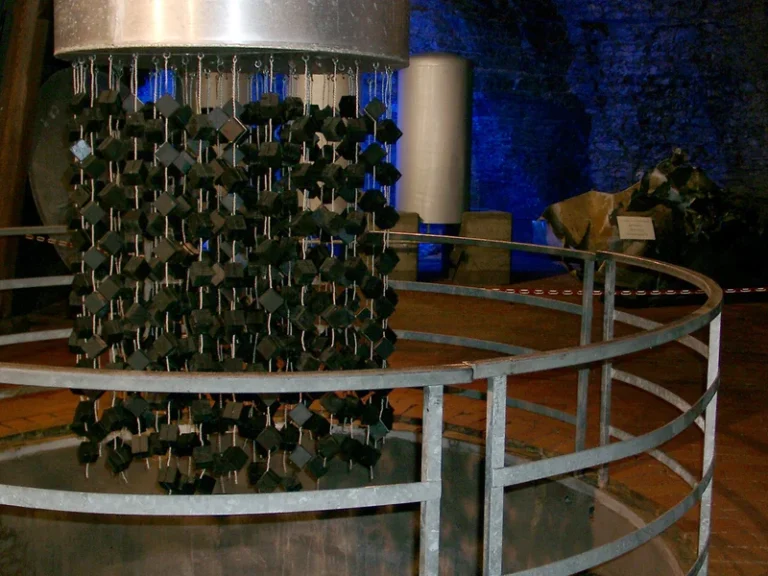
The B8 experiment at Haigerloch was designed as a cylindrical magnesium-aluminum vessel approximately two meters in diameter and depth, submerged within an annular water tank and encased in a ten-ton graphite neutron reflector shield. From an aluminum top plate, 664 cubes of natural metallic uranium were suspended on 78 steel chains submerged in roughly 1,400 liters (1.5 metric tons) of heavy water (deuterium oxide, D2O).
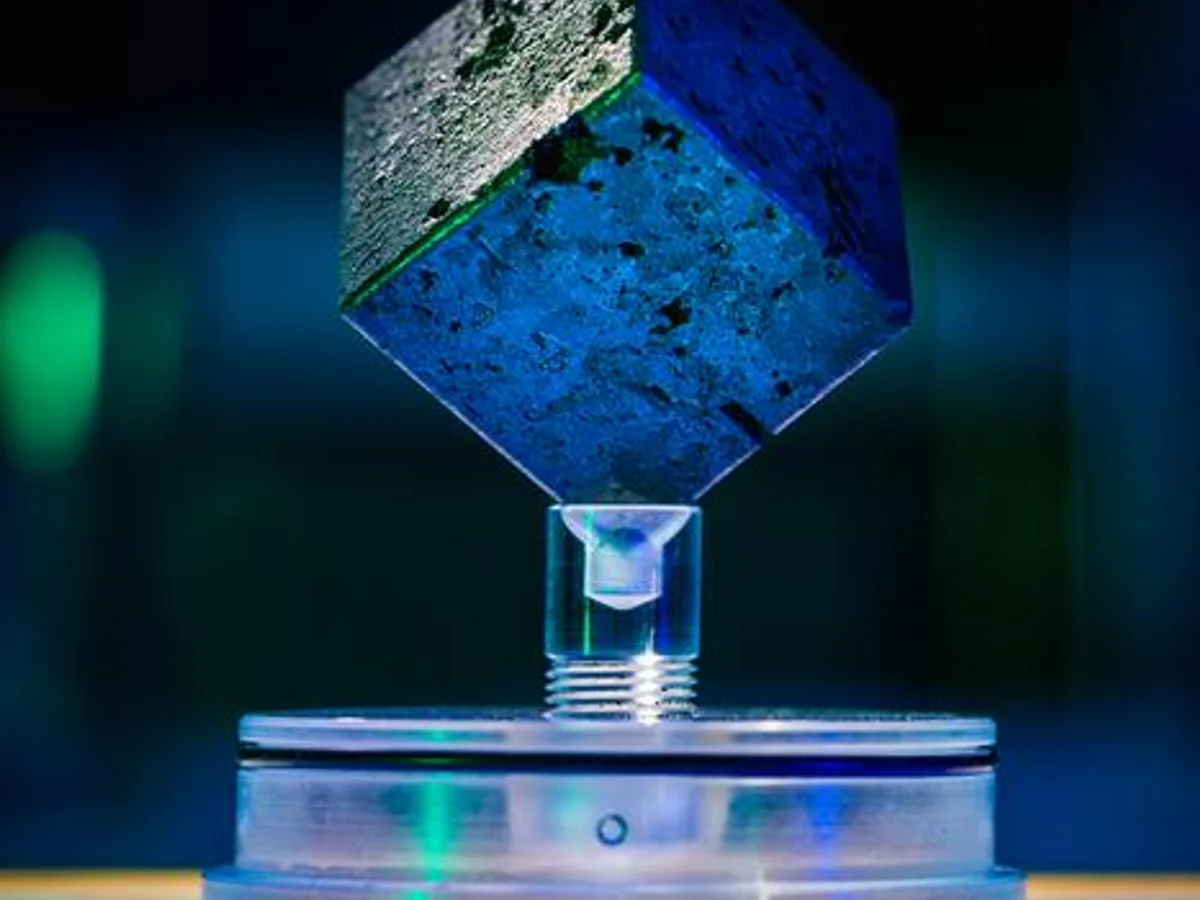
Each cube measured five centimeters on an edge and weighed approximately 2.2 to 2.4 kilograms, constituting an aggregate uranium mass of 1.58 metric tons. Heavy water served as the neutron moderator, slowing down fission neutrons into the thermal spectrum where they could be effectively captured by uranium-235 nuclei. A central radium-beryllium capsule provided the initial neutron flux.
During the frantic final run in April 1945, Heisenberg’s team measured a 6.7-fold increase in neutron density at the core boundary upon complete flooding with heavy water. Relying on rudimentary diffusion approximations, Heisenberg extrapolated that merely increasing the core’s dimensions by an estimated 10 to 15 percent would drive the effective multiplication factor to criticality (k = 1.0).
Yet, these wartime calculations rested on deeply flawed theoretical frameworks. Heisenberg’s team lacked computational tools to model the spatial resonance capture of neutrons across a complex 3D lattice, leading to an overly optimistic assessment of their system’s neutron economy.
Postwar claims that the B8 reactor barely missed criticality are refuted by rigorous modern supercomputer neutronics.
The B8 reactor reached an effective multiplication factor of only 0.94, remaining far below the threshold of a chain reaction.
Achieving criticality required 3.2 tons of uranium and 3,000 liters of heavy water—more than double the Reich’s total wartime assets.
The Allied sabotage of Norway’s Norsk Hydro plant crippled Germany’s ability to procure the heavy water needed for nuclear testing.
Nuclear Forensics and Supercomputer Simulation of Criticality
To test the validity of Heisenberg’s claims, the research team analyzed authentic uranium cubes recovered in April 1945 by the Anglo-American Alsos Mission, commanded by Colonel Boris Pash (Boris Pash) and scientific head Samuel Goudsmit (Samuel Goudsmit). Preserved in institutions such as the Smithsonian, Pacific Northwest National Laboratory (PNNL), and the University of Maryland, the cubes were subjected to inductively coupled plasma mass spectrometry (ICP-MS) and high-resolution gamma-ray spectroscopy.
The radiochronological isotopic ratios of uranium-235, uranium-238, and daughter nuclides (thorium-230 and protactinium-231) confirmed that the metal was processed between 1943 and late 1944 at the Degussa facilities in Frankfurt. Crucially, trace element profiling identified micro-contaminants of boron, cadmium, and rare-earth elements within the cast uranium. Because boron and cadmium possess enormous thermal neutron capture cross-sections, they acted as unmodeled neutron sponges, heavily depressing reactor reactivity.
Incorporating these exact chemical purities and original Haigerloch architectural blueprints, the scientists built a comprehensive digital replica inside the Monte Carlo N-Particle (MCNP) transport code—the gold standard software used in modern reactor physics. The supercomputer simulations revealed that the effective neutron multiplication factor (k_eff) of the B8 reactor was only 0.94.
In reactor engineering, bridging the gap between k = 0.94 and criticality (k = 1.0) represents an insurmountable chasm. To achieve a self-sustaining chain reaction within the Haigerloch configuration, the German team would have required at least 3.2 metric tons of uranium—more than double the amount present—and over 3,000 liters of heavy water, quantities that exceeded Nazi Germany’s total available war reserves.
«The historical myth that German scientists were only a few uranium cubes away from nuclear criticality has been thoroughly dismantled. Nazi Germany stood zero realistic chance of building an atomic bomb.»
Patrick J. Park, Nuclear Physicist and Lead Author, PNAS Nexus
Norwegian Sabotage and Structural Disarray Across the Reich
The fatal bottleneck hamstringing the German project was an acute deficit of heavy water. Continental Europe’s solitary industrial producer of deuterium was the Norsk Hydro electrolysis facility at Vemork, Norway. The audacious sabotage carried out by Norwegian commandos in Operation Gunnerside in February 1943, followed by US Eighth Air Force bombing raids and the sinking of the ferry SF Hydro on Lake Tinn, severed the supply line irrevocably.
Vemork’s entire wartime deuterium output amounted to less than three tons, much of which was lost or dispersed among rival German laboratories. Unlike the American Manhattan Project, which mobilized 130,000 personnel and a staggering $2 billion under the centralized military direction of General Leslie Groves (Leslie Groves), the German nuclear effort was fractured by bureaucratic rivalries.
The Uranprojekt was splintered into three non-communicating factions: Heisenberg’s Kaiser Wilhelm Institute, Kurt Diebner’s (Kurt Diebner) military ordnance group at Gottow and Stadtilm, and Manfred von Ardenne’s (Manfred von Ardenne) laboratory backed by the Reich Postal Ministry. These entities hoarded raw materials, duplicated flawed geometries, and engaged in territorial warfare for scarce resources.
Even if Heisenberg had integrated his B8 pile with Diebner’s Stadtilm stocks, the combined assets would still have fallen critically short of self-sustained operation. Modeling such complex nuclear physics systems parallels broader scientific endeavors, such as analyzing high-energy cosmic phenomena and nuclear transformations that govern stellar evolution.
- Nazi Germany never reached closer than half the fissile and moderator inventory required to trigger a self-sustaining chain reaction.
- Undetected boron and cadmium contaminants in Degussa uranium cubes severely degraded neutron economy via parasitic capture.
- Severe organizational rivalry between three disjointed research factions prevented any concentration of industrial capital or scientific personnel.
- Even under hypothetical criticality, synthesizing weapons-grade plutonium would have required decades of operation beyond Germany’s means.
Why a Nazi Atomic Bomb Was Technically Impossible
Achieving reactor criticality is merely the preliminary milestone on the arduous path toward nuclear weaponry. Even if the B8 assembly had miraculously attained criticality in the spring of 1945, the uncooled, unshielded pile lacked control rods and thermal regulation mechanisms, precluding sustained power operation.
To breed the six to eight kilograms of plutonium-239 necessary for an implosion-type weapon, a natural-uranium reactor must operate continuously at megawatt-scale thermal power for years. Nazi Germany possessed no remote chemical reprocessing facilities to separate plutonium from lethal fission products, had not developed industrial-scale gas centrifuge or gaseous diffusion enrichment cascades for uranium-235, and lacked the precision explosive lensing technology required for implosion.
The revelations in PNAS Nexus decisively close the chapter on World War II atomic mythology. The assertion that German physicists were on the cusp of producing an atomic bomb was a postwar fiction conceived to salvage scientific prestige and mask structural failure. In truth, the Third Reich was stranded at the threshold of basic reactor physics, leagues away from an operational atomic weapon. Also read our related investigative feature on astrophysics of high-energy matter and nuclear reactions.