


For over a century and a half, one of London’s most enduring historical riddles puzzled historians: why a 4th-century Roman sarcophagus at Westminster Abbey, originally carved for a Roman-British citizen named Valerius Amandinus, was reused to inter a prominent medieval Christian figure. Discovered in 1869 by celebrated Victorian architect Sir George Gilbert Scott beneath the Chapter House vestibule, the limestone coffin features an intricately carved Anglo-Saxon cross on its gabled lid and was long presumed looted and emptied. However, following a comprehensive conservation initiative in 2016 and meticulous bioarchaeological investigation led by the Abbey’s Consultant Archaeologist Professor Warwick Rodwell, researchers have finally identified the occupant: an elite 11th-century Benedictine prelate, almost certainly Abbot Aelfwig (who died around 1020) or his successor Abbot Wulfnoth (who died in 1049).
The Victorian Discovery of 1869: Valerius Amandinus and the Saxon Riddle
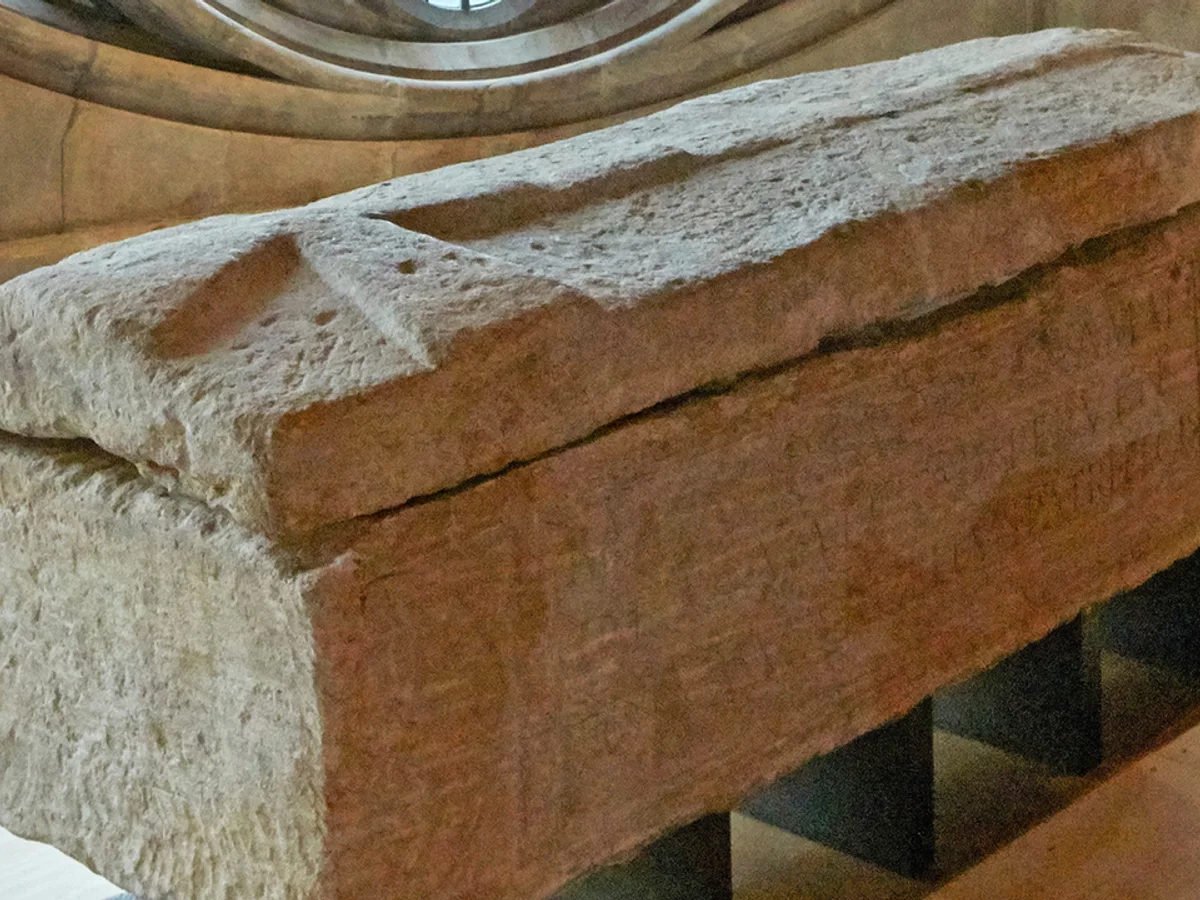
In late 1869, Sir George Gilbert Scott, one of Victorian Britain’s most renowned Gothic revival architects and restoration masterminds, was supervising extensive structural restorations at the Chapter House of Westminster Abbey. Beneath the stone floor of the medieval entrance vestibule, workmen uncovered an immense oolitic limestone sarcophagus measuring over six feet in length. On its primary facade, an impeccably preserved Roman imperial inscription caught Scott’s immediate attention: “MEMORIAE. VALER. AMANDINI. VALERI. SVPERVENTOR. ET. MARCELLVS. PATRI. FECER.” Translated from Latin, the dedication clearly states that Valerius Superventor and Marcellus had erected this grand resting place in memory of their beloved father, Valerius Amandinus, a distinguished Roman-British citizen of 4th-century Londinium.
What stunned antiquarians, however, was the sarcophagus lid. Instead of classical Roman moulding or pagan iconography, the stone cover featured a distinct gabled roof profile adorned with a crisply carved Latin cross with flared extremities. This artistic hallmark belonged unmistakably to the late Anglo-Saxon era, firmly datable to the 10th or 11th century. The discovery represented a paramount example of spoliation—the deliberate reuse and ideological reappropriation of ancient monumental stonework by medieval Christian builders centuries after the collapse of Roman Britain.
Due to the intense pace of Victorian construction, the contents of the stone coffin received only cursory examination. While historical notes noted fragments of human bone, a consensus quickly hardened within Victorian historiography that the tomb had been thoroughly looted in antiquity or during the Middle Ages, leaving behind nothing of scientific value. For nearly 150 years, the sarcophagus stood in the Abbey cloister and museum spaces as an intriguing epigraphic curiosity, its true archaeological wealth obscured by unverified assumptions.
Such dramatic archaeological revelations constantly reshape our comprehension of ancient burial customs and monumental interments, demonstrating that behind every repurposed stone lies a complex tapestry of political legitimacy, spiritual devotion, and cultural evolution.
The 2016 Conservation Project: Rediscovering the Intact Medieval Skeleton
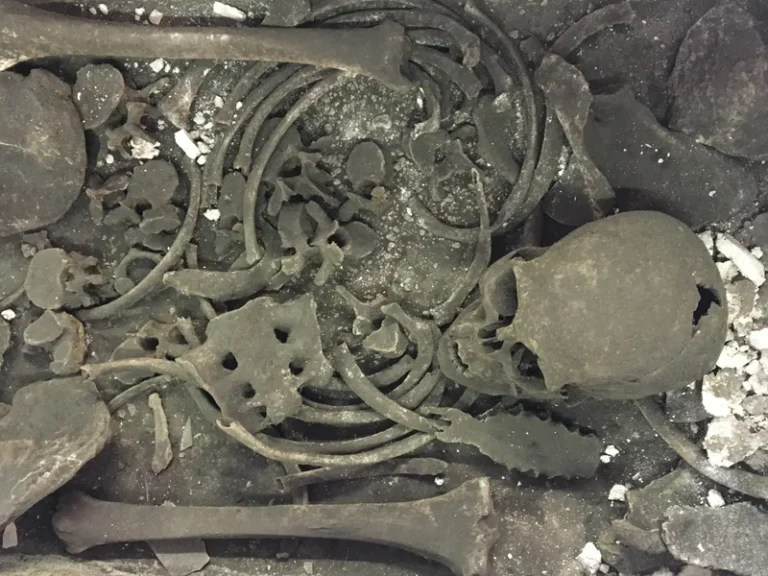
The historical narrative took a dramatic turn in 2016 during preparations for the opening of the Queen’s Diamond Jubilee Galleries within Westminster Abbey’s 13th-century triforium. As part of a thorough conservation initiative, conservators and archaeological specialists meticulously raised the heavy Saxon lid of Valerius Amandinus’s sarcophagus. To their profound astonishment, the coffin was far from empty: lying undisturbed within the carved limestone chamber was a complete, perfectly articulated human skeleton, arranged according to strict Christian liturgical tradition with the skull facing west toward Jerusalem in anticipation of the Resurrection.
The pristine anatomical articulation instantly dismissed any notion of casual secondary bone deposition or violent medieval ransacking. The joints, vertebrae, and delicate hand bones remained in exact anatomical positions. Microscopic analysis of residue clinging to the base of the stone basin revealed degraded organic fibres, confirming that the body had been carefully shrouded in fine woolen or linen funerary textiles. Because the sarcophagus had been sealed with thick lime mortar, the internal cavity maintained an exceptionally stable microenvironment, protecting the osteological material from the damaging groundwater of Thorney Island.
Recognizing the extraordinary significance of the discovery, the Dean and Chapter of Westminster commissioned an exhaustive, multidisciplinary investigation headed by Professor Warwick Rodwell, Consultant Archaeologist to the Abbey. Professor Rodwell assembled an elite team of bioarchaeologists, physical anthropologists, and isotope specialists from the University of Oxford and the British Geological Survey to establish the biological profile, origin, and social status of the deceased.
Initial osteological examinations indicated that the remains belonged to a mature male who lived well beyond 50 or 60 years of age—a venerable longevity for the early 11th century. Crucially, the skeleton displayed no musculoskeletal markers of manual labour, agricultural toil, or battle trauma, indicating that the individual had enjoyed an elite, protected lifestyle reserved for high-ranking ecclesiastical statesmen.
Carved from Oxfordshire oolitic limestone, the monolithic coffin was dedicated by Valerius Superventor and Marcellus to their father in Roman Londinium.
The gabled stone lid bearing a flared Latin cross demonstrates the deliberate and revered medieval Christian spoliation of Roman monumental antiquity.
Radiocarbon dating at Oxford and isotope testing confirmed an elderly male of elite status who died between 1000 and 1050 AD on a rich pescatarian diet.
Historical records point directly to Abbot Aelfwig (d. ~1020) or Abbot Wulfnoth (d. 1049), the two foundational leaders of late Anglo-Saxon Westminster.
Bioarchaeological and Isotopic Analysis: Elite Diet and Oxford Radiocarbon Window
High-precision accelerator mass spectrometry (AMS) radiocarbon dating was performed on purified collagen samples extracted from the femur and rib bones at the Oxford Radiocarbon Accelerator Unit. The calibrated radiocarbon results yielded a remarkably tight chronological window between 1000 and 1050 AD, with the highest statistical probability centering between 1010 and 1045 AD. This pinpointed the burial squarely within the turbulent late Anglo-Saxon era, spanning the troubled reign of King Aethelred the Unready, the Scandinavian conquest and rule under King Cnut the Great, and the advent of King Edward the Confessor.
Simultaneously, stable isotope analyses of carbon (δ13C) and nitrogen (δ15N) reconstructed the dietary profile of the interred prelate. The isotopic ratios revealed an overwhelmingly pescatarian diet enriched with marine and freshwater fish, eels, high-grade wheat, and dairy. Under the Benedictine Rule, the consumption of meat from four-footed animals was prohibited for healthy monks, and sustaining such an opulent, fish-heavy regimen was exclusively the privilege of wealthy monastic leaders who commanded extensive estate revenues and monastic fisheries.
Furthermore, strontium (87Sr/86Sr) and oxygen (δ18O) isotope analysis of the tooth enamel established that the individual had spent his formative childhood years in southern or eastern England, completely consistent with an Anglo-Saxon cleric belonging to the established southern monastic network. Dental attrition matched the typical medieval profile resulting from millstone grit in daily bread flour, while showing no signs of nutritional deficiencies or infectious dental disease.
Every line of scientific evidence converged to form a coherent biography: an elderly, highly revered Benedictine churchman who observed strict monastic dietary protocols, passed away during the first half of the 11th century, and was granted the supreme honor of burial within the sacred precincts of Saint Peter’s Abbey on Thorney Island.
«Finding this remarkably complete articulated skeleton inside the limestone coffin of Valerius Amandinus overturned generations of scholarly assumption that the tomb had been plundered. This provides extraordinary physical evidence of the exalted prestige enjoyed by monastic leaders at Westminster on the eve of the Norman Conquest.»
Professor Warwick Rodwell, Consultant Archaeologist to the Dean and Chapter of Westminster
Historical Deduction: How Abbot Aelfwig or Abbot Wulfnoth Claimed the Roman Sarcophagus at Westminster Abbey
With the chronological window fixed to 1010–1045 AD and the monastic dietary signature confirmed, Professor Warwick Rodwell examined the Abbey’s surviving cartularies, charters, and medieval rolls. During this specific era, only two individuals occupied the supreme office of Abbot of Westminster: Abbot Aelfwig, whose abbacy spanned from approximately 995 until his death around 1020, and his immediate successor Abbot Wulfnoth, who ruled the monastic foundation from 1020 until his death in 1049.
Both historical candidates align extraordinarily well with the radiocarbon dating and biological age profile. Nonetheless, Professor Rodwell puts forward compelling archival arguments favoring Abbot Aelfwig as the most probable occupant. Monastic chronicles indicate that Aelfwig had risen through the ranks as a resident monk at Westminster before his election as abbot. As an institutional son of the monastery, his brotherhood would have had both the time and profound devotion to prepare a monumental funerary resting place for their spiritual father.
In contrast, Abbot Wulfnoth’s death in 1049 coincided with the momentous decision of King Edward the Confessor to completely demolish the ancient Saxon basilica and construct a massive Romanesque abbey church. Medieval records suggest that Wulfnoth’s memory was later associated with a tomb in another sector of the complex, though the possibility of his remains being enshrined in the Roman chest cannot be entirely discounted. In either case, the skeleton represents one of the foundational figures who steered Westminster through the Danish conquest.
The definitive identification of an 11th-century abbot’s skeleton represents a momentous milestone for English medieval archaeology. Until now, the Anglo-Saxon history of Westminster Abbey was largely overshadowed by the triumphant stone architecture of the Norman Conquest. Uncovering this intact burial establishes an unbroken physical thread connecting modern Britain to its pre-Conquest monastic roots.
- The sarcophagus was originally crafted around 300–400 AD and rediscovered in 1869 beneath the floor of Westminster Abbey’s Chapter House vestibule.
- The Latin epitaph reads: MEMORIAE. VALER. AMANDINI. VALERI. SVPERVENTOR. ET. MARCELLVS. PATRI. FECER. («To the memory of Valerius Amandinus; his sons made this for their father»).
- High-precision radiocarbon dating determined the date of death within 1010–1045 AD, matching the reigns of King Aethelred the Unready and King Cnut the Great.
- Reusing prominent Roman stone monuments conveyed ecclesiastical authority, imperial continuity, and exceptional spiritual reverence in pre-Conquest England.
The Cultural Significance of Spoliation: Bridging Classical Rome and Anglo-Saxon Monasticism
The reuse of Roman monumental masonry in Anglo-Saxon England was far more than an expedient response to raw material scarcity. Although high-quality ashlar stone was indeed scarce following the abandonment of Roman quarries, and hauling a monolithic 1.5-tonne limestone chest across the Thames demanded immense logistical resources, the choice to enshrine a Benedictine abbot in a Roman patrician’s tomb carried intense theological and political resonance.
For early medieval English churchmen, Rome was the supreme fount of apostolic legitimacy, orthodox canon law, and imperial prestige. Interring a Christian abbot inside the tomb of Roman citizen Valerius Amandinus was a physical demonstration of the triumph of Christ over pagan antiquity (interpretatio christiana), while simultaneously clothing the monastic superior in the enduring authority of the Roman Empire. Rather than chiseling away Amandinus’s epitaph, the monks deliberately preserved it intact, carving an Anglo-Saxon cross onto the lid to claim spiritual succession over the imperial past.
Topographical investigations suggest that the monks salvaged the sarcophagus from a Roman cemetery located along ancient Watling Street or from the ruins of a Roman suburban villa situated on Thorney Island itself. Transporting and sculpting this massive limestone relic was a formidable corporate enterprise, reserved solely for the spiritual shepherd of the monastery.
Today, the sarcophagus of Valerius Amandinus and Abbot Aelfwig stands among the most celebrated treasures of Westminster Abbey. Professor Rodwell’s research, published in the Journal of the British Archaeological Association, not only resolves a 150-year-old Victorian mystery but exemplifies how modern bioarchaeological science can breathe vivid historical reality into ancient stone. Also read our related investigative feature on ancient burial customs and monumental interments.