



The explosive ascendancy of generative artificial intelligence platforms such as ChatGPT, Claude, and Gemini has ignited a persistent public illusion that true machine consciousness is imminent. Conversational agents compose eloquent poetry, pass rigorous medical licensing examinations, and debug intricate software code, creating a compelling veneer of profound human-like intellect. Yet, groundbreaking cognitive research from the Université du Québec à Montréal (UQAM) demonstrates that modern artificial intelligence cannot think like humans do. Arriving at an identical output does not imply identical mental architecture, and an unbridgeable evolutionary gulf separates statistical token prediction from genuine physical comprehension.
The Illusion of Machine Intellect: Fluency Is Not Cognitive Understanding
The human psyche possesses an innate developmental bias toward anthropomorphism. We naturally project intentionality, agency, and conscious emotion onto inanimate systems, whether treating an unreliable vehicle as stubborn or interpreting animated geometric shapes as possessing moral character. When a state-of-the-art conversational chatbot generates flawless grammar, weaves nuanced philosophical analogies, and effortlessly resolves logic riddles, our brains intuitively leap to a flawed conclusion: ‘If it speaks with the eloquence of a thinking mind, it must possess thought.’

However, cognitive neuroscientists Didier Camilo Olarte Gonzalez and Pier-Luc de Chantal urge a rigorous conceptual distinction between performance and process. Two mechanical devices can produce the numeral ‘4’ when given the input ‘2+2’; yet if one computes via silicon semiconductors and the other utilizes an abacus, their computational nature remains fundamentally dissimilar. In the domain of artificial intelligence, this distinction is not merely semantic—it is profoundly ontological.
Modern transformer architectures draw historical inspiration from biological neurons, yet their underlying mechanics are entirely statistical. A large language model is a multi-dimensional matrix of parameter weights. During self-supervised pre-training, it ingests trillions of words, mapping high-dimensional vectors to capture syntactic and semantic co-occurrence patterns. When presented with a prompt, the system does not ‘reflect’ or ‘reason’; it computes a probability distribution over vocabulary tokens to output the most statistically plausible sequence. That this pure mathematical process produces persuasive essays is a triumph of statistical engineering, not an emergence of biological reasoning.
Moreover, in practical cybersecurity, excessive trust in generative AI fluency has already introduced acute vulnerabilities. Fraudulent actors exploit this veneer of humanity, as evidenced by capabilities and limitations of generative artificial intelligence in automated extortion schemes and synthetic media scams. Victims instinctively assume that polished prose reflects genuine human empathy, overlooking the algorithmic detachment of the software.
The Anatomy of a Falling Cup: Anticipatory Intuitive Physics
To illuminate the chasm dividing biological reasoning from machine learning, the researchers present an everyday scenario: reaching for an ordinary coffee cup perched near the edge of a kitchen counter.
For an adult human, grasping a cup is second nature. Yet from a control-engineering perspective, it demands staggering computational coordination. If you misjudge the distance by millimeters, apply insufficient grip pressure, or jerk your forearm too rapidly, the cup will slip, shatter on the floor, and spill scalding liquid. The biological brain avoids this consequence through anticipatory processing—remaining constantly one step ahead by running real-time predictive simulations of intuitive physics.
Humans can vividly imagine the sticky mess resulting from an overfilled mug, or visualize whether an oversized sofa will pass through an apartment doorway long before purchasing it. These everyday projections align with a central paradigm in cognitive neuroscience known as predictive processing. Under this framework, the brain is an active prediction machine: it projects top-down expectations onto incoming sensory streams and utilizes prediction errors—discrepancies between expected and actual sensory feedback—to fine-tune motor actions.
Consider lifting a cup you assumed was full of coffee, only to discover it is completely empty. Your motor cortex, primed for a heavy object, deploys excessive muscular force. The cup flies upward abruptly, feeling featherweight. That immediate mismatch triggers an urgent error signal, recalibrating motor control and updating your internal estimate of mass. This sophisticated feedback loop executes within milliseconds simply to retrieve a beverage.
«To a human, a cup on the edge of a counter is not merely a cylinder of glazed ceramic; it is a nexus of physical affordances. It can be graspable, fragile, boiling hot, or precariously balanced. Large language models predict sentences describing a falling cup via statistical text correlations, but they possess zero embodied comprehension of mass, gravity, or friction.»
Didier Camilo Olarte Gonzalez, Cognitive Science Researcher, Université du Québec à Montréal (UQAM)
Language Models vs World Models: The Gulf Between Statistical Tokens and Matter
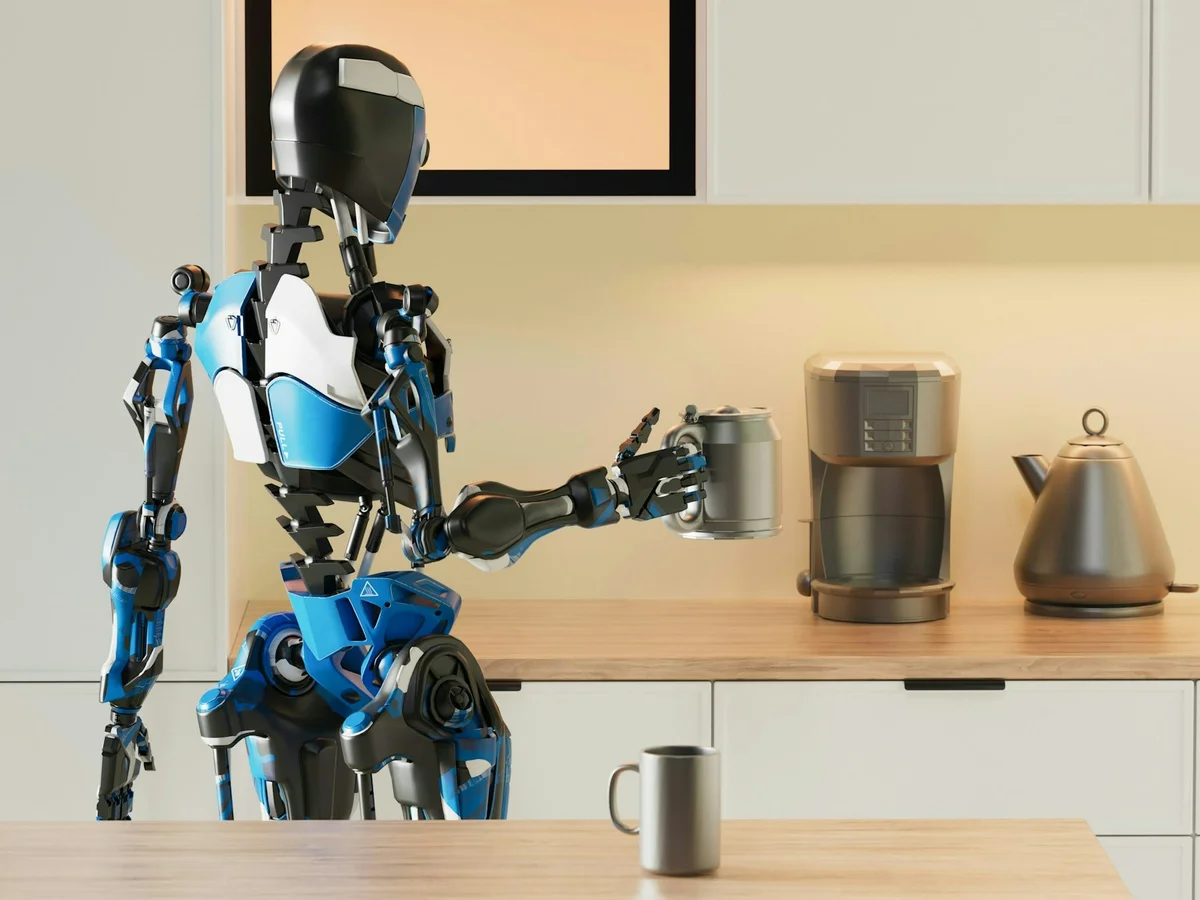
Even the most advanced humanoid robots currently struggle to manipulate everyday dishware in unstructured environments, requiring thousands of hours of reinforcement learning and physics simulations to master basic friction and fragility.
Large language models also generate predictions, but within an exclusively symbolic domain. Consider the prompt: ‘A hand bumps a cup near the edge of a table. The cup…’. Having identified patterns across billions of text passages, the model continues: ‘tips over the edge and falls to the floor.’ The system describes a physically accurate scenario without ever having seen, touched, or dropped a physical object. To the algorithm, ‘cup’ and ‘falls’ are abstract numerical vectors that frequently co-occur in corpus embeddings.
To bridge this divide, leading AI architects, including Yann LeCun, are advancing ‘world models.’ Unlike text-only systems, world models train on raw video streams, 3D spatial simulations, and robotic sensorimotor telemetry. Their objective is to predict how physical environments evolve over time and how deliberate actions modify physical states.
A domestic robot powered by a world model can anticipate that gripping porcelain too tightly will crush it, or that an uneven surface will tip a container. This integration of visual, tactile, and kinematic data represents a major milestone, mirroring embodied cognition and intuitive physical reasoning in biological minds. Yet, predicting a physical outcome in simulation remains fundamentally distinct from genuine human comprehension.
The probabilistic mathematical architecture of LLMs that strings coherent words together without grasping real-world physical references.
The foundational development of intellect through direct physical resistance, bodily equilibrium, temperature, and somatic consequences.
A biological neural paradigm where the brain actively anticipates incoming sensory streams, adjusting motor control prior to conscious awareness.
Video and sensor-driven robotic simulations designed to anticipate environmental state transitions and action-outcome trajectories.
Jean Piaget and Infant Development: The Somatic Roots of True Meaning
The divergence between human thought and algorithmic prediction is rooted in embodied cognition. To a biological organism, a cup is never an abstract spatial coordinate; it is embedded in lived experience: it can be ‘my favorite mug,’ ‘a gift from a mentor,’ ‘scalding hot,’ ‘fragile,’ or ‘dangerous to leave near a toddler.’
Human conceptual understanding is inextricably woven into an interconnected network of motor affordances, somatic memories, and emotional valences. In the mid-twentieth century, pioneering developmental psychologist Jean Piaget demonstrated that infants construct cognitive reality primarily by acting upon the physical world during the sensorimotor stage.
A six-month-old infant does not memorize textbooks on Newtonian mechanics. The infant reaches for a rattle, chews its edge, drops it from a crib, listens to the impact, touches the cold floor, and intuitively deduces gravity, object permanence, and material resilience. Over millions of sensorimotor iterations, the infant brain associates kinesthetic muscle tension with visual motion. Gradually, this external manipulation is internalized: an older child mentally simulates a falling object without needing to break it.
As highlighted in computational linguistics research (DOI: 10.1162/coli_a_00492), human learning is not the passive ingestion of digital data. It is the consolidation of tactile touch, thermal sensation, physical weight, and bodily consequences. An AI system, even when equipped with cameras and robotic actuators, lacks physical vulnerability, biological needs, and mortal stakes—the very elements that endow predictive thought with existential meaning.
- Large Language Models (LLMs) predict the next probable text fragment from vast datasets without possessing an internal causal model of physical reality.
- Human cognition is fundamentally embodied: it develops through sensory-motor interaction, somatic proprioception, and physical vulnerability.
- The biological brain operates via predictive processing, constantly projecting forward hypotheses about environmental physics and updating them via prediction errors.
- Emerging ‘world models’ train robots to anticipate physical dynamics, but generating a plausible outcome is fundamentally distinct from human understanding.
Performance vs Process: Why AI Will Remain an Instrument, Not an Organic Mind
As artificial intelligence capabilities advance, distinguishing performance from process will become the preeminent intellectual imperative of the modern era. An algorithm’s ability to solve a complex differential equation or identify pulmonary nodules on a radiograph does not mean it possesses mathematical intuition or an understanding of human illness.
Artificial neural networks operate as objective-function optimizers, identifying statistical paths of least resistance through hyper-dimensional parameter spaces. Human thinking, by contrast, is a dynamic equilibrium among somatic feedback, limbic emotional drives, social bonding, and cortical computation. Biological intellect was forged across hundreds of millions of years of evolutionary survival, where every cognitive heuristic was tested against physical mortality.
Will world models make robots vastly more capable and autonomous? Absolutely. Assistive robots will reliably navigate homes, care for the elderly, and operate vehicles safely in complex traffic. However, labeling these mechanical achievements as ‘human thought’ remains an anthropomorphic error. Generating a correct forecast reveals nothing about the subjective knowledge or existential context that underpins it.
Acknowledging the profound difference of artificial intelligence is not a dismissal of technological achievement; it is the prerequisite for responsible progress. AI is an extraordinary, unprecedented instrument for pattern recognition and simulation. Yet authentic thought—infused with empathy, subjective qualia, intuitive physics, and existential purpose—remains the exclusive domain of embodied biological life.