

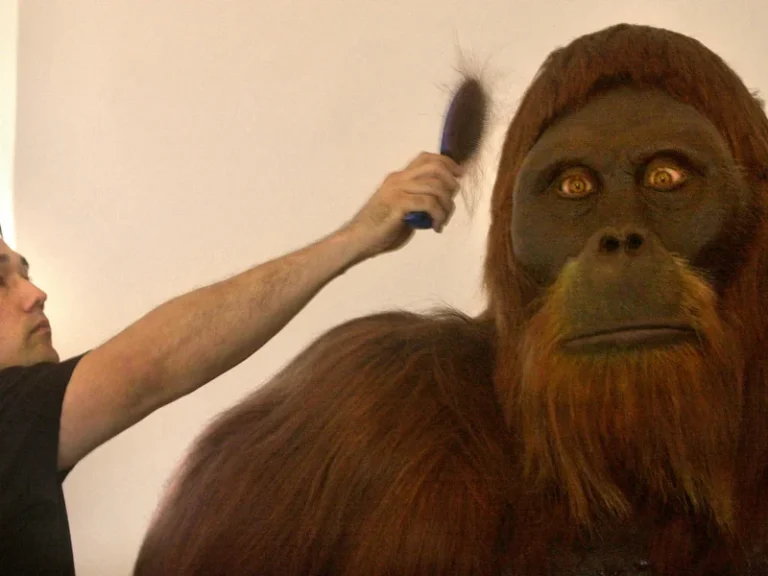

When early hominins first trekked beneath the dense tropical canopy of Pleistocene Southeast Asia, they ventured directly into the domain of the largest primate that ever walked the Earth — a towering, ten-foot-tall herbivore weighing up to 660 pounds. The hypothetical encounter with Gigantopithecus (Gigantopithecus blacki) has long stood as one of the most enthralling mysteries in human evolutionary biology: was it a deadly clash between cunning hominin hunters and a gentle titan, a distant coexistence in segregated ecological niches, or a moment of profound awe experienced by early humans? By combining advanced isotope geochemistry from fossilized tooth enamel with high-precision luminescence dating across karst cave systems, international paleoanthropologists have finally unraveled how human ancestors and giant apes shared a prehistoric continent.
Titans of the Pleistocene: Who Was the Colossal Primate?
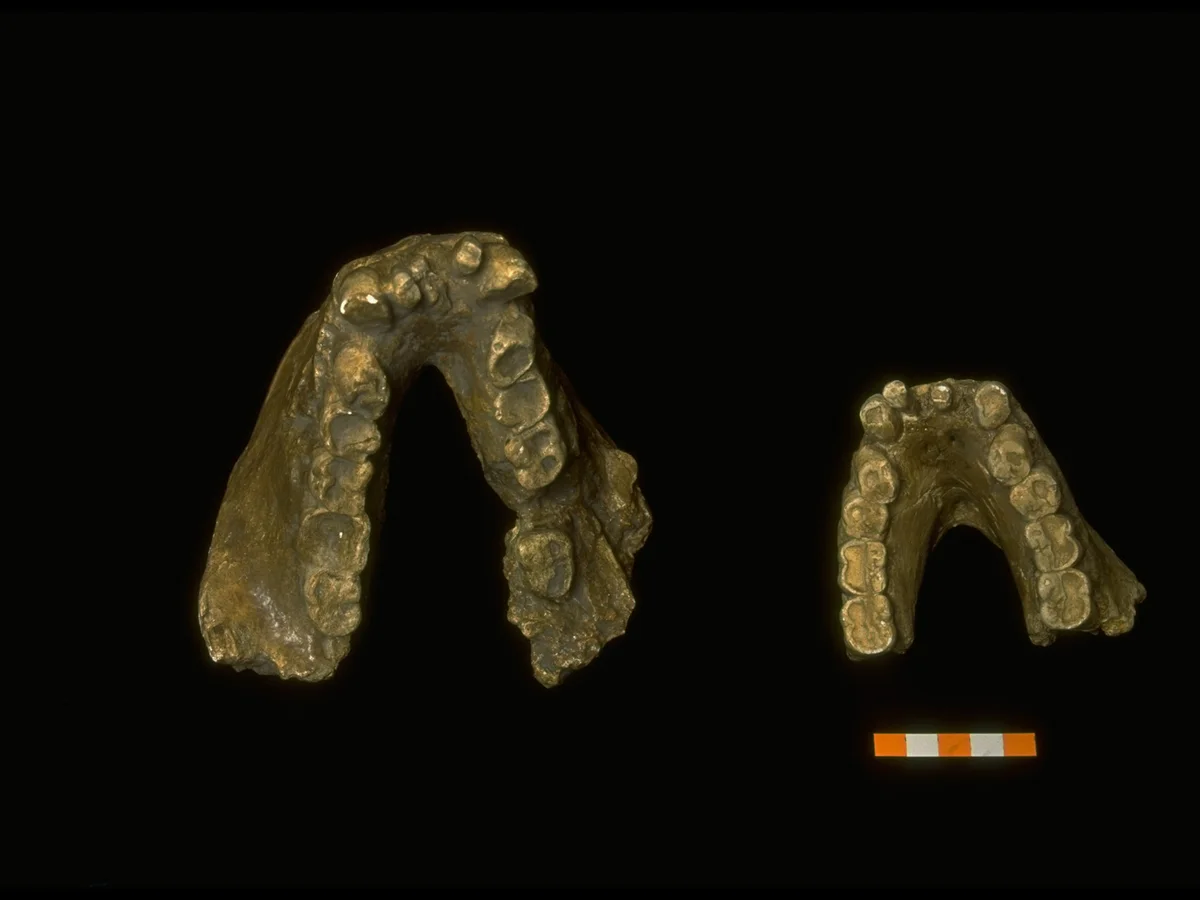
For nearly two million years, the lush karst landscapes of Southeast Asia provided sanctuary for a primate whose sheer scale borders on mythological folklore. First identified in 1935 by German-Dutch paleontologist Gustav Heinrich Ralph von Koenigswald inside a Hong Kong traditional apothecary shop, Gigantopithecus blacki immediately challenged established paradigms of mammalian evolution.
Recent paleoproteomic analysis of fossil enamel has conclusively shown that Gigantopithecus was not an ancestor of modern hominins or an oversized African ape, but a specialized sister clade to modern orangutans. Ground-dwelling due to its immense mass, this gentle herbivore spent its days grinding massive quantities of fibrous plants with molars protected by enamel up to a quarter-inch thick.
Yet between 800,000 and 300,000 years ago, new inhabitants infiltrated these prehistoric ecosystems. Populations of Homo erectus, armed with bifacial handaxes and coordinated foraging strategies, spread across the region. Concurrently, other archaic human relatives, such as Denisovans and archaic lineages, were expanding across Eurasia, creating a dynamic multi-species theater.
Encounter Scenarios: Predation, Avoidance, or Existential Awe?
The question of how our direct ancestors responded upon seeing a ten-foot-tall ape emerging from the bamboo mist has fueled decades of academic speculation. While direct fossil evidence of physical confrontations remains elusive, evolutionary anthropology provides a compelling framework.
Friedemann Schrenk, Professor of Paleobiology at Johannes Gutenberg University Mainz in Germany, argues that if hostility arose, early humans were almost certainly the instigators. Armed with stone tools and likely wooden throwing spears, hunting parties of Homo erectus encroached on pristine habitats. Schrenk suggests that Gigantopithecus would have actively avoided hominins, mirroring how modern orangutans retreat before agricultural expansion.
Conversely, Frido Welker, Professor of Biomolecular Paleoanthropology at the University of Copenhagen, highlights the perceptual shock experienced by ancient hominins. Coming face-to-face with an ape towering twice their stature would have commanded profound respect and existential caution, making hominins think twice before launching unprovoked attacks.
Archaic hominins like Homo erectus wielded Acheulean handaxes, spears, and controlled fire, posing a lethal collective threat to large herbivores.
Carbon isotope ratios in fossilized teeth demonstrate that Gigantopithecus inhabited closed deep forests, whereas hominins roamed open savannahs.
High-resolution dating proves that the giant ape vanished between 295,000 and 215,000 years ago due to severe environmental aridification.
Unlike opportunistic human ancestors, the giant ape was physically incapable of subsisting on fallback foods when seasonal droughts struck.
Dental Geochemistry: Segregated Habitats and Differing Lifestyles
Definitive empirical insight into hominin-ape coexistence arrived via stable isotope geochemistry. Hervé Bocherens, Professor of Biogeology at the University of Tübingen in Germany, analyzed carbon (δ13C) and oxygen (δ18O) isotopes preserved in fossilized tooth enamel from karst caves across southern China.
The carbon signatures revealed that Gigantopithecus fed exclusively on C3 vegetation typical of dense, closed-canopy rainforests. In contrast, dental samples from contemporaneous Homo erectus exhibited significant C4 isotopic input, reflecting an omnivorous lifestyle adapted to open grasslands, riverbanks, and mosaic savannahs.
This biogeochemical divergence confirms that hominins and giant apes maintained minimal direct competition for food. While their ranges occasionally overlapped along forest margins, they occupied fundamentally different ecological worlds.
«If we examine the broader pattern of human evolution, our lineage has consistently behaved as an apex predator. Humans and our ancestors exhibited a remarkable tendency to explore, exploit, and at times eliminate large fauna sharing their habitat. It is reasonable to imagine that direct encounters involved a volatile mixture of curiosity, cautious indifference, and violent aggression.»
Renaud Joannes-Boyau, Director of Higher-Degree Research Training at Southern Cross University, Australia
The Ultimate Demise: Environmental Crisis Over Hominin Overkill
The long-standing theory that aggressive hominins hunted Gigantopithecus to extinction has been definitively refuted by a landmark study led by paleontologist Yingqi Zhang from the Institute of Vertebrate Paleontology and Paleoanthropology (IVPP) in the leading scientific journal Nature.
Examining 22 cave sites across Guangxi with six independent geochronological dating methods, Zhang’s team pinpointed the extinction window between 295,000 and 215,000 years ago. This interval coincided with profound climate restructuring: regional monsoon shifts caused closed tropical canopies to fragment into dry scrubland.
Gigantopithecus, constrained by extreme anatomical bulk and specialized caloric demands, could not transition to tough fallback vegetation, as evidenced by chronic enamel hypoplasia. Adaptable, tool-using hominins navigated the environmental shifts with ease, leaving the giant ape behind as one of evolutionary history’s most magnificent lost giants.
- Estimated standing height of nearly 10 feet (3 meters) and body weight between 250 and 300 kg (550–660 lbs).
- Closest living relative: modern orangutans (genus Pongo), from which its evolutionary lineage diverged roughly 10–12 million years ago.
- Strictly herbivorous diet dominated by seasonal canopy fruits, fibrous bamboo shoots, and tender foliage.
- Temporal persistence spanning from approximately 2 million years to 200,000 years ago across southern China and Vietnam.
- Absence of butcher marks or taphonomic evidence indicating systematic hominin predation in cave fossil assemblages.