

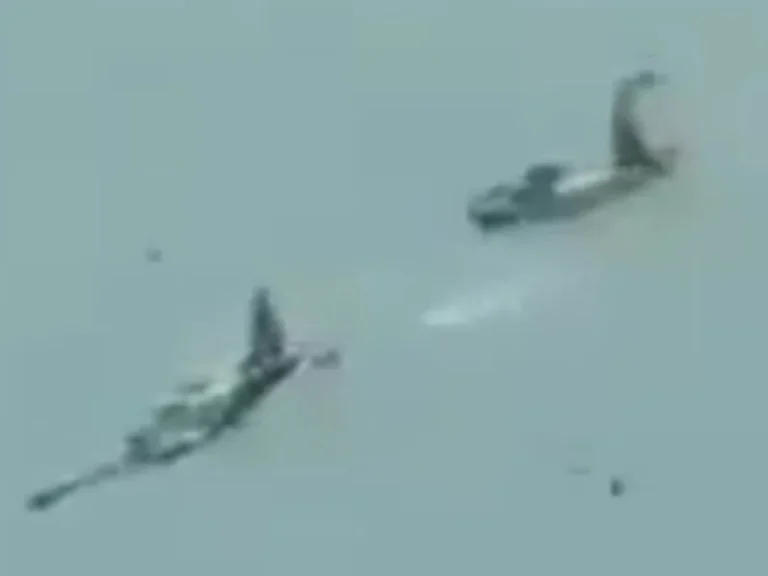

The Philippine Air Force (PAF) has confirmed the tragic deaths of four military aviators after two light attack trainer aircraft collided mid-air during a formation flight rehearsal. The fatal incident occurred at approximately 3:51 PM local time over Fernando Air Base in Lipa City, Batangas province, south of Manila. Video footage captured from the ground shows the two Italian-made SIAI-Marchetti SF-260 planes flying low in formation before their wings clipped, triggering an immediate burst of smoke and sending both aircraft into an uncontrollable descent inside the perimeter of the air base. The horrific Philippines military planes crash has prompted military leadership to immediately ground the entire SF-260 fleet pending an official investigation.
Fatal Collision in Batangas Skies: Reconstructing the Mid-Air Impact
On the afternoon of October 23, visual meteorological conditions over Batangas were clear as Philippine Air Force pilots conducted standard formation training over Fernando Air Base in Lipa City. The exercise involved a coordinated flyby of six SF-260 trainer aircraft designed to maintain strict tactical separation.
Authentic video footage recorded by observers near the airfield shows the aircraft flying low in close formation. Suddenly, two trailing aircraft converged catastrophically: the wing of one machine struck the control surface of the other. The impact generated a sharp puff of smoke and immediate structural disintegration.
Both aircraft rapidly lost aerodynamic lift, entering steep spins toward the earth. Operating at low altitude, the four aviators had no viable ejection or parachute envelope. Both planes impacted within the secure perimeter of the base, resulting in immediate fatalities.
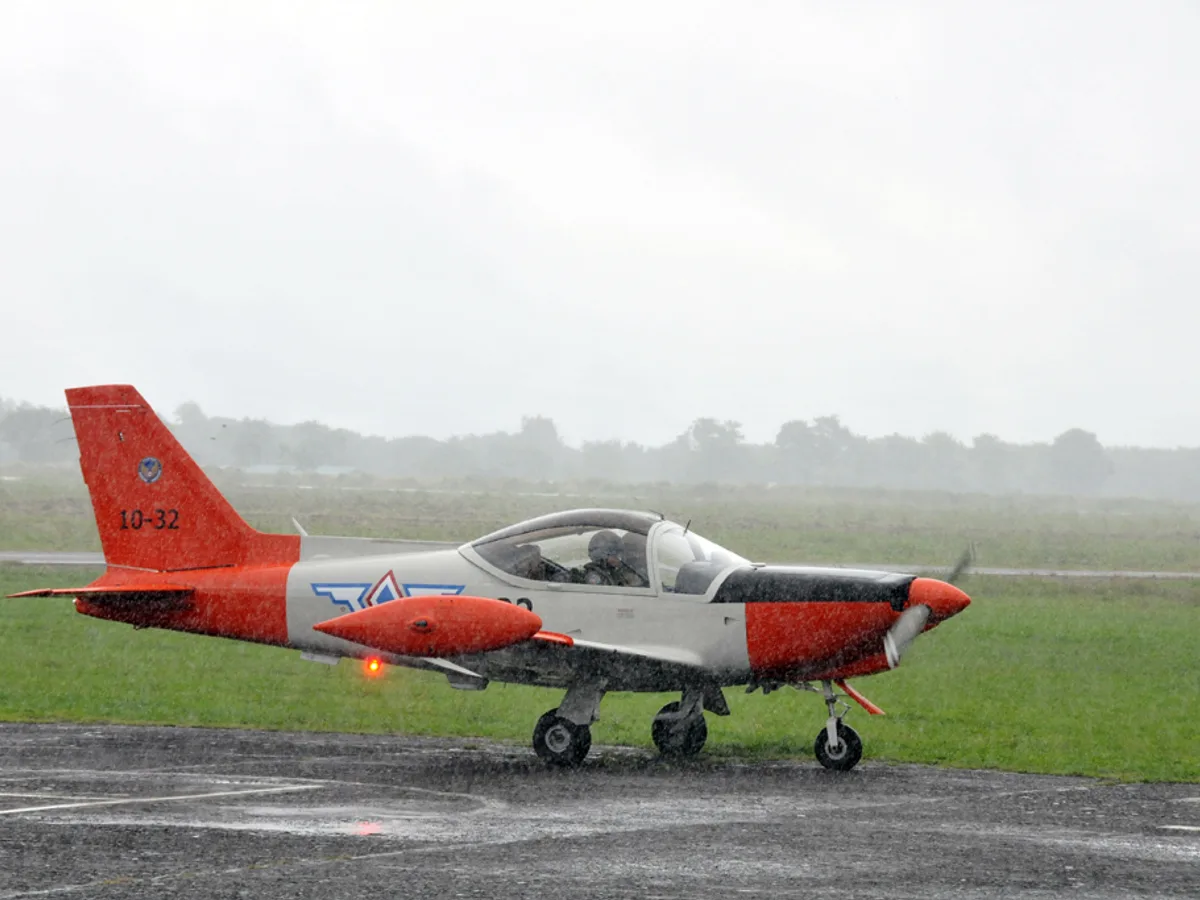
The SIAI-Marchetti SF-260: The Workhorse of Philippine Military Flight Training
Originally designed by Italian aeronautical engineer Stelio Frati, the SIAI-Marchetti SF-260 has served as a foundational primary flight trainer for military air arms around the globe for decades. Celebrated for its crisp handling and high-g aerobatic capability, the type became known as a pilot’s aircraft.
The Philippine Air Force has operated both piston-engine variants and turboprop SF-260TP models for foundational cadet instruction as well as light strike operations in counter-insurgency campaigns across the southern archipelago, utilizing wing hardpoints for rocket pods and machine guns.
However, operating lightweight airframes in tropical maritime environments creates ongoing maintenance challenges regarding metal fatigue, control cable tension, and airframe longevity, prompting regular scrutiny of fleet modernization timelines.
Both two-person flight crews perished when the aircraft impacted the ground inside Fernando Air Base.
The aircraft were operating alongside four others during tight formation flyby exercises when paths converged.
The Philippine Air Force immediately grounded all remaining SF-260 trainer aircraft as a safety precaution.
Both aircraft crashed inside open airfield territory, preventing injuries or damage to surrounding civilian neighborhoods.
Investigative Hypotheses: Wake Turbulence, Spatial Disorientation, or Mechanical Failure?
The Armed Forces of the Philippines immediately convened an aircraft accident investigation board to review telemetry, radio communications, and maintenance logs associated with both tail numbers.
Aviation safety analysts suggest several potential contributing factors. In close-formation flight, encountering the wake turbulence or prop-wash of a leading aircraft can violently upset a light trainer, inducing sudden uncommanded roll that is virtually irrecoverable at tree-top level.
Investigators are also examining spatial disorientation and mechanical failure in rudder or aileron linkages. In response, Air Force leadership grounded the entire SF-260 inventory nationwide, ordering non-destructive testing and control cable inspections on all airframes.
«The PAF mourns the loss of four pilots in an aviation accident involving two SF-260 aircraft during a training flight at Fernando Air Base. Both aircraft went down within the base perimeter, with no other casualties reported. An investigation is underway to determine the cause, while all SF-260 aircraft have been temporarily grounded.»
Philippine Air Force Official Spokesperson
Geopolitical Tensions and Increasing Operational Demands
The fatal accident occurs against a backdrop of heightened military alertness across the Philippine archipelago. Territorial friction in the South China Sea has prompted Manila to dramatically expand surveillance patrols and joint naval maneuvers with the United States, Japan, and regional allies.
Accelerated operational tempos place substantial strain on pilot training pipelines and ground maintenance crews tasked with keeping veteran fleets flight-ready. Managing older inventory while ramping up combat readiness poses complex logistical hurdles.
The Philippine military has suffered high-profile aviation tragedies in recent memory, most notably the 2021 crash of a C-130 Hercules transport aircraft in Sulu province that claimed over 50 lives, underscoring the urgent imperative for modern military aviation procurement.
- Time and location: October 23, 2026, at 3:51 PM local time at Fernando Air Base in Lipa City, Batangas.
- Aircraft involved: Two twin-seat SIAI-Marchetti SF-260 light military training/attack aircraft.
- Operational context: Flight rehearsal involving a formation of six aircraft operating at low altitude.
- Immediate response: Fire and rescue teams responded immediately; investigation team dispatched by Air Force HQ.
- Precautionary grounding: Full grounding order issued across all PAF flight training wings operating SF-260 units.
Honoring Fallen Aviators and Lessons for Flight Safety Protocols
Air Force officials expressed profound condolences to the families of the four fallen pilots, pledging full institutional assistance while requesting public privacy during bereavement.
The authentic footage documenting the catastrophe provides invaluable forensic data for international flight safety regulators. Low-level multi-aircraft formation maneuvers represent one of aviation’s most unforgiving disciplines, requiring millisecond-level precision.
The findings from the Fernando Air Base inquiry are expected to accelerate Philippine defense modernization programs, reinforcing the strategic transition toward next-generation advanced jet trainers equipped with automated collision-avoidance systems.
Forensic Investigation Protocols: Telemetry Reconstruction and Collision Dynamics
The formal aircraft accident investigation convened at Fernando Air Base is utilizing advanced digital photogrammetry, high-resolution terrestrial lidar scanning, and trajectory simulation modeling to reconstruct the flight profiles of both SF-260 aircraft down to fractions of a second.
Forensic teams are meticulously examining fracture surfaces along the wing spars and horizontal stabilizers using metallurgical scanning electron microscopy. This process will determine whether structural failure preceded or resulted from aerodynamic impact, definitively resolving mechanical hypotheses.
The comprehensive final report will be shared with allied air arms worldwide, generating vital telemetry data to refine close-formation maneuvering envelopes and improve low-altitude collision-avoidance training across multinational pilot instruction programs.