

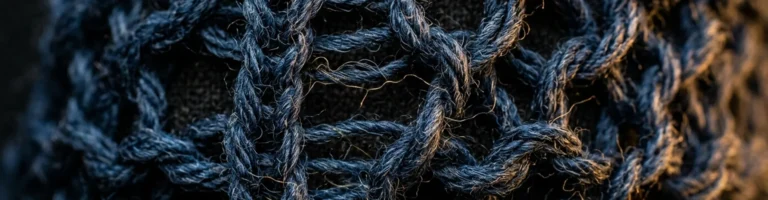

When we slip into flexible, form-fitting knitted clothing, its remarkable elasticity and structural resilience are governed not merely by the chemical composition of the yarn, but by the fundamental topology of its interconnected loops. A team of theoretical physicists and mathematicians has achieved a groundbreaking insight by applying knot theory to textile mechanics, proving that knitted fabrics withstand localized defects thanks to topological invariants that halt catastrophic unravelling.
Knots, Loops, and the Hidden Mathematics of Textile Weaves
For thousands of years, humans have crafted textiles intuitively, passing knitting and weaving patterns down through generations. Yet from the perspective of modern condensed matter physics, a knitted textile represents a complex two-dimensional network of entangled closed curves, forming an intricate macroscopic knot without loose ends. While conventional woven fabrics rely on perpendicular warp and weft strands held primarily by friction, knitted fabrics derive their mechanical integrity from topological interlocking.
A research team led by Dr. Daisuke S. Shimamoto at Ritsumeikan University, in collaboration with colleagues from Tohoku University, set out to establish a rigorous mathematical foundation for this phenomenon. In a landmark paper published in Physical Review X, the scientists formulated an analytical framework explaining why certain stitch patterns yield stable, stretchable textiles while others catastrophically unravel under the slightest disruption.
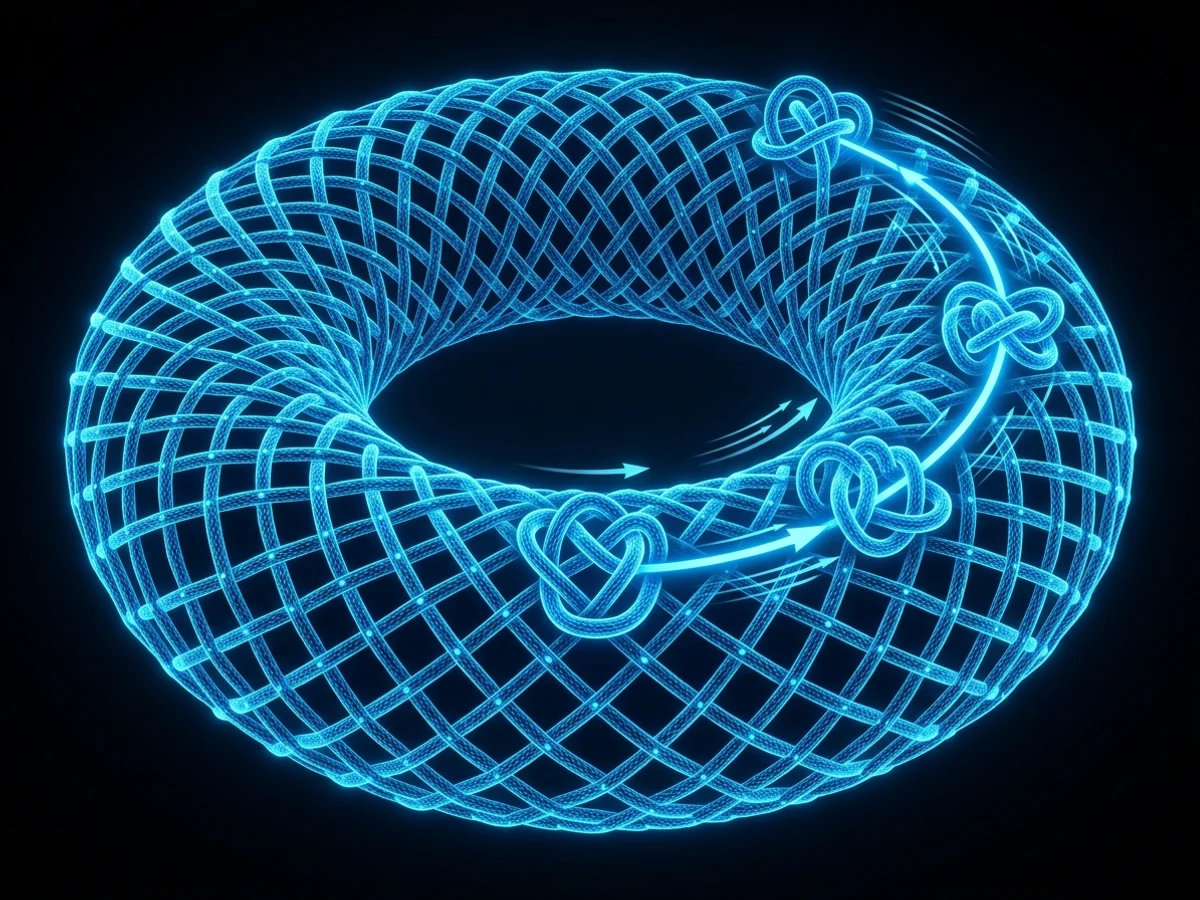
The Torus Geometry: Testing Defects on a Seamless Virtual Doughnut
A primary computational obstacle in modeling fabrics has always been edge boundary effects: stitches near garment borders behave fundamentally differently from those in the bulk fabric, obscuring intrinsic physical laws. To overcome this, the researchers projected a periodic two-dimensional lattice of loops onto a mathematical torus — a seamless, closed doughnut-shaped manifold.
Within this boundary-free digital environment, the team deliberately introduced a localized structural defect, mimicking a broken or dropped stitch. Advanced numerical algorithms then tracked the dynamical propagation of this disruption across the lattice, observing whether it triggered an irreversible cascading run (laddering) or stabilized through cooperative strain distribution.
Folding the stitch network onto a torus eliminated confounding boundary artifacts in stress calculations.
Discovered geometric conditions where a severed loop automatically locks against adjacent yarns.
Mathematical knot models facilitate designing fabrics with negative Poisson ratios for space tech.
Custom-tailored elastomeric sleeves provide directed kinematic motion without mechanical hinges.
Classifying Knittable Fabrics and Topological Jamming
The simulations revealed a sharp topological division across textile architectures. Genuine knitted structures — such as stockinette, garter stitch, and crochet networks — exhibited an innate topological self-jamming mechanism. When a single loop severed, neighboring stitches shifted in a manner that dramatically elevated local frictional contact, effectively locking the breach and preventing further degradation.
In contrast, non-knittable lattice topologies lacked this geometric damping, causing localized flaws to propagate indefinitely across the entire surface. This crucial finding enabled the authors to establish a predictive topological criterion that distinguishes resilient textiles from inherently unstable arrangements.
«In knot theory, the topology of a knot describes crossings that cannot be undone without cutting the strand. Fabricating a textile essentially creates a gigantic knot. Our framework bridges ancient crafting traditions with modern differential geometry, allowing engineers to design materials with programmed damage resistance.»
Dr. Daisuke S. Shimamoto, Senior Researcher at Ritsumeikan University
From Smart Wearables to Auxetic Metamaterials and Soft Robotics
The implications of Dr. Shimamoto’s topological discovery extend far beyond everyday apparel. In modern materials science, the controlled entanglement of macromolecular chains, protein filaments, and synthetic polymers determines the fracture toughness of advanced composites.
By leveraging topological defect mitigation, engineers can now fabricate auxetic metamaterials — structures that expand laterally rather than narrow when stretched. Such custom-engineered textiles are vital for next-generation astronaut spacesuits, impact-resistant ballistics, and lightweight aerospace structural membranes.
- Establishes the first rigorous knot theory framework to define and classify the knittability of entangled textiles.
- Demonstrates that knitted fabrics arrest defects through localized geometric self-jamming of neighboring loops.
- Provides direct applications for high-durability cardiovascular grafts, soft robotic actuators, and astronaut suits.
- Enables predictive engineering of fracture-resistant fabrics without altering fiber chemistry.
Biomedical Implants and Soft Actuator Skins
In soft robotics, pneumatic actuators require flexible, tear-resistant sleeves capable of enduring millions of inflation cycles without mechanical fatigue. Topologically optimized knitting enables seamless elastomeric skins that direct robotic movement along predefined geometric vectors without bulky mechanical joints.
In regenerative medicine, these mathematical principles pave the way for bioengineered vascular grafts and cardiac patches. By closely replicating the nonlinear compliance of natural human tissue, topological implants eliminate localized shear stress and minimize the risk of arterial wall rupture under pulsating hemodynamic pressure.
The Future of Topological Material Architecture
This pioneering Japanese study highlights how pure mathematical concepts — knot theory, algebraic topology, and manifold geometry — directly solve high-stakes engineering challenges. The research team is currently adapting the framework to advanced industrial 3D knitting machines for automated aerospace part manufacturing.
By calculating failure envelopes and defect pathways before a single thread is spun, researchers are ushering in a new era of programmable materials where durability is woven directly into geometry.