

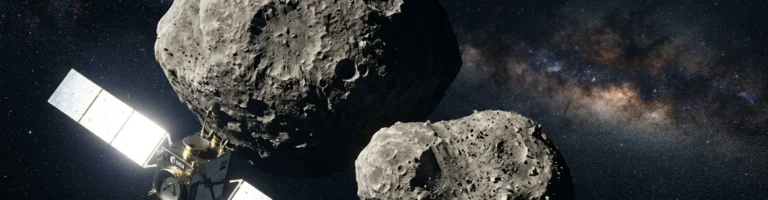

In October 2026, the European Space Agency’s (ESA) Hera robotic probe reached the binary near-Earth asteroid system Didymos and its companion moonlet Dimorphos. Four years after NASA’s kinetic impactor spacecraft DART deliberately slammed into Dimorphos at 22,500 km/h, Hera has initiated an unprecedented post-impact investigation, transforming kinetic asteroid deflection from an experimental gamble into a proven planetary defense capability.
Completing the Four-Year Cruise and Critical Braking Burn
Launched in October 2024, the Hera spacecraft journeyed hundreds of millions of kilometers through interplanetary space, leveraging a critical Mars gravity assist in early 2025. In October 2026, Hera executed a flawless 93-minute orbit insertion burn, matching velocities with the Didymos binary system and transitioning into close-proximity orbital operations.
The primary scientific focus is the 160-meter-wide moonlet Dimorphos, which orbits the 780-meter primary asteroid Didymos. NASA’s September 2022 collision shifted Dimorphos’s orbital period by a staggering 33 minutes, demonstrating an immense momentum enhancement driven by high-velocity impact ejecta.
Impact Crater or Total Structural Reshaping?
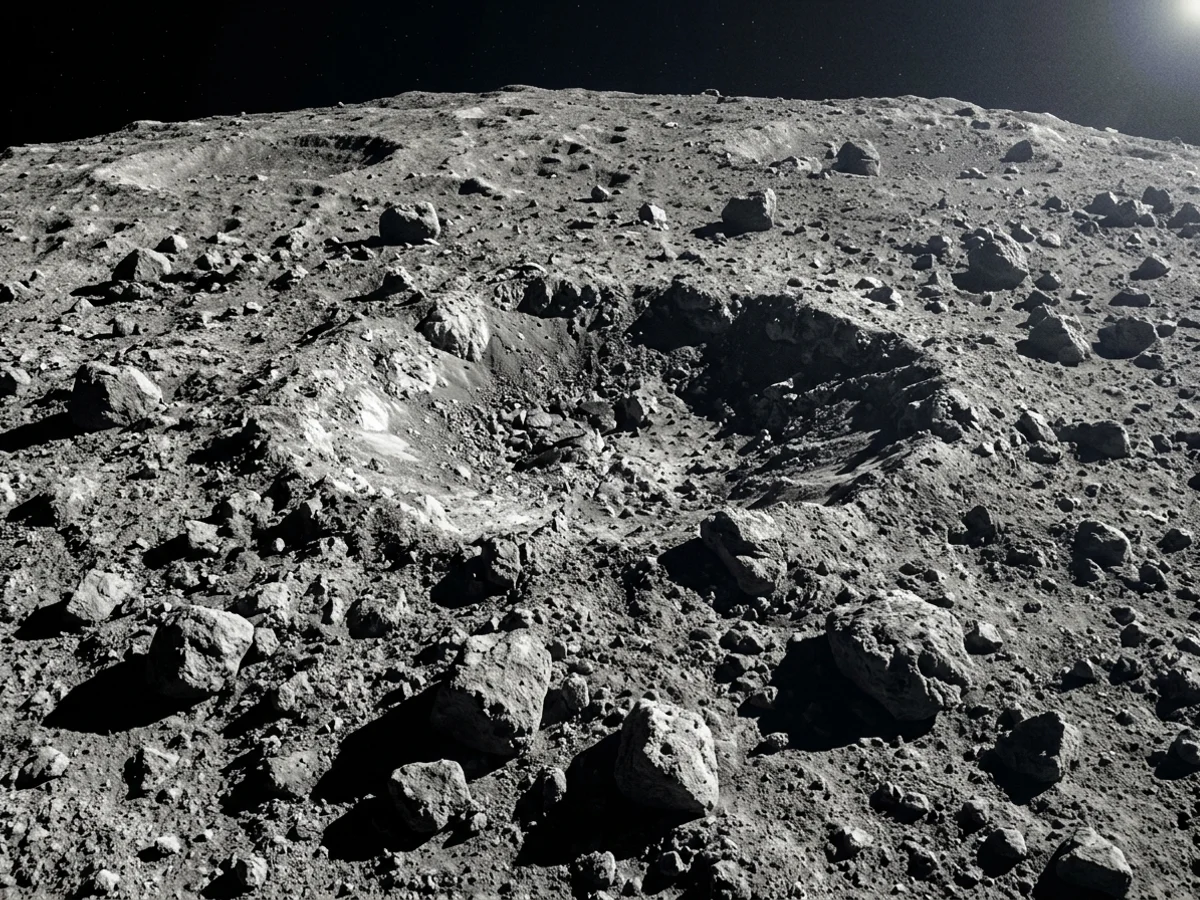
Initial close-range observations from Hera’s Asteroid Framing Camera revealed an astonishing revelation: instead of carving a conventional circular bowl crater, the DART impact caused global structural reshaping of Dimorphos.
As a loosely bound gravitational rubble pile, Dimorphos absorbed the kinetic shock wave through collective readjustment of constituent boulders. Tens of thousands of tons of regolith were expelled into space, while the asteroid elongated along its equatorial plane, leaving extensive fresh scarps and surface fissures across its monolithic blocks.
Hera fired orbit control thrusters to match orbital velocity with the asteroid pair.
The kinetic strike reorganized the loosely bound rubble pile, altering Dimorphos’s global shape.
Juventas CubeSat conducts low-frequency subsurface tomography of interior voids.
Quantifying ejecta recoil to calibrate kinetic deflection protocols for planetary defense.
Milani and Juventas CubeSats: Subsurface Radar Tomography
A cornerstone of the mission architecture is the deployment of two dedicated 6U CubeSats: Milani and Juventas. Milani carries the ASPECT imaging spectrometer to map surface mineralogy and assess space weathering alterations across both bodies.
Meanwhile, Juventas carries a specialized low-frequency monostatic radar to perform the first direct radar sounding of an asteroid’s interior. By penetrating tens of meters into the rubble pile, Juventas maps interior void spaces and mass distribution before attempting a historic low-velocity soft landing on Dimorphos.
«NASA’s DART showed the world that kinetic deflection works. Now, with Hera, we acquire the fundamental physical numbers: the precise mass of Dimorphos, its internal porosity, and the geometry of the impact crater. Without these parameters, kinetic deflection cannot be reliably modeled for a real planetary hazard.»
Dr. Patrick Michel, Hera Principal Investigator (Observatoire de la Côte d’Azur)
Momentum Transfer Factor (Beta) and Impact Physics
The core planetary defense objective centers on measuring the momentum enhancement factor, denoted as beta. If Dimorphos were a rigid monolithic rock, beta would equal 1. However, the rocket-like recoil of the ejected material amplified the kinetic transfer significantly.
Utilizing radio science Doppler tracking and laser altimetry, Hera will measure Dimorphos’s gravitational mass with an uncertainty below 1%. This enables physicists to compute the exact beta factor, establishing standard protocols for future hazardous asteroid mitigation missions.
- First direct, high-precision gravimetric mass determination of the binary asteroid moonlet Dimorphos.
- High-resolution multi-spectral mapping of the DART impact zone down to centimeter scales.
- Pioneering CubeSat landing and microgravity accelerometer profiling on an asteroid surface.
- Establishing humanity’s first standardized kinetic deflection blueprint for planetary protection.
The AIDA International Partnership for Earth Protection
Hera represents the European phase of the international Asteroid Impact and Deflection Assessment (AIDA) collaboration between ESA and NASA. It stands as humanity’s first end-to-end planetary defense validation program.
«We have proven that catastrophic asteroid impacts, unlike volcanic eruptions or earthquakes, are the only natural disaster that modern science can actively predict and prevent», stated Ian Carnelli, Hera Mission Manager at ESA.
Planetary Science and Primitive Solar System Clues
Beyond planetary defense, Hera provides vital insights into the primordial building blocks of the Solar System. Rubble pile asteroids preserve pristine material unaltered for over 4.5 billion years.
Deciphering the tensile cohesion and grain packing of Dimorphos sheds light on early planetesimal accretion mechanisms within the young Sun’s protoplanetary disk.