

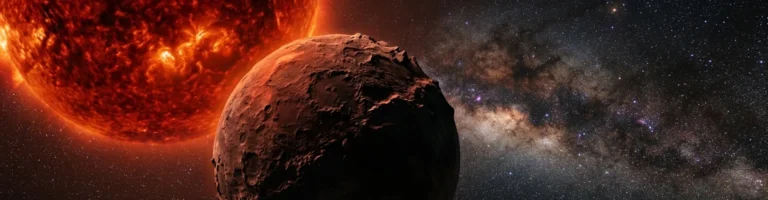

Drifting merely six light-years from Earth in the constellation of Ophiuchus lies Barnard’s Star — the closest solitary star to our solar system and the second-nearest stellar system overall, surpassed only by the triple Alpha Centauri system. For over a century, astronomers have persistently scrutinized this ancient red dwarf in search of orbiting worlds. Now, an international team led by the European Southern Observatory (ESO) has achieved a momentous discovery: using the ultra-precise ESPRESSO spectrograph on the Very Large Telescope (VLT) in Chile, astronomers have officially discovered the sub-Earth rocky exoplanet Barnard b, possessing merely half the mass of Venus, alongside compelling evidence for three additional planetary companions.
The Century-Long Quest: Historical Controversies of Barnard’s Star
Identified in 1916 by American astronomer Edward Emerson Barnard, this dim red dwarf of spectral type M4V holds the undisputed velocity record for stellar proper motion across our night sky: it traverses 10.3 arcseconds annually, covering an angular distance equivalent to the diameter of the full Moon in just 180 years. Because of this dramatic motion, it was dubbed “Barnard’s Runaway Star.”
Throughout the mid-20th century, the star was embroiled in intense astronomical controversy. In the 1960s, astronomer Peter van de Kamp announced the discovery of a gas giant planet based on perceived astrometric wobbles on photographic plates. Decades later, rigorous investigations revealed that these oscillations were spurious instrumental artifacts caused by optical realignments of the telescope lens.
In 2018, another candidate cold super-Earth on a 233-day orbit was proposed, but subsequent high-cadence spectroscopic campaigns demonstrated that the periodic Doppler variations originated from stellar magnetic activity and rotational modulation. Decades of refined instrumentation were required to disentangle real planetary gravitational tugs from stellar photospheric jitter.
Within contemporary observational efforts focused on characterizing sub-Earth exoplanets, Barnard’s Star remained the paramount target in the solar neighborhood.

The Triumph of ESPRESSO: Sub-Meter Radial Velocity Precision
The ultimate confirmation of Barnard b was achieved through the Echelle SPectrograph for Rocky Exoplanets and Stable Spectroscopic Observations (ESPRESSO), mounted on ESO’s Very Large Telescope (VLT) at Paranal Observatory in Chile. This state-of-the-art instrument delivers unprecedented radial-velocity precision of approximately 10 centimeters per second — a leisurely human walking pace.
Astronomers conducted high-cadence spectroscopic monitoring of Barnard’s Star over five contiguous years, cross-calibrating ESPRESSO data with extensive archival velocity records from HARPS, HARPS-N, and CARMENES spectrographs. Advanced Bayesian modeling and Gaussian process regression separated intrinsic stellar activity signals from genuine Keplerian orbital reflexes, isolating a periodic wobble with an amplitude of only 0.5 meters per second.
In a definitive study published in the journal Astronomy & Astrophysics, the international consortium formally established the existence of the exoplanet Barnard b.
The astonishing sensitivity of this campaign demonstrates how ultra-precise radial velocity spectroscopy pushes the frontier of exoplanetary discovery down to sub-terrestrial masses.
Barnard’s Star is located only 6 light-years from Earth, representing the second-nearest stellar system to our Sun.
Barnard b harbors a mass of just 0.37 Earth masses, making it one of the lightest exoplanets ever confirmed.
The planet orbits at 0.023 AU from its cool red dwarf parent star, maintaining an equilibrium temperature of ~125°C.
Radial velocity residuals revealed hints of three additional sub-Earth exoplanets orbiting within a compact system.
Physical Properties of Barnard b: A Scorched Sub-Earth on a 3-Day Orbit
The physical dimensions of Barnard b place it among the lightest exoplanets ever detected. It harbors a minimum mass ($M \sin i$) of roughly 0.37 Earth masses — equal to about half the mass of Venus or roughly three Mars masses. It ranks as the lowest-mass exoplanet ever uncovered via radial-velocity techniques around an adjacent solitary star.
Barnard b orbits exceptionally close to its parent red dwarf, maintaining a semi-major axis of merely 0.023 astronomical units (approximately 3.4 million kilometers) — twenty times closer than Mercury orbits the Sun. It completes one full orbital revolution around the star in just 3.15 Earth days.
Because Barnard’s Star is an intrinsically cool M-dwarf with an effective temperature of roughly 3,100 Kelvin and a luminosity merely 0.04% that of the Sun, this close orbital proximity does not vaporize the planet into magma. Thermal calculations indicate an equilibrium surface temperature of approximately 125°C (398 Kelvin).
While this surface temperature precludes the persistence of liquid water oceans, ruling out conventional habitability, it provides a pristine astrophysical testbed for investigating mantle outgassing, volatile retention, and atmospheric survival around active red dwarf stars.
«Barnard’s Star is our closest single stellar neighbor on our galactic doorstep. Discovering a planet with merely a third of Earth’s mass proves the extraordinary sensitivity of ESPRESSO. We are standing on the threshold of uncovering entire families of rocky worlds around low-mass stars right in the solar neighborhood.»
Dr. Jonay González Hernández, Lead Researcher at the Instituto de Astrofísica de Canarias (IAC)
A Compact Retinue: Evidence for a Multi-Planet System Around Barnard’s Star
The discovery of Barnard b revealed only the first chapter of a broader architectural story. Upon subtracting the Keplerian solution for Barnard b, the residual velocity signals exhibited three distinct periodicities that cannot be accounted for by stellar magnetic cycles.
The strongest candidate signal suggests a second planet with an orbital period of 4.12 days; a third candidate exhibits a period of 2.34 days; and a fourth candidate indicates a period of 6.74 days. All three putative companions possess sub-Earth masses and orbit within the compact interior architecture of the system.
Should these candidates receive definitive spectroscopic confirmation, Barnard’s Star will represent a compact multi-planet system of terrestrial sub-Earths analogous to the famed TRAPPIST-1 system, demonstrating that low-mass M-dwarf stars routinely foster rich planetary broods tightly packed within sub-tenth-AU domains.
- Barnard b was discovered using the ESPRESSO spectrograph on ESO’s Very Large Telescope in Chile.
- Barnard’s Star exhibits the fastest proper motion of any known star in the night sky (10.3 arcseconds per year).
- The host star’s low luminosity (0.04% of the Sun) keeps the planet at a moderate 125°C despite its close orbit.
- The upcoming 39-meter Extremely Large Telescope (ELT) will attempt direct atmospheric spectroscopy of this sub-Earth.
The Observational Horizon: Atmospheric Probing with the ELT and Interstellar Probes
The extreme proximity of Barnard’s Star (a distance of just 1.8 parsecs) establishes it as a prime observational candidate for next-generation astrophysics. When the 39-meter Extremely Large Telescope (ELT) commences operations in Chile’s Atacama Desert, its ANDES high-resolution spectrograph will be uniquely equipped to attempt direct spectroscopic characterization of the system.
Combining advanced coronagraphic masks with extreme adaptive optics, the ELT will seek to isolate reflected starlight from Barnard b, probing its atmosphere for spectroscopic signatures of carbon dioxide, nitrogen, or water vapor.
Looking toward the mid-21st century, Barnard’s Star is an optimal destination for directed-energy interstellar nanoprobes under the Breakthrough Starshot initiative. Propelled by phased laser arrays to 20% the speed of light, miniature probes could reach Barnard b in approximately three decades, transmitting back mankind’s first close-up visual images of an alien terrestrial world.
The discovery of Barnard b proves that the cosmic void directly surrounding our solar system is brimming with exotic rocky worlds awaiting detailed exploration.