


South Korean engineers have achieved a historic milestone in mobile robotics: the quadrupedal robot RAIBO2 has become the world’s first legged robot to complete a full 42.195 km (26.2-mile) marathon on a single battery charge. Navigating an official course in 4 hours, 19 minutes, and 52 seconds at an average speed of 9.7 km/h, the robot finished with 34% battery life still remaining. The groundbreaking research is formally featured in the main edition of the journal Nature.
A longstanding bottleneck for legged robotic platforms (including Boston Dynamics’ Spot) has been power consumption: conventional quadruped motors typically drain batteries in under 90 minutes. While artificial intelligence has endowed machines with staggering conversational and cognitive reasoning—as seen with the Figure 01 humanoid robot developed with OpenAI—mechanical energy efficiency remains the deciding factor for autonomous field deployment.
Engineering Architecture: Regenerative Braking and Custom Joints
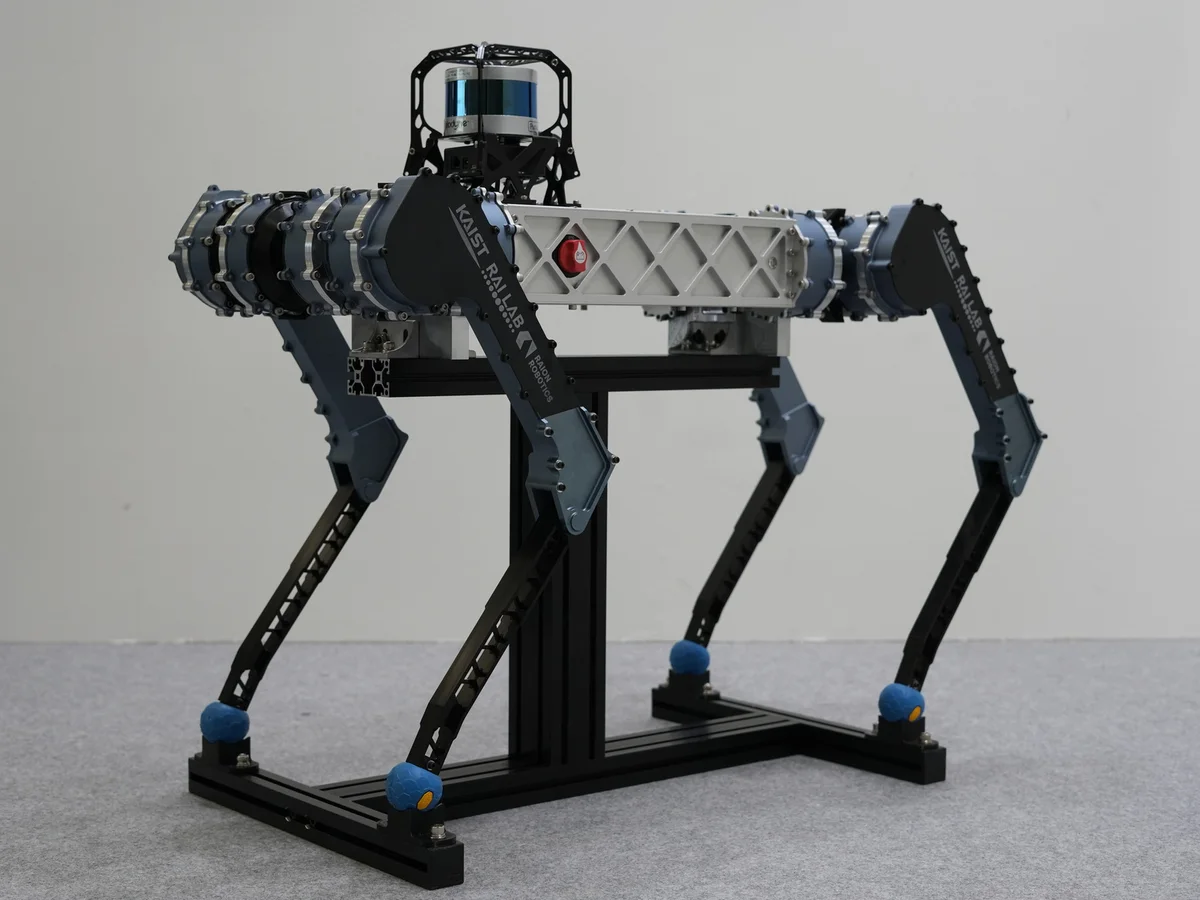
Developed by the Robotics & Artificial Intelligence Lab at the Korea Advanced Institute of Science and Technology (KAIST) under Professor Jemin Hwangbo (Jemin Hwangbo), RAIBO2 abandoned the brute-force approach of simply adding heavy batteries, which increases inertial drag and rapidly consumes torque.
«We optimized whole-system efficiency across mechanics, electronics, and algorithms. Our high-torque transparency joint mechanisms exhibit virtually zero backlash, allowing the actuators to act as regenerative generators on downhills and foot swings, recovering up to 20% of energy».
Jemin Hwangbo (Jemin Hwangbo), project lead and professor of mechanical engineering at KAIST
Unprecedented Transport Efficiency (TCOT): RAIBO2 achieved a Total Cost of Transport score of just 0.248. For comparison, trained human marathoners run at a baseline of approximately 0.37, while existing commercial robot dogs range between 0.8 and 1.5. RAIBO2 is demonstrably more energy-efficient than a human runner!
Reinforcement Learning in RaiSim Simulator
The marathon course in Sangju presented harsh real-world conditions: two substantial 50-meter elevation climbs, irregular asphalt patches, and sharp descents. Instead of rigid trajectory programming, the robot’s gait was trained via deep reinforcement learning within the proprietary RaiSim simulation environment.
Operating at a control frequency of 1,000 Hz, the control policy dynamically modulates joint stiffness to prevent foot slippage and minimize ground impact shock. When descending slopes, the controller commands regenerative braking, transforming gravitational potential energy directly into stored electrical charge.
- Platform mass: 42 kg, mirroring the scale of an adult dog.
- Projected operating range: with 34% battery remaining post-marathon, the platform has an estimated range exceeding 65 km on a single charge.
- Endurance mission duration: up to 8 continuous hours of autonomous surveillance or transport.
Real-World Search-and-Rescue and Inspection Deployments
Thermal accumulation has historically crippled long-duration legged robotics missions. Under sustained cyclic locomotion, electric motor coils sealed within robotic limb chassis routinely escalate to 80–100 °C, inducing thermal throttling or abrupt shutdown. In RAIBO2, KAIST engineers incorporated an aerodynamic convective thermal management architecture that utilizes airflow generated by leg swing motions, maintaining internal actuator core temperatures below 45 °C throughout all four continuous hours of running.
Furthermore, custom compliant joint decoupling dampens shock impacts transmitted to precision gearbox bearings by 40% compared to rigid direct drives. This mechanical buffering ensures structural survivability across thousands of operational kilometers without requiring field overhauls or component replacement.
RAIBO2 solves the operational handicap that has previously kept legged robots confined to short demonstrations. The endurance breakthrough paves the way for extended wilderness search-and-rescue, continuous perimeter security along expansive industrial sites, and disaster zone reconnaissance where recharging infrastructure is unavailable.
KAIST spin-off venture Raion Robotics is currently commercializing the platform for industrial rollout. The complete paper, marking South Korea’s first robotics publication in the primary edition of Nature, is published in Nature.