


An international team of astronomers has confirmed the discovery of Elias 2-24 b, the youngest exoplanet ever documented by science. With an estimated age of less than one million years, this newborn giant world is an astronomical infant, still actively accreting gas and dust from the protoplanetary disk orbiting its parent star.
Prior to this milestone, the title of the youngest known planets belonged to gas giants like those in the PDS 70 system, aged at roughly 5 million years. However, Elias 2-24 b presents a fundamental challenge to prevailing planet formation models: standard core accretion theory suggests that forming a Jupiter-mass giant at such vast distances takes millions of years. This discovery echoes previous paradigm shifts, such as when researchers discovered a phoenix planet candidate reborn around a white dwarf, rewriting planetary evolution timelines.
From a Protoplanetary Disk Gap to Direct Planet Detection
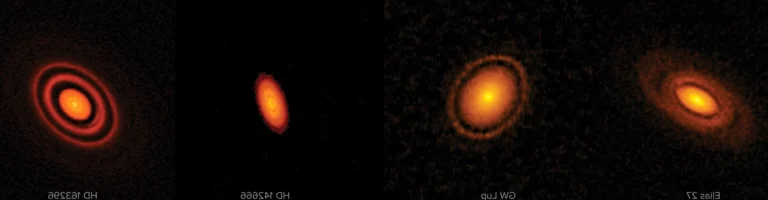
The young star Elias 2-24 lies approximately 450 light-years away in the Ophiuchus star-forming complex. Nearly a decade ago, observations by the Atacama Large Millimeter/submillimeter Array (ALMA) in Chile revealed a prominent circular gap in the dusty disk at a distance of about 55 astronomical units (AU) from the central star (nearly double the distance from the Sun to Neptune).
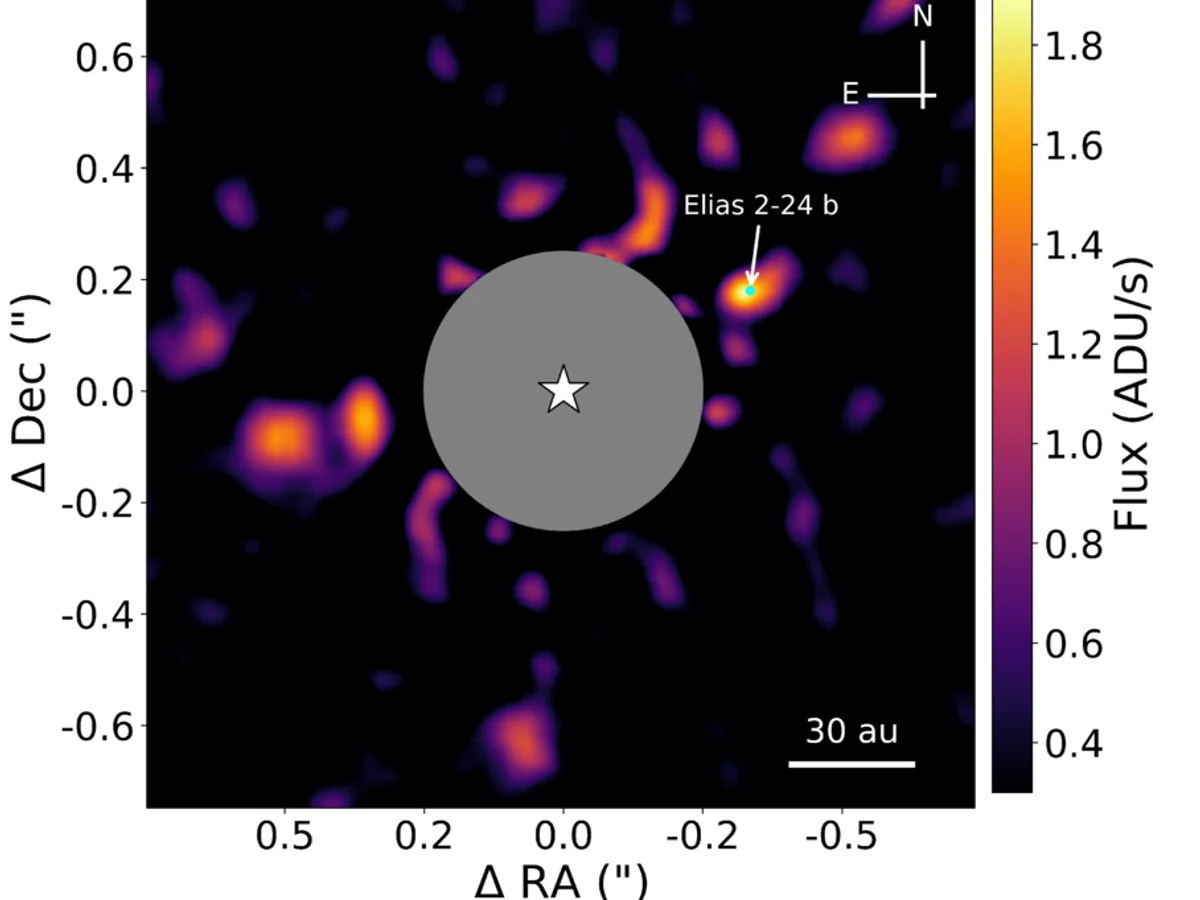
Astrophysicists hypothesized that a forming planet was gravitationally sweeping clean this ring of dust. However, directly detecting the faint thermal emission of the planet next to its bright host star proved elusive. The breakthrough came from a team led by astronomer Andrea Bernardi (Andrea Bernardi) at the Universidad Diego Portales in Chile.
«By re-evaluating high-contrast archival infrared data from the Keck Observatory’s NIRC2 coronagraph gathered in 2018 and 2020, we detected a faint point source tracking the star’s orbital motion precisely inside the disk gap».
Andrea Bernardi (Andrea Bernardi), lead author and astrophysicist at Universidad Diego Portales
Physical properties of Elias 2-24 b: The planet’s estimated mass ranges between 1.9 and 4.0 times that of Jupiter. Orbiting at 55 AU, its glowing atmospheric temperature remains above 1,000 °C due to gravitational contraction and ongoing infalling matter from its circumplanetary disk.
How Did a Giant Planet Form in Under One Million Years?
The existence of a multi-Jupiter-mass planet at such an early epoch challenges standard planet-formation physics. Classical core accretion posits that rocky planetesimals slowly collide to build a 10-Earth-mass core before rapidly drawing in gas. In the sparse outer regions of a disk at 55 AU, this accretion process typically requires 3 to 10 million years.
Because Elias 2-24 b reached maturity in a fraction of that time, astronomers are investigating alternative evolutionary scenarios:
- Gravitational Disk Instability: Dense clumps of the protoplanetary disk may have collapsed under self-gravity within thousands of years, similar to star formation.
- Pebble Accretion: Millimeter-sized pebbles slowed down by aerodynamic gas drag could have fed the young core at orders-of-magnitude faster rates than traditional planetesimal collisions.
- Rapid Migration: The planet may have initially formed closer to the host star in denser environments before migrating outward through orbital resonances.
Implications for Planetary Science
Elias 2-24 b offers an unparalleled natural laboratory for directly probing the early stages of planetary architecture. Watching how matter streams onto the circumplanetary disk will clarify how giant moons form around planets like Jupiter and Saturn.
The landmark research is formally published in The Astrophysical Journal Letters. Upcoming spectroscopic observations with the James Webb Space Telescope (JWST) will measure atmospheric carbon-to-oxygen ratios, potentially resolving whether the planet collapsed directly or grew via rapid pebble accretion.