

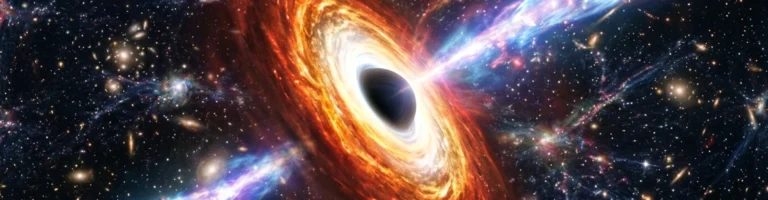

The James Webb Space Telescope has propelled modern astrophysics into its most exhilarating theoretical crisis in decades: peering into the cosmic dawn, its infrared eyes have unveiled billion-solar-mass quasars whose existence cannot be reconciled with standard cosmological models of stellar evolution.
When astrophysicists first trained the NIRCam imaging arrays and NIRSpec spectrometers of the James Webb Space Telescope (JWST) toward ultra-deep cosmological redshifts ($z > 6-7$), the consensus expectation was to glimpse faint, nascent proto-galaxies harboring modest clusters of first-generation stars. Instead, the cosmic abyss erupted with incandescent gravitational powerhouses: supermassive quasars blazing with the luminosity of trillions of suns. The photons captured by the Webb telescope departed these monsters when the universe was barely 500 to 700 million years old—an eye-blink accounting for less than 5% of cosmic history since the Big Bang.
The core paradox resides in the foundational physics of accretion. Growing a black hole exceeding one billion solar masses from the stellar-mass remnant of a Population III star requires billions of years of uninterrupted mass feeding. Yet the empirical data from JWST is unequivocal: these colossal singularities were already fully assembled, commanding vast galactic ecosystems when primordial hydrogen gas clouds had scarcely begun to cool.
The Eddington Limit and the Mathematical Impasse of Accretion Growth
At the bedrock of classical accretion theory lies the Eddington limit. As primordial gas spirals into the gravitational well of a black hole, extreme shear viscosity and differential rotation compress the infalling matter into a blazing accretion disk heated to millions of Kelvin, liberating tremendous fluxes of ionizing ultraviolet and X-ray radiation.
The outward radiation pressure exerted by these photons counters the inward pull of gravity. When the Eddington threshold is reached, radiation pressure violently drives the surrounding gaseous reservoir outward, choking off further infall. The timescale required for an accreting black hole to double its mass under continuous Eddington accretion—termed the Salpeter timescale—is rigidly constrained to roughly 45–50 million years. Even if a 100-solar-mass seed formed immediately after the cosmic dark ages, it could not mathematically attain a billion solar masses by redshift $z = 7$.
Cosmologists thus confront an inescapable divergence: either matter accretion bypassed the Eddington barrier via geometrically thick, super-Eddington choke flows, or the initial black hole seeds were orders of magnitude more massive than any single stellar collapse could generate.
«Finding such colossal quasars in the universe’s infancy is the cosmological equivalent of walking into a kindergarten and discovering a six-foot-six Olympic heavyweight champion sitting in a crib. Nature found a shortcut that our models failed to anticipate.»
Roberto Maiolino, Professor of Experimental Astrophysics, University of Cambridge
The Direct Collapse Paradigm: Heavy Primordial Seeds in the Infant Universe
To resolve this chronological crisis, theoretical astrophysicists developed the Direct Collapse Black Hole (DCBH) model. In the pristine infant universe, massive protogalactic clouds containing hundreds of thousands of solar masses of primordial hydrogen and helium were susceptible to catastrophic monolithic collapse. Ordinarily, such clouds cool via molecular hydrogen ($H_2$) transitions, fragmenting into low-mass stellar nurseries.
However, if bathed in an intense background of Lyman-Werner ultraviolet radiation emitted by neighboring starburst galaxies, molecular hydrogen is photodissociated into atomic hydrogen. Denied efficient molecular cooling, the colossal gas cloud bypasses fragmentation entirely. The cloud collapses as a coherent monolithic structure under its own relentless self-gravity, forging a seed black hole of $10^4$ to $10^6$ solar masses directly within the event horizon without ever igniting a thermonuclear stellar phase.
A heavy seed possessing an initial mass of $10^5$ solar masses easily reaches supermassive quasar status within the abbreviated cosmological timeframe. Infrared instruments aboard JWST are rigorously scanning the high-redshift universe for distinctive spectral fingerprints of DCBH candidates, notably ionized helium He II $lambda 1640$ emission unpolluted by metallic absorption features.
Super-Eddington Accretion Flows
Thick slim-disk accretion configurations allow dense gas to funnel rapidly into the event horizon along equatorial planes, while radiation escapes through narrow polar funnels without throttling accretion.
Direct Collapse Black Holes (DCBH)
Pristine atomic gas clouds exceeding $10^5$ solar masses collapse directly into gravitational singularities when molecular cooling is suppressed by intense external Lyman-Werner ultraviolet flux.
Primordial Black Holes (PBH)
Non-stellar singularities formed from extreme density perturbations during cosmic inflation in the first fraction of a second post-Big Bang, serving as pre-assembled gravitational anchors.
Hyper-Dense Cluster Mergers
Runaway stellar collisions in dense protogalactic cores formed quasi-stars: immense radiating envelopes powered from the inside out by growing black hole cores.
Relativistic Physics: Tidal Disruptions and Relativistic Plasma Jets
Early quasars served as cosmic arenas of extreme relativistic mechanics. Stars wandering within the tidal radius of these monsters were ruthlessly captured and shredded through spaghettification—a phenomenon detailed in our investigation of how a supermassive black hole devours a wandering star in extreme gravitational encounters.
In the dense environments of the early universe, tidal disruption rates and compact binary coalescences occurred at frequencies hundreds of times higher than today. Intense twisted poloidal magnetic fields in the inner accretion disk launched relativistic plasma jets piercing deep into intergalactic space at fractions of light speed. This quasar feedback deposited immense kinetic energy, quenching star formation and dictating host galaxy co-evolution.
Astoundingly, JWST observations suggest that black holes in the early universe accounted for up to 10% to 20% of their host galaxies’ total stellar mass, whereas in the modern epoch that ratio is a meager 0.1%. Black holes were not merely secondary tenants inhabiting galaxies; they were the cosmic architects actively sculpting the earliest structures in the universe.
Cosmological Implications: Challenging the Standard $Lambda$CDM Model
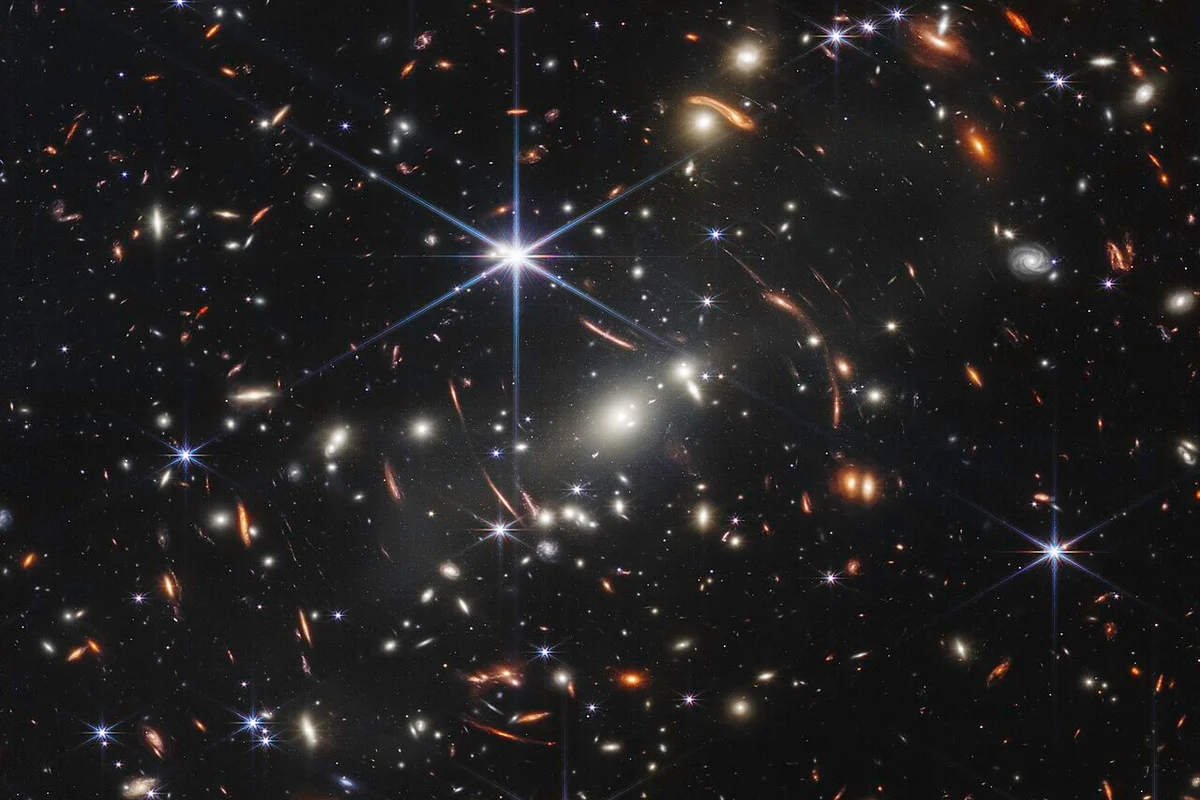
The standard $Lambda$CDM cosmological paradigm dictates that large-scale cosmic structure develops hierarchically, with small dark matter halos merging gradually into expansive halos over gigayears. The breathtaking discoveries from the Webb telescope challenge this bottom-up dogma by revealing hyper-accelerated mass assembly.
If these quasars originated from primordial black holes generated during inflation, the standard model of inflationary cosmology will require significant restructuring. If super-Eddington mechanisms dominate, relativistic plasma magnetohydrodynamics near the event horizon must be comprehensively revised.
Key Astrophysical Fact: The most distant spectroscopically confirmed quasar at $z approx 7.5$ harbors a black hole of 1.6 billion solar masses. Classical Eddington growth requires at least 800 million years of continuous feeding—exceeding the total age of the universe at that epoch.
Future Observational Horizons: Gravitational Waves and LISA
The definitive verdict on black hole genesis will emerge from next-generation space missions. While electromagnetic telescopes observe accretion emission from luminous disks, the earliest seeds and dense mergers are frequently cloaked behind thick veils of gas and dust.
The upcoming Laser Interferometer Space Antenna (LISA), slated for launch by ESA and NASA, will monitor low-frequency gravitational waves emitted during the coalescence of intermediate-mass black holes across the visible horizon, capturing seed mergers directly in gravitational spacetime ripples.
The James Webb Space Telescope has ushered in a golden era of discovery. Far from being simple cosmic sinks, early quasars were primary engines of evolution, reshaping our understanding of gravity, matter, and the origin of our cosmos.