

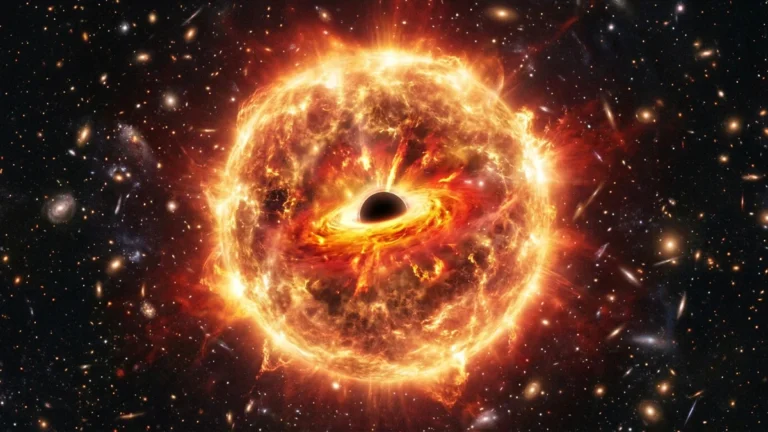

In the cosmic theater, no gravitational cataclysm matches the raw, sheer violence of a Tidal Disruption Event (TDE) — the catastrophic destruction of an errant star straying too close to a supermassive black hole’s event horizon. Over the span of hours, relentless tidal shear forces stretch an entire stellar body into a filament of hyperheated plasma, releasing an energetic torrent that outshines the combined starlight of its host galaxy for months.
The Roche Limit and the Critical Tidal Capture Radius
Every supermassive black hole—possessing masses spanning millions to billions of solar equivalents—is enveloped by an invisible boundary of destruction: the tidal radius (Roche limit). For a solar-mass star, this demarcation lies tens of millions of kilometers from the singularity. When gravitational three-body interactions scatter a star onto an eccentric plunge trajectory across this threshold, its destruction is absolute.
Tidal tensors act with asymmetric severity: the black hole’s gravity fiercely compresses the stellar envelope perpendicularly while stretching it radially along the infall vector. Known in theoretical astrophysics as spaghettification, this rapid shear transforms a spherical star exceeding one million kilometers in diameter into an ultra-dense plasma ribbon hundreds of millions of kilometers long within minutes.
The Fate of Stellar Debris: Orbital Mechanics of the Plasma Stream
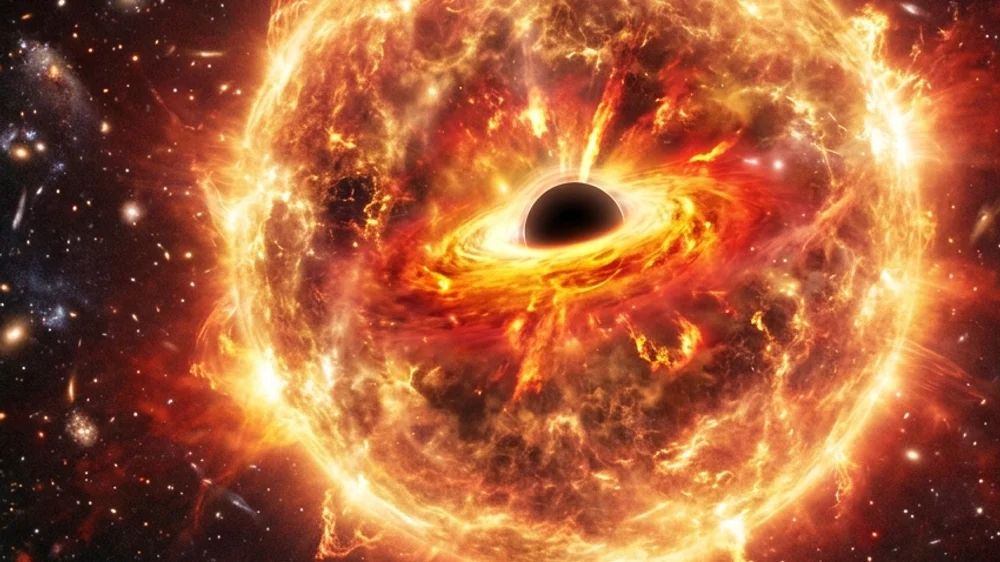
Contrary to popular misconception, the black hole does not swallow the entire stellar mass instantaneously. Under Keplerian and relativistic orbital mechanics, approximately half of the disrupted mass becomes unbound, absorbing kinetic energy and escaping into the intergalactic void as an expansive hypersonic hyperbolic stream.
The remaining 50% remains gravitationally bound, returning along eccentric trajectories toward pericenter. The returning debris stream violently collides with itself at near-light speeds, inducing self-intersection shock fronts. This intense hydrodynamic dissipation circularizes the stellar remnants into an ultra-luminous accretion disk reaching millions of degrees Kelvin.
Extreme tidal shear forces squeeze the star laterally and stretch it into a stream within minutes.
Half of the stellar material is violently flung into intergalactic space on unbound orbits.
Blandford-Znajek magnetic mechanisms accelerate particles to 99.99% the speed of light.
X-ray reverberation mapping precisely tracks frame dragging around the spinning Kerr horizon.
Relativistic Jets: Nature’s Premier Cosmic Particle Accelerators
In high-spin configurations where the central black hole possesses rapid Kerr frame dragging, the Blandford-Znajek mechanism can activate. Twisted, ultra-strong magnetic flux ropes thread the ergosphere, tapping the black hole’s rotational energy to launch collimated relativistic plasma jets aligned with the spin axis.
Particles within these jets are accelerated to 99.99% of the speed of light, emitting synchrotron radiation, teraelectronvolt gamma rays, and ultra-high-energy astrophysical neutrinos. Global observatories—including the James Webb Space Telescope, Hubble, and NASA’s Chandra X-ray Observatory—track these luminous beacons across billions of light-years.
«When a star crosses the tidal radius of a supermassive black hole, the gravitational gradient between its near and far hemispheres overwhelms its self-gravitational binding energy. The star doesn’t just fall — it is ripped apart from within in a process of extreme spaghettification, producing a luminous relativistic debris stream.»
Dr. Suvi Gezari, Chair of the Science Staff and Astronomer, Space Telescope Science Institute (STScI)
The X-Ray Corona and Relativistic Reverberation Mapping
During the mature phases of the accretion disk, temperatures adjacent to the innermost stable circular orbit (ISCO) soar to tens of millions of degrees. The fully ionized plasma produces copious soft and hard X-ray photons. By analyzing Doppler-shifted relativistic iron K-alpha emission lines, astronomers map spacetime curvature around the black hole with unprecedented fidelity.
TDEs serve as extraordinary natural laboratories for Einstein’s General Relativity, providing ideal empirical environments to test Lense-Thirring frame dragging and event horizon physics under extreme gravitational potentials unreachable in terrestrial physics facilities.
- Total isotropic energy release exceeds 10⁴⁴ Joules, surpassing the cumulative mechanical yield of a typical core-collapse supernova.
- Peak UV and optical luminosity rivals or exceeds the host galaxy’s integrated light output for months.
- Jetted relativistic outflows occur in roughly 1% of the most extreme rapidly spinning Kerr black hole interactions.
- Coincident detection of PeV-scale astrophysical neutrinos confirms TDEs as dominant extragalactic cosmic ray engines.
Volumetric Rates and the Frontier of the Vera C. Rubin Observatory
Within any single Milky Way-class galaxy, a tidal disruption event is exceedingly rare, occurring roughly once every 10,000 to 100,000 years. Yet within the observable universe’s vast census of hundreds of billions of galaxies, thousands of stars are undergoing tidal disruption at any given moment.
With the commissioning of the Vera C. Rubin Observatory in Chile and its 3.2-gigapixel Legacy Survey of Space and Time (LSST), researchers anticipate detecting thousands of transient TDEs annually, unlocking a golden era in supermassive black hole demographic mapping.