

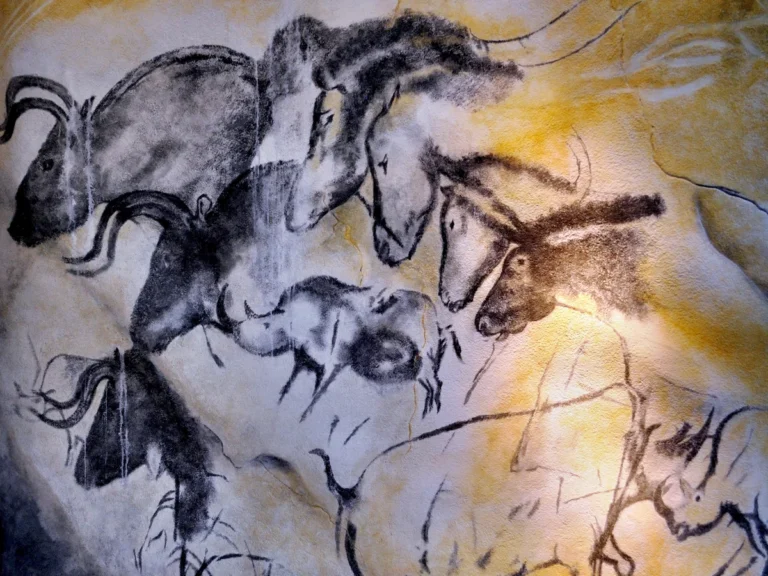

For more than thirty-seven millennia, some of humanity’s earliest and most breathtaking artistic triumphs remained hidden in total darkness within deep limestone galleries in southern France, surviving in such immaculate condition that they seem completed only yesterday. The world-renowned cave art in Chauvet Cave (Grotte Chauvet-Pont-d’Arc) has long astonished archaeologists and conservators: how could fragile, unfixed charcoal drawings endure tens of thousands of years in the humid atmosphere of an underground karst cave? An international research team led by prominent archaeometrist Philippe Walter from Sorbonne University and the French National Centre for Scientific Research (CNRS) has finally cracked the puzzle. In a breakthrough study published in ACS Omega, researchers demonstrated that the prehistoric drawings are coated with an ultra-thin, invisible layer of translucent calcite — a natural mineral varnish that hermetically sealed the ancient pigment against decay.
The Paleolithic Masterpiece: The Enduring Wonder of Chauvet-Pont-d’Arc
The discovery of Chauvet Cave in December 1994 by French speleologists Jean-Marie Chauvet, Éliette Brunel, and Christian Hillaire sent shockwaves throughout the global archaeological community. Deep inside the limestone cliffs of the Ardèche gorge, explorers uncovered over four hundred monumental compositions depicting more than one thousand animals from fourteen distinct species. While famous Franco-Cantabrian sites such as Lascaux and Altamira primarily portray game animals, Chauvet is dominated by formidable apex predators of the Pleistocene epoch: cave lions, giant cave bears, woolly rhinoceroses, leopards, and stampeding bison.
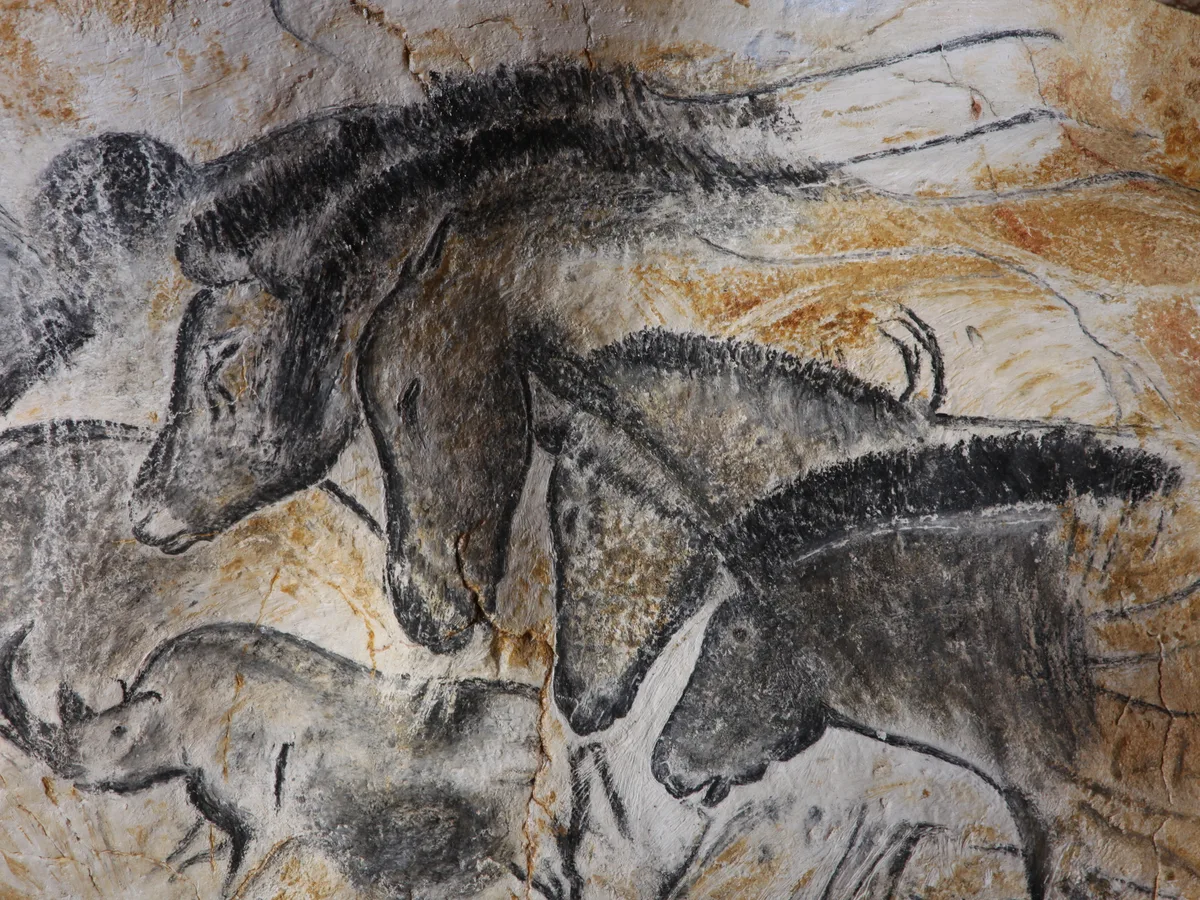
The extraordinary anatomical precision, masterful perspective, charcoal shading (estompe), and kinetic energy captured on the rock initially caused several art historians to question the timeline, assuming such sophisticated works had to belong to the much later Magdalenian culture. However, comprehensive accelerator mass spectrometry (AMS) radiocarbon dating conclusively established that the prime panels, including the Panel of the Horses and the Megaloceros Gallery, were crafted between 36,000 and 38,000 years ago during the Aurignacian period, shortly after anatomically modern humans arrived in Europe.
Yet the greatest scientific mystery of Chauvet remained its pristine preservation. Charcoal pigment, held onto rough vertical limestone walls solely by weak Van der Waals attractions and mechanical adhesion, had neither crumbled into dust nor been washed away by condensed water or digested by microbial biofilm. For tens of thousands of years, the charcoal outlines remained startlingly sharp, defying ordinary geomorphological expectations of underground rock weathering.
Strict Conservation Protocols: Studying Masterpieces from a Distance
Having witnessed the tragic deterioration of Lascaux and Altamira due to massive tourist influxes, artificial lighting, and invasive fungal outbreaks, the French authorities took unprecedented measures to protect Chauvet. From its very discovery, the cave was permanently sealed off from the general public. While a magnificent full-scale replica (Grotte Chauvet 2) was constructed nearby for visitors, access to the authentic subterranean sanctuary was restricted exclusively to tiny scientific teams for only a few weeks each year.
Within the cave, scientists are strictly required to walk along elevated stainless-steel catwalks barely one meter wide, wearing sterile suits and specialized protective footwear. Stepping onto the prehistoric cave floor is strictly illegal: the clay sediments remain an untouched archaeological time capsule. They preserve ancient cave bear hibernation nests, scattered Pleistocene skeletons, charred torch fragments, and even the fossilized footprint of an eight-year-old child who walked through the darkness thirty thousand years ago.
These vital conservation rules presented a formidable obstacle for analytical chemists. The permanent walkways sit roughly two to three meters away from the primary painted walls. Destructive physical sampling or scratching even a microgram of charcoal from the cliff faces was absolutely forbidden, as any invasive contact would permanently degrade the fragile Paleolithic imagery.
«Our remote spectroscopic investigation allowed us to peer beneath the microscopic surface of these masterworks without endangering humanity’s priceless cultural heritage. We discovered that nature itself applied an ultra-thin crystalline shield of calcium carbonate over the fragile charcoal strokes, acting like a perfect Paleolithic protective varnish.»
Professor Philippe Walter, lead researcher and archaeometrist, Sorbonne University / CNRS
Remote UV Fluorescence Spectroscopy: Cave Art in Chauvet Cave in a New Light
To overcome this distance barrier without endangering the priceless artwork, a scientific research team led by Professor Philippe Walter of Sorbonne University and the CNRS engineered a custom, highly sensitive mobile optical instrument. The researchers mounted an ultra-lightweight optical probe equipped with high-intensity ultraviolet LEDs emitting at a wavelength of 365 nanometers alongside a fiber-optic collector onto a 2.5-meter telescopic carbon-fiber pole. This setup allowed the team to extend the sensor directly from the catwalk to within millimeters of the cave wall without touching the surface.
Ultraviolet fluorescence spectroscopy works by exciting molecular electron transitions in surface minerals and capturing the resulting luminescence emission spectra. Because distinct mineral phases, binding residues, sulfates, and carbonate varieties emit light at highly specific characteristic wavelengths, the non-destructive technique acts as a chemical fingerprinting tool that instantly differentiates surface layers in real time.
The optical measurements collected from the Panel of the Horses delivered a decisive breakthrough. The sensors detected a robust, sharp luminescence signature corresponding precisely to ordered crystalline calcite containing trace manganese ions. Quantitative spatial mapping revealed that across the charcoal drawings, the black pigment is completely enveloped by an ultra-thin, continuous layer of translucent calcite that is totally invisible under ordinary ambient lighting or white halogen torches.
The Aurignacian masterpieces retain crisp charcoal shading, anatomical subtleties, and intense dynamic realism across limestone walls.
Non-destructive optical measurements were conducted via a 2.5-meter carbon-fiber pole from metal walkways without touching the rock.
Microcrystalline calcite (CaCO3) precipitated slowly from capillary moisture, securely cementing the charcoal particles to the substrate.
The remote technique safeguarded delicate cave floors, preserving fossil bear prints and the footprint of an ancient child.
The Natural Mineral Varnish: Geochemical Mechanics of the Calcite Shield
How did this invisible mineral shield come into existence over the millennia? Geochemical analysis revealed that the secret lies in the delicate hydrogeological dynamics of the Ardèche karst plateau. Rainwater filtering through the overlying forest soils absorbs biogenic carbon dioxide, transforming into a mildly acidic carbonic solution capable of slowly dissolving surrounding limestone rock into dissolved calcium bicarbonate.
As this capillary moisture slowly migrates through the porous rock wall into the subterranean chamber, excess carbon dioxide gradually outgasses into the cave atmosphere. This geochemical shift causes the pH to rise, inducing the precipitation of microcrystalline calcium carbonate (calcite). Crucially, this mineral deposition occurred not as rushing rivulets or heavy droplets that would wash away loose charcoal powder, but as a subtle, pervasive capillary film that gently evaporated over thousands of years.
The nanoscale calcite crystals slowly nucleated and grew within the micro-voids between the charcoal grains and the limestone wall, welding the pigment into a solid, cohesive mineral composite. The drawings were effectively embedded beneath a natural glass-like shield. This remarkable natural preservation echoes broader discoveries across archaeology, such as how investigations of ancient artifacts and materials demonstrate that natural chemical matrices can safeguard fragile organic structures for millennia when protected from environmental fluctuations.
- Deposition of an ultra-thin, optical-grade translucent calcite film directly over charcoal pigments;
- Hermetic sealing of the cave entrance by a massive cliff collapse ~21,500 years ago, establishing stable microclimate;
- Use of high-grade Scots pine (Pinus sylvestris) charcoal by Upper Paleolithic artists, providing exceptional chemical stability;
- Absence of erosive dripping water due to dominant capillary evaporation and condensation cycles.
Implications for Global Rock Art Preservation and Future Archaeometry
The findings of Philippe Walter and his team, detailed in their publication in ACS Omega, carry profound implications for the global preservation of prehistoric cultural heritage. Around the world, millions of ancient petroglyphs and rock paintings — from the Sahara Desert and Kakadu National Park in Australia to South African rock shelters — face severe threats from climate change, moisture damage, and industrial air pollution. Understanding how nature forms a protective translucent film rather than opaque crusts provides valuable insights for creating biomimetic conservation coatings.
Furthermore, Walter’s remote UV fluorescence methodology establishes an exemplary gold standard for non-invasive archaeological fieldwork. The ability to collect rigorous mineralogical and chemical data across a span of several meters eliminates the need for physical contact or destructive sampling. This remote analytical platform can be readily deployed to study vulnerable prehistoric art sites in Indonesia, South America, and across the Mediterranean.
Ultimately, Chauvet Cave stands as a testament to the harmonious convergence of prehistoric human genius and fortunate geological circumstance. Approximately 21,500 years ago, a catastrophic cliff collapse permanently sealed the ancient entrance, isolating the interior environment from exterior temperature swings and wind erosion. Within this natural sanctuary, where humidity lingers near saturation and the temperature remains steady at 11 °C, nature’s calcite shield preserved humanity’s dawn of artistic expression for thirty-seven thousand years.