

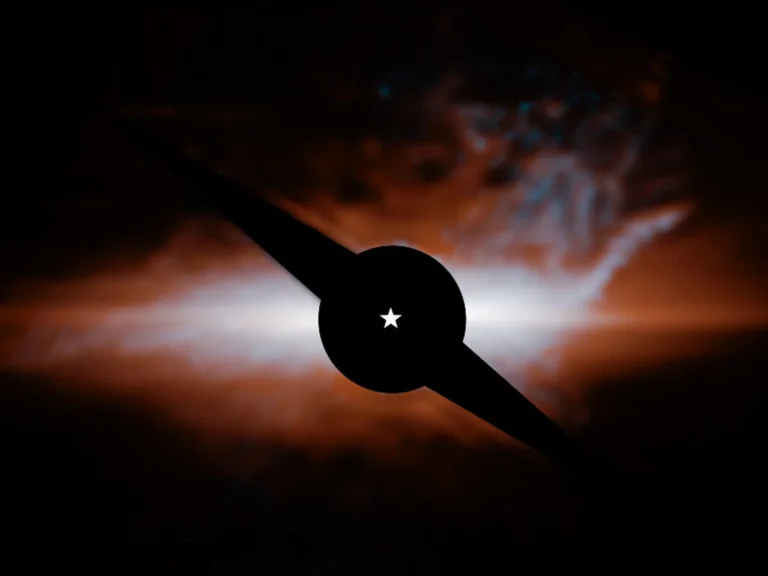

Astrophysicists utilizing the James Webb Space Telescope (JWST) have discovered an unprecedented, highly inclined dusty feature officially known as the Cat’s Tail in Beta Pictoris system. Located just 63 light-years from Earth in the southern constellation of Pictor, this renowned young stellar system has long served as an invaluable cosmic laboratory for studying infant extrasolar architecture and protoplanetary dynamics. High-contrast mid-infrared imaging has exposed an enormous curved plume of dark, carbon-rich organic dust rearing sharply out of the secondary debris disk. Extending across a staggering 10 billion miles — well over 1,000 astronomical units, or a whimsical 200 trillion domestic cats placed nose-to-tail — this structure reveals the immediate, violent aftermath of planetary collisions unfolding in deep space.
The Enigma of Beta Pictoris: A Benchmark Laboratory for Planet Formation
The star Beta Pictoris has long occupied a legendary status in the annals of observational astrophysics. Positioned merely 63 light-years away from our solar neighborhood, this luminous A6V-type star boasts roughly 1.75 solar masses and first electrified the scientific world back in 1983, when the Infrared Astronomical Satellite (IRAS) detected an enormous infrared excess radiating from its vicinity. By 1984, astronomers Richard Terrile and Bradford Smith had captured the first-ever optical coronagraphic image of an extrasolar circumstellar debris disk surrounding the star. Clocking in at an estimated age of only 20 million years, Beta Pictoris represents a celestial infant, caught squarely in the volatile developmental era when planetary architectures coalesce from protoplanetary rubble.
Over subsequent decades, ground-based and orbital observatories confirmed the presence of two massive gas giants directly imaged within the system: Beta Pictoris b and Beta Pictoris c. These super-Jovian exoplanets orbit their host at approximately 9 and 2.7 astronomical units respectively, exerting powerful, recurring gravitational perturbations across the surrounding reservoir of planetesimals, comets, and asteroids. These dynamical forces warped the primary ring into an inclined secondary debris disk, underscoring an active, chaotic environment marked by continuous hypervelocity bombardments and orbital migrations.
Gaining insight into such volatile circumstellar fringes is imperative for deciphering the violent early epochs of our own Solar System, during which Jovian planet migrations scattered billions of icy planetesimals across trans-Neptunian space. Modern astronomical infrastructure continues to push the envelope in tracking these distant icy fragments: a prime example is the recent discovery of small outer system bodies facilitated by cutting-edge wide-field survey facilities. In Beta Pictoris, however, astrophysicists are afforded an extraordinary front-row seat to watch large-scale planetesimal destruction unfold in real time.
Unlike mature planetary families where small debris has settled into stable gravitational reservoirs such as the Kuiper Belt or Oort Cloud, the raw mass density inside Beta Pictoris remains extraordinarily high. Thousands of massive planetesimals trace crossing orbits at steep relative velocities, establishing ideal prerequisites for head-on catastrophic impacts. Until recently, astronomers lacked the spatial resolving power and contrast required to isolate individual impact plumes, but the commissioning of the James Webb Space Telescope has revolutionized our understanding of this celestial crucible.
MIRI and NIRCam Instruments: How Webb Unveiled the Cat’s Tail in Beta Pictoris System
An international research consortium led by Dr. Isabel Rebollido of the Spanish Astrobiology Center (CAB/CSIC) and the European Space Agency (ESA) trained the James Webb Space Telescope’s instruments on the heart of Beta Pictoris. The researchers harnessed the coronagraphic capabilities of the Mid-Infrared Instrument (MIRI) alongside the Near-Infrared Camera (NIRCam). By utilizing specialized opaque occulting masks to obscure the blazing glare of the primary star, the science team succeeded in recording the exceptionally faint thermal emissions emanating from circumstellar dust grains.
To their astonishment, MIRI observations obtained at 15.5 and 23 microns unveiled a sharply curved, sweeping filament branching away from the southwestern extension of the secondary disk. This elongated structure, arcing outward at an unexpected inclination of nearly 30 degrees relative to the primary disk plane, strongly resembles the arched tail of an inquisitive feline. In stark contrast, NIRCam observations spanning near-infrared wavelengths between 1 and 5 microns revealed virtually no detectable signal within the exact same patch of space.
This striking optical disparity presented a fascinating physical conundrum. Why would an enormous circumstellar dust feature glow vividly across mid-infrared channels while remaining completely concealed in near-infrared imaging? The answer lies within the basic microphysical properties of interplanetary dust: MIRI detects intrinsic thermal emission radiated by solar-heated grains, whereas NIRCam predominantly relies on reflected and scattered stellar light. Unraveling this paradox required the team to cross-correlate Webb’s infrared dataset with historic archival observations collected by the Hubble Space Telescope.
Re-evaluating coronagraphic imaging acquired by Hubble’s Space Telescope Imaging Spectrograph (STIS) confirmed that a subtle, faint trace of the tail had indeed been recorded in optical bands years earlier; however, ambient diffraction artifacts had prevented researchers from recognizing it as a genuine physical structure. Webb’s unparalleled sensitivity definitively verified the existence of the feature, mapped its intricate geometry, and catalyzed an exhaustive suite of numerical hydrodynamic modeling efforts.
«Beta Pictoris is the debris disk that has it all: it has a really bright, close star that we can study very well, with a complex architecture including known gas giants and an inclined secondary belt. But when we inspected the MIRI observations, we were utterly amazed: the newly revealed tail exhibited a steep geometry unlike anything observed in circumstellar debris disks before.»
Isabel Rebollido, Lead Astrophysicist, Center for Astrobiology (CAB/CSIC) / European Space Agency
Anatomy of an Impact: The Cataclysmic Collision of Pluto-Sized Worlds
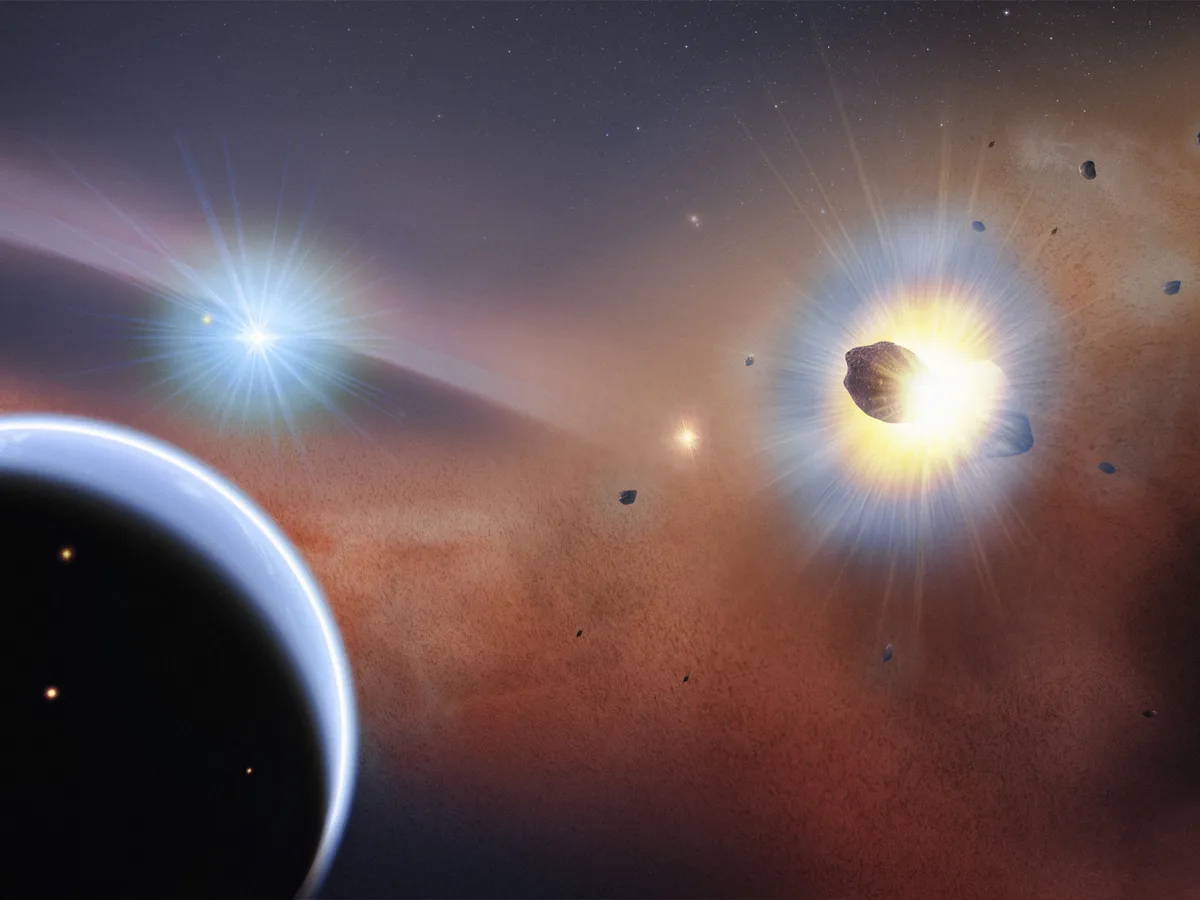
To deduce the physical mechanism responsible for sculpting the cat’s tail, astrophysicist Christopher Stark of NASA’s Goddard Space Flight Center engineered sophisticated computational models simulating grain orbital mechanics influenced by radiation pressure. The dynamical simulations quickly ruled out the possibility that the tail was an equilibrium structure sculpted by the steady, long-term gravitational secular resonance of known giant planets. Instead, the models converged upon a single compelling explanation: a massive, isolated impact between large planetary bodies.
According to the calculations published by Stark, Rebollido, and their colleagues, an energetic collision occurred roughly 100 to 300 years ago — a mere heartbeat in cosmic terms — situated approximately 100 astronomical units away from the central star. Two gargantuan icy and rocky planetesimals, each possessing dimensions comparable to Pluto or Ceres (spanning several hundred to a thousand kilometers across), slammed together at relative velocities of several kilometers per second. The kinetic energy liberated during this cataclysm instantly pulverized and fragmented massive swathes of crustal and mantle material.
This colossal collision ejected an enormous cloud of fine gravel, dust, and microscopic debris into circumstellar space, totaling hundreds of billions of tons of pulverised matter. While the impact initially generated a compact, localized expanding cloud of debris, the orbital trajectory around the star combined with planetary perturbations rapidly elongated and sheared the material into a prominent curving filament.
The youthful vintage of the collision directly accounts for the tail’s sharpness and high surface brightness. Had this destructive encounter taken place a million years ago, mutual particle collisions and Keplerian orbital shear would have smoothly smeared the debris into an axisymmetric, homogeneous ring. Instead, astronomers caught a transient cosmic snapshot, capturing the raw aftermath of planet formation before orbital dynamics can homogenize the evidence.
The dust plume spans more than 1,000 astronomical units, an expanse equivalent to roughly 200 trillion average housecats aligned in a cosmic chain.
Hydrodynamic modeling indicates the dust was generated in a massive collision between two Pluto- or dwarf planet-sized bodies 100 to 300 years ago.
Grains are fluffy, dark refractory carbonaceous particles that absorb visible light while glowing brilliantly in Webb’s mid-infrared coronagraphic bands.
Intense photon pressure from the luminous A6V host star blows lightweight microscopic dust grains out faster than the parent bodies can follow.
Porous Organic Carbon Physics and Stellar Radiation Pressure Blowout
The crowning scientific achievement of the study was the characterization of the chemical composition and microphysics governing the dust grains within the Cat’s Tail. Thermal data recorded by MIRI revealed that dust within the feature maintains temperatures between 115 and 125 Kelvin — substantially hotter than the typical 80 to 90 Kelvin expected for conventional circumstellar silicate grains at radial distances exceeding 100 astronomical units from the star.
This significant thermal anomaly is directly attributable to the mineralogical makeup of the dust: rather than dense, reflective silicate crystalline particles like olivine or pyroxene, the Cat’s Tail consists primarily of dark, highly porous refractory organic carbon material, akin to carbonaceous chondritic soot or cometary tholins. These particles exhibit an extremely fluffy, fractal aggregate structure riddled with microscopic voids. Their pitch-black albedo causes them to efficiently absorb stellar ultraviolet and visible light, elevating their temperature and mid-infrared glow while rendering them practically invisible to optical telescopes due to minimal optical reflectance.
Furthermore, the host star Beta Pictoris generates an intense flux of radiation pressure. When this fine, porous carbonaceous soot was liberated in the planetary impact, stellar photons began exerting a formidable outward mechanical force upon the microscopic grains. The ratio of radiation pressure to gravitational attraction (known in astrophysics as the beta parameter) scales inversely with grain mass and directly with cross-sectional area. For lightweight, fluffy carbon grains, this radiation force easily overcame the gravitational pull of the star.
Consequently, the smallest dust grains were propelled into hyperbolic escape trajectories, blown radially outward at velocities far exceeding those of their parent bodies. Larger rocky remnants remained anchored to their initial Keplerian orbits, while the expelled microscopic carbon soot was systematically blown backward and outward relative to the orbital motion. This differential radiation blowout naturally sculpted the sweeping, inclined curve that astronomers now marvel at as the celestial Cat’s Tail.
- Steep morphological break departing from the secondary disk plane at a 25 to 30 degree angle;
- Confirmation through archival Hubble Space Telescope (STIS) optical coronagraphic imaging;
- Thermal contrast anomaly: dust within the tail is notably hotter than expected for distances exceeding 100 AU;
- Transient cosmic timescale: stellar radiation pressure will disperse this dust trail into interstellar space within a few hundred thousand years.
A Window Into the Solar System’s Violent Past: Implications for Planetary Science
The discovery of this recent, giant collision in Beta Pictoris provides invaluable empirical insights into the violent formative epochs of our own Solar System. More than four billion years ago, during the tumultuous era of the Late Heavy Bombardment, orbital migrations undertaken by Jupiter, Saturn, and Neptune tossed millions of icy planetesimals across the inner system. It was during this volatile window that a Mars-sized protoplanet collided with the primordial Earth to form the Moon, while massive impacts tilted Uranus and stripped Mercury’s mantle.
However, within our own planetary neighborhood, geological activity, volcanism, and atmospheric weathering have largely erased direct physical records of those primordial collisions, leaving only cratered surfaces on airless worlds like the Moon and Mercury. By observing Beta Pictoris through the extraordinary optics of the James Webb Space Telescope, planetary scientists can investigate the real-time physics of catastrophic impacts, testing computational fragmentation codes and observing the behavior of liberated volatile species.
Moreover, the pervasive presence of organic refractory carbon within the planetesimals of Beta Pictoris carries profound implications for astrobiology and prebiotic chemistry. If infant planetary systems routinely harbor vast reservoirs of complex, carbon-rich refractory solids, the bombardment of newly coalesced terrestrial worlds by such planetesimals could serve as a ubiquitous cosmic mechanism for seeding planetary surfaces with the organic precursors necessary for the emergence of life.
The international research team spearheaded by Dr. Isabel Rebollido is now preparing follow-up observations combining JWST’s high-resolution spectrographs with the Atacama Large Millimeter/submillimeter Array (ALMA) in Chile. Scientists anticipate observing morphological changes in the Cat’s Tail over the coming decades, as stellar radiation pressure continues to push the organic soot into interstellar space. Documenting this real-time dispersal will deliver the first-ever cinematic time-lapse of planetary debris evolution in deep space.