

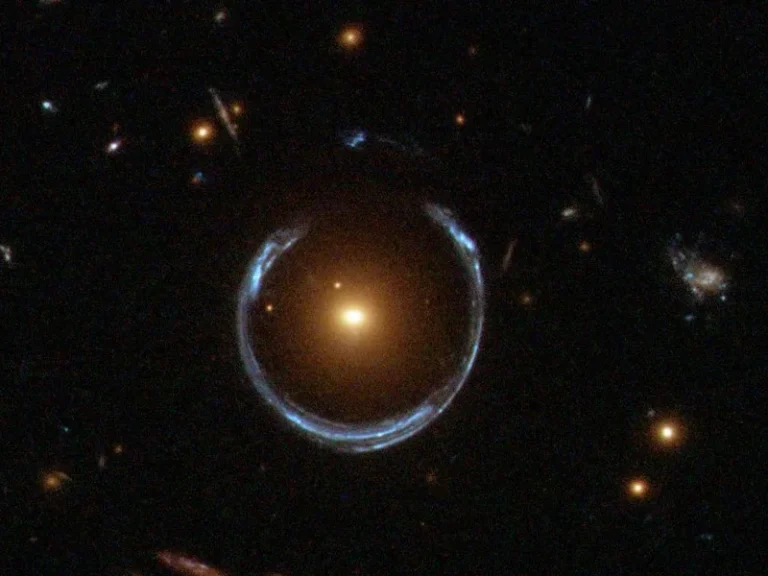

Einstein rings and gravitational lenses act as colossal natural telescopes throughout the cosmos, enabling modern astrophysics to study primordial phenomena at the very edge of the observable universe. When the immense mass of a galaxy cluster warps the fabric of spacetime, light rays emitted by ultra-distant background sources bend around the gravitational well, producing luminous circular rings, dramatic arcs, and multiple optical mirages of the same celestial object.
Einstein Rings: General Relativity’s Ultimate Observational Triumph
In 1915, Albert Einstein formulated the core principle of general relativity: gravity is not merely an attractive force acting across Euclidean space, but the geometric curvature of four-dimensional spacetime itself. Massive celestial bodies carve deep potential wells into this fabric, forcing photons to travel along curved null geodesics. When a distant background galaxy, an intermediate massive lensing cluster, and an Earth-based observer align along an identical optical line of sight, the arriving wavefront splits symmetrically to form a breathtaking complete Einstein ring.
Decades ago, Einstein himself remained skeptical that such rings would ever be detected, assuming the probability of precise stellar alignment was vanishingly small. However, the advent of extragalactic astrophysics in the late 20th century demonstrated that gravitational lensing operates on vast cosmological scales. Galaxy clusters harboring masses exceeding hundreds of trillions of suns serve as cosmic collector lenses with focal lengths stretching across billions of light-years.
The James Webb Space Telescope and Primordial Star Magnification
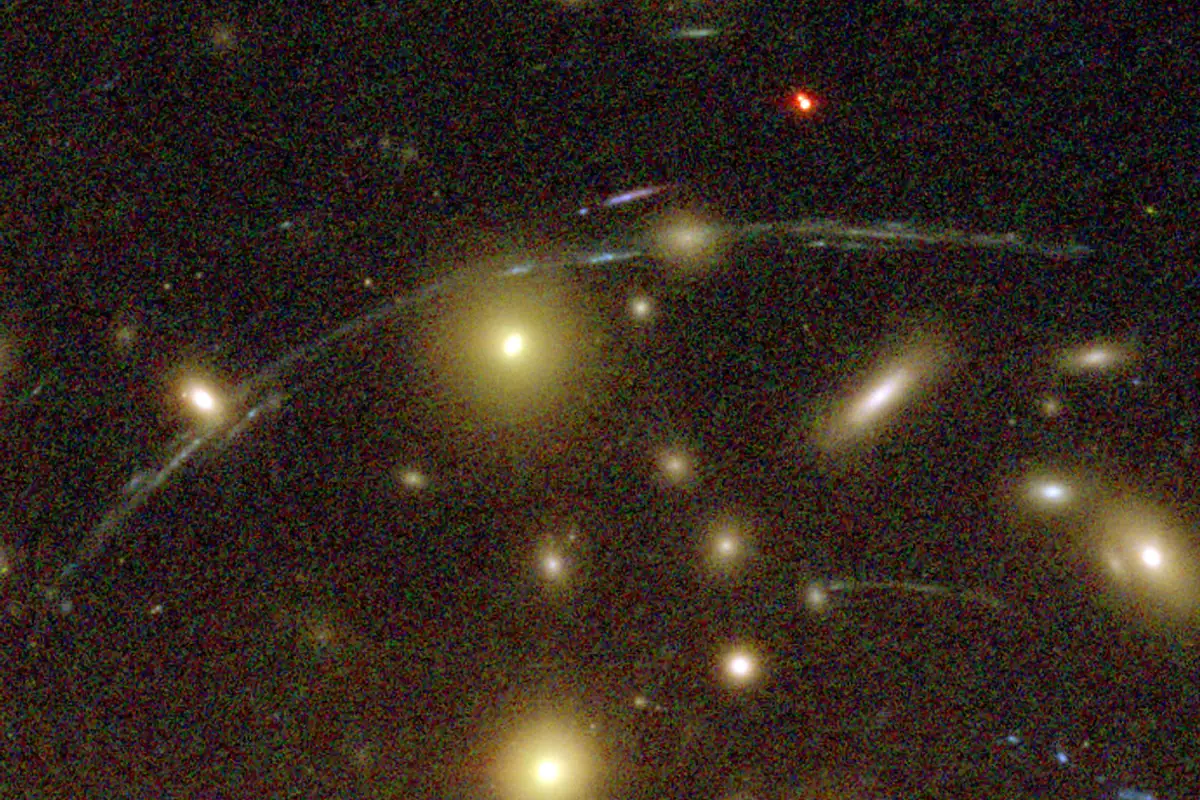
With the successful deployment of the James Webb Space Telescope (JWST), the investigation of gravitational lenses reached unprecedented sensitivity. Utilizing Webb’s NIRCam and NIRSpec instruments, astronomers peer directly through dense cosmic dust and high cosmological redshift, capturing highly magnified arcs of galaxies that existed merely 300 to 400 million years following the Big Bang. Massive clusters such as MACS J0138.0–2155 and SMACS 0723 provide optical magnification factors scaling from tens to hundreds of times.
Crucially, caustic gravitational magnification has allowed researchers to isolate emissions from candidate Population III stars—the long-sought, pristine stellar giants composed solely of primordial hydrogen and helium devoid of heavier metals. Without the geometric amplification provided by cluster lenses, observing individual luminous points across such cosmic distances would remain entirely beyond the reach of human instrumentation.
Formation of complete Einstein rings, luminous elongated arcs, and multiple distinct images during precise geometric optical alignment.
Magnification of total integrated flux by factors of 100 to 1,000 along critical spacetime caustic boundaries.
High-precision mathematical reconstruction of invisible dark matter halos based on distorted background galaxy photon trajectories.
Differences in optical transit time along distinct light paths yield direct, independent measurements of the Hubble constant.
Weighing the Unseen: Mapping Dark Matter with Gravitational Optics
Gravitational lensing serves as the most robust gravitational scale available in observational astrophysics. Because the bending angle of light is dictated strictly by the total mass enclosed within the lens—accounting for both baryonic matter and non-baryonic dark matter—researchers reconstruct comprehensive mass density profiles. Juxtaposing stellar light distributions against reconstructed mass maps definitively proves that over 85% of total cluster mass resides in diffuse, non-luminous dark matter halos.
«Gravitational lenses have transformed the curved fabric of spacetime into the ultimate cosmic super-telescope, unveiling the deepest secrets of cosmic dawn.»
Dr. Patrick Kelly, astrophysicist at the University of Minnesota
Furthermore, gravitationally lensed supernovae (such as Supernova Requiem and Supernova Encore behind cluster MACS J0138) illustrate the temporal dynamics of cosmic expansion. Photons traversing divergent gravitational paths through the cluster experience distinct Shapiro time delays, causing separate images of the same stellar explosion to arrive months or even years apart. You can explore further breakthroughs in our feature on how resilient celestial bodies regenerate from the remnants of dead stars, expanding our understanding of planetary evolution.
Harnessing the Solar Gravitational Lens
The principles of relativistic optics are currently shaping the next generation of interstellar exploration concepts. NASA and international research consortia are formulating interstellar probe missions designed to reach the Solar Gravitational Lens focal zone, beginning at 547 astronomical units from Earth. By using the Sun’s own gravitational field as an enormous relativistic objective lens, such a spacecraft could resolve surface continents and cloud formations on Earth-like exoplanets dozens of light-years away.
Einstein rings have evolved from mathematical curiosities into indispensable scientific platforms, illuminating the origin of the first stars and mapping the large-scale architecture of the cosmos.