


For millennia, mirrors have maintained a chilling, mystical presence across human folklore and esoteric traditions, widely regarded as portals to the spirit realm, instruments of necromancy, or conduits for summoning the dead. Yet beneath ancient superstitions lie profound mechanisms of human visual perception, neural adaptation, and the neurophysiology of altered states of consciousness. In a pioneering experimental investigation published in the Journal of Anomalous Experience and Cognition, a research team led by Dr. Christine Simmonds-Moore brought the phenomenon of mirror apparitions into a rigorous laboratory setting. Testing thirty individuals who previously reported authentic anomalous encounters, the study revealed that ghostly mirror encounters psychomanteum stem not from external phantoms, but from the intricate interplay of neural adaptation, Troxler’s fading, and synesthesia.
From Ancient Oracles to Raymond Moody: The Evolution of the Psychomanteum
The practice of scrying or gazing into reflective surfaces (catoptromancy) stretches back thousands of years. In ancient Greece, pilgrims journeyed to the subterranean chambers of the Necromanteion on the River Acheron, where following prolonged fasting and purification rituals, they stared into dark cauldrons of oil or polished bronze disks to commune with ancestral spirits. In the late 20th century, this forgotten contemplative tradition was revived within academic psychiatry by Dr. Raymond Moody, renowned author of the groundbreaking classic “Life After Life.”
Dr. Moody designed the modern psychomanteum — an enclosed, sound-dampened chamber featuring a comfortable recliner facing a mirror angled upward toward dark velvet drapery. Crucially, the observer could not see their own reflection; instead, they stared into a soft, depthless field of darkness illuminated only by a distant, dim 15-watt bulb or candle. Moody employed this protocol as an adjunctive bereavement therapy, facilitating cathartic emotional resolution for grieving individuals.
Moody’s clinical findings astounded the psychiatric community: over half of his subjects reported vivid encounters with departed loved ones, accompanied by tangible tactile sensations and telepathic dialogue. For decades, these reports sparked debate between parapsychologists and mainstream neuroscientists. Meanwhile, parallel clinical studies into altered states and near-death experiences demonstrate the extraordinary capacity of the human central nervous system to construct fully immersive, hyper-realistic subjective phenomena.

Experimental Protocol: Recreating the Haunted Chamber Under Laboratory Control
To move beyond anecdotal memoirs, a team of psychological researchers led by Dr. Christine Simmonds-Moore at the University of West Georgia designed a rigorous experimental protocol. Their findings, published in the Journal of Anomalous Experience and Cognition, incorporated synchronized physiological telemetry, continuous heart-rate variability (HRV) recording, environmental electromagnetic field (EMF) monitoring, and a hardware random number generator (RNG).
The researchers recruited thirty participants who each possessed authentic histories of experiencing what they believed to be genuine paranormal apparitions. The cohort was intentionally bifurcated: fifteen individuals possessed verified synesthesia (a neurological condition where sensory modalities involuntarily cross over, such as tasting shapes or hearing colors), while the remaining fifteen served as a non-synesthetic control group.
Each participant completed a standardized session consisting of 15 minutes of intention-setting and relaxation, followed by a 45-minute continuous mirror-gazing trial in dim illumination. Subjects held a silent, handheld button interface, allowing them to record the precise millisecond onset of any anomalous perceptual shift — ranging from visual distortion of the mirror plane to full-bodied apparitional encounters.
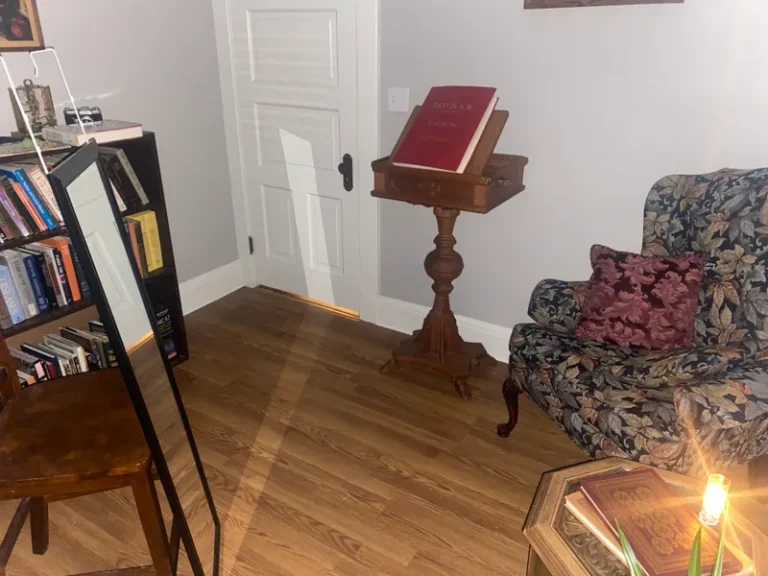
A sound-isolated dimly lit room with an angled mirror designed to reflect pure velvety darkness rather than the observer’s direct silhouette.
Participants with neurological cross-modal sensory pathways experienced significantly more vivid visual illusions and physical sensed presences.
Retinal photoreceptors and cortical neurons stop transmitting static visual signals in dim light, prompting the brain to synthesize phantom faces.
Synchronized telemetry captured sharp shifts in heart-rate variability during apparitional reports despite zero ambient electromagnetic fluctuations.
The Neurobiology of Illusion: Troxler Fading and Facial Feature Dissociation
The subjective reports gathered during the trials were striking: participants logged frequent sensations of spatial warping, luminous fog, localized temperature drops, movement behind the glass, and intense feelings of an external presence. However, correlated biometric data demonstrated that these experiences originated entirely within normal human visual neurophysiology rather than disembodied spirits.
The core neurological mechanism is rooted in Troxler’s fading, an optical phenomenon identified in 1804 by Swiss physician Ignaz Paul Vital Troxler. When an individual fixates their gaze steadily on a stationary target under low light, retinal ganglion cells and neurons within the primary visual cortex (V1) undergo rapid sensory adaptation. Because the unchanging stimulus ceases to trigger new action potentials, peripheral details gradually fade from conscious perception.
This sensory dropout triggers the “strange-face illusion,” documented extensively by Italian psychologist Giovanni Caputo. Deprived of reliable external data, the brain’s fusiform face area (FFA) and higher-order pattern recognition networks enter an active generative mode. Driven by pareidolia, the visual cortex synthesizes missing details from micro-saccadic noise and ambient shadows, constructing grotesque transformations, ancestral faces, or phantom visitors.
«Our investigation demonstrates that mirror apparitions and the sensed presence in the psychomanteum are not indicators of pathology or supernatural agency, but natural manifestations of an adaptable human brain. When sensory input is stabilized in low light, visual cortex pathways transition into a generative mode, projecting subconscious imagery into conscious awareness.»
Christine Simmonds-Moore, Professor of Psychology at the University of West Georgia
The Role of Synesthesia and Transliminality: Why Some People See Ghosts
The most compelling empirical insight of the study centered on cognitive differences between participant cohorts. Synesthetic subjects reported significantly higher frequencies of vivid apparitions, tactile chills, and auditory impressions compared to non-synesthetic controls. In synesthetes, sensory uncoupling in the visual domain rapidly spilled over into auditory and somatosensory networks.
The authors interpret these results through the lens of transliminality — a psychological dimension describing the degree of permeability between conscious awareness, subconscious processing, and hypnagogic imagery. Individuals high in transliminality possess highly fluid neurological boundaries, enabling internal mental representations and emotional archetypes to cross freely into external perceptual space.
Within the sensory-deprived environment of the psychomanteum, their cognitive architecture interprets internal memory traces and subconscious expectations as external optical phenomena originating from the mirror glass. This neurocognitive model provides a comprehensive, non-pejorative explanation for why certain individuals are inherently predisposed to apparitional encounters while others remain unaffected.
- Experimental research conducted by Christine Simmonds-Moore, Chase O’Guinn, Michael Stidder, and Elena Mayfield.
- Published in the peer-reviewed Journal of Anomalous Experience and Cognition (JAEX).
- Cohort composed of 30 participants with prior ghost encounters; exactly half met clinical criteria for neurological synesthesia.
- Session incorporated a 15-minute intention-setting phase followed by 45 minutes of continuous mirror-gazing in controlled dim illumination.
- Empirical findings substantiate the transliminality hypothesis — heightened permeability between conscious perception and subconscious mentation.
Demystifying the Haunted Mirror: Clinical Implications for Phobia and Anxiety
Telemetry analysis revealed another vital physiological marker: button presses logging apparitional encounters correlated directly with abrupt drops in heart-rate variability (HRV) and marked surges in sympathetic nervous system arousal. Crucially, environmental magnetometers and hardware RNG devices recorded zero anomalous physical disturbances in the room.
This proves that apparitional encounters, while internally generated, evoke authentic biological stress responses. The autonomic nervous system reacts to the brain’s self-generated visual phantom with a genuine fight-or-flight spike, reinforcing the subject’s conviction that an external entity was present. The visceral bodily response validates the illusion in the observer’s mind.
Demystifying mirror apparitions offers immense clinical value for treating catoptrophobia (fear of mirrors) and phasmophobia (fear of ghosts). By demonstrating that eerie figures in darkened glass are the natural output of sensory adaptation and imaginative cognitive processing, science empowers individuals to understand the extraordinary generative power of their own minds.