


For five millennia, conventional historical chronicles of ancient Egyptian origins relegated royal women strictly to secondary roles as queens consort, interim regents for young sons, or high priestesses, while absolute sovereign power was presumed to belong entirely to male monarchs. Celebrated female rulers such as Hatshepsut and Cleopatra appeared on the historical stage thousands of years later, well after the unification of Upper and Lower Egypt. Now, a landmark breakthrough in Egyptology, utilizing state-of-the-art digital image processing and re-examination of early dynastic excavations at Saqqara and Abydos, has definitively confirmed: Queen Merneith (Meretneith) was not merely a motherly regent, but the authentic first female king of Egypt who ruled with supreme sovereignty during the First Dynasty.
The Enigma of Tomb Y at Abydos: A Century of Academic Skepticism
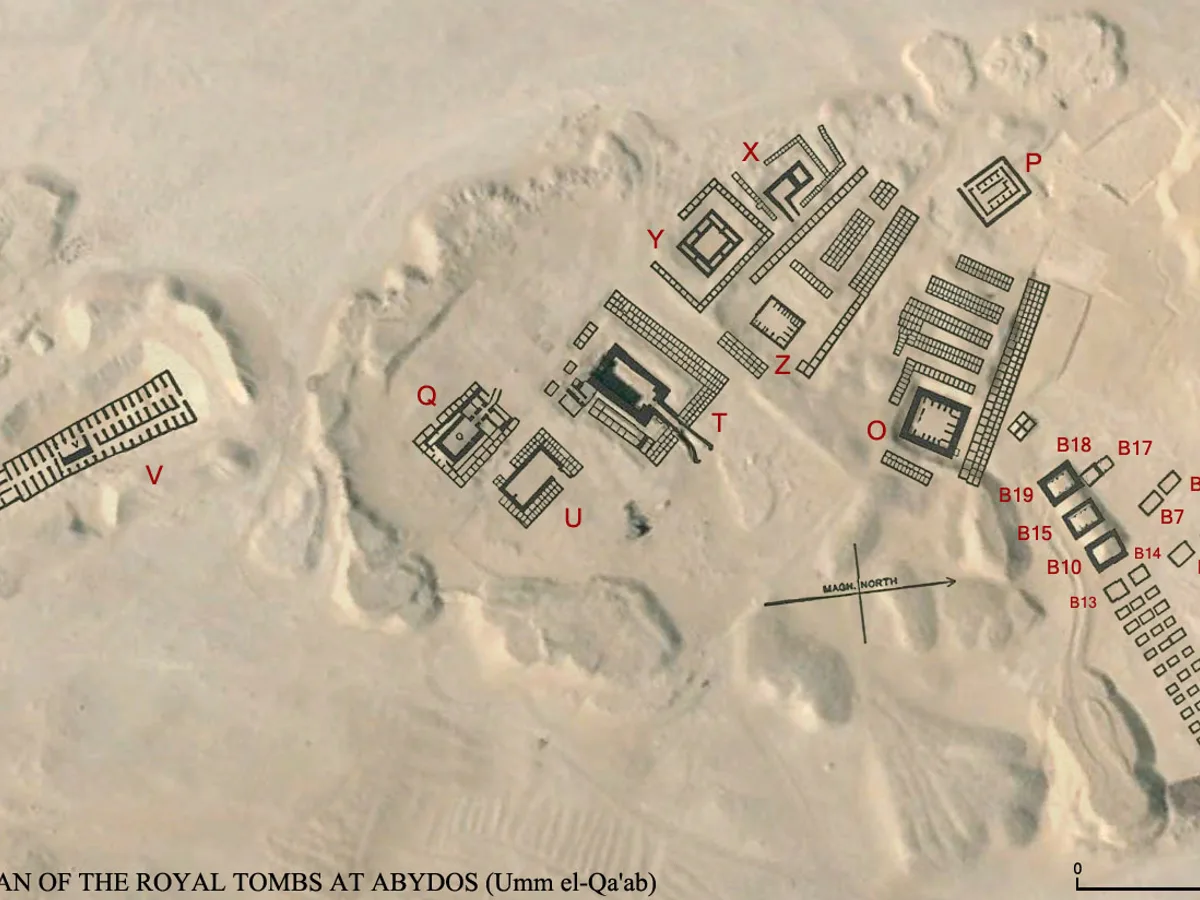
The story of Merneith’s royal recognition began in 1900 when the father of modern scientific archaeology, Sir William Flinders Petrie, began systematic excavations at the royal cemetery of Umm el-Qaab near the holy city of Abydos. Among the desert sands housing the tombs of Egypt’s first pharaohs, Petrie uncovered an enormous subterranean brick-lined burial chamber designated as “Tomb Y.” The wealth of artifacts inside was staggering: carved alabaster vessels, remnants of fine ivory, gold leaf adornments, and hundreds of massive jars that once stored vintage royal wine.
Outside the sepulcher stood a colossal limestone stele inscribed with the name “Merneith” (“Beloved of Neith”). The architectural scale of the complex, flanked by dozens of subsidiary graves for retainers, craftspeople, and court officials, was entirely identical to the burials of contemporary male monarchs such as Djer, Djet, and Den. Yet in the Victorian and Edwardian mindset of the early 20th century, historians refused to accept that a woman could have exercised sovereign kingship. Petrie initially assumed the tomb belonged to a male king; once the feminine grammatical markers were noted, scholars hastily reclassified her as an ordinary queen consort or temporary regent.
Over subsequent generations, Merneith’s historical status remained bitterly contested. On a formal dynastic seal list discovered during the reign of her son, King Den, Merneith was recorded with the title “King’s Mother.” This led traditionalist Egyptologists to argue that she never ruled in her own right. However, contemporary archaeological discoveries of early human ancestry demonstrate how modern cultural biases have frequently clouded our understanding of prehistoric authority structures.
Walter Emery’s Lost Jar Stoppers: The Saqqara Serekh Mystery
The critical clue in this archaeological detective story came to light in the late 1940s through excavations conducted by renowned British archaeologist Walter Bryan Emery at the First Dynasty necropolis of Saqqara. While clearing the burial shaft of elite tomb S3503, Emery recovered thirteen stamped mud stoppers used to seal commodity and wine jars. Stamped into the clay was a repeating impression of four royal serekhs — rectangular palace-façade frames surmounted by the falcon god Horus.
Emery documented that while the first and fourth serekhs belonged to King Djer, the central serekhs clearly bore the distinctive hieroglyphs of Merneith’s name. If substantiated, this was explosive epigraphic proof: Merneith had exercised full sovereign prerogative, placing her royal crest on official crown goods. Unfortunately, the turbulent geopolitical events of the mid-20th century intervened; the fragile mud stoppers and Emery’s original photographic glass plates vanished from institutional collections.
All that remained was a single, faded black-and-white print archived by the Egypt Exploration Society in London. Due to visual degradation and poor contrast, mainstream historians for over eighty years dismissed Emery’s assertion as wishful thinking, an excavational recording error, or visual artifacts on cracked mud.
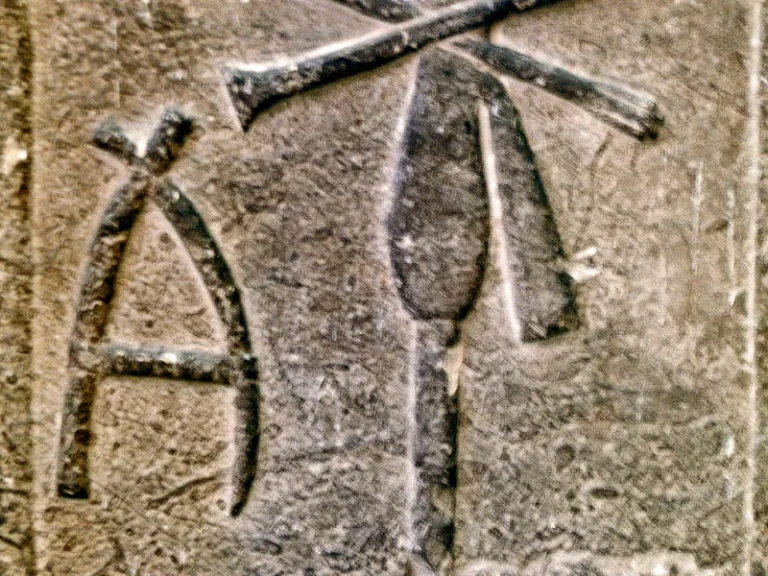
The sacred palace-façade crest of divine kingship in early dynastic Egypt, confirmed by digital imaging to bear the name of female ruler Merneith.
Merneith held paramount leadership throughout the First Dynasty — transitioning from co-ruler and sovereign king to queen mother of King Den.
Grand subterranean royal tomb complete with hundreds of sealed wine jars and subsidiary graves matching the scale of contemporary male pharaohs.
Official recognition moves the historical precedent of female sovereign kingship in ancient Egypt back by more than a millennium.
Digital Resurrection: How Computational Imaging Restored Her Serekh
The resolution of this eighty-year impasse arrived via a pioneering collaborative study by Egyptologist Sue Kelly and digital imaging specialist Crystal Miller, published in Prague Egyptological Studies. Rather than relying on naked-eye inspection, the team applied high-resolution digital scanning, sub-pixel edge detection, and multi-band contrast equalization to Emery’s sole surviving print.
The computational algorithms peeled back decades of emulsion fade, grain noise, and uneven lighting. The resulting sharp micro-relief of the clay impressions revealed unmistakable clarity: inside the contested serekhs were the crossed arrows in a shield representing the goddess Neith alongside the hoe sign representing “Mer.” It was indisputably Merneith.
Furthermore, the top of the serekh unmistakably displayed the stylized plumage and crest of the Horus falcon. In the First Dynasty, the serekh was the exclusive symbol of absolute political and cosmic legitimacy; no queen consort, crown prince, or prime minister was ever permitted to place their personal name inside this royal frame. This discovery provided irrevocable proof that the first female king of Egypt reigned with full monarchical legitimacy.
«The definitive presence of Merneith’s name enclosed within the royal serekh on ancient mud jar stoppers resolves an eighty-year-old debate in Egyptology. This provides unambiguous epigraphic proof that an Early Dynastic woman possessed the supreme institutional authority of a sovereign king, rewriting our understanding of state formation and gender in the Nile Valley.»
Sue Kelly and Crystal Miller, lead researchers in Prague Egyptological Studies
Three Decades of Sovereignty: From Co-Ruler to King Mother
With this epigraphic proof established, historians have reconstructed Merneith’s astonishing three-decade political career during the critical unification era around 2950 BCE. Textual evidence suggests a gradual, highly strategic consolidation of power. Originating as a royal daughter or high noblewoman under King Djer, she subsequently became co-regnant with King Djet.
When Djet died prematurely, his heir Den was still a young child. Rather than stepping aside or allowing rival factions to plunge Egypt into civil strife, Merneith assumed complete command of the Egyptian state. She directed domestic administration, expanded state mining expeditions in the Sinai, supervised monumental building works, and maintained royal grain and wine registries.
When Den reached maturity and took the throne — going on to become one of the most innovative pharaohs of the First Dynasty — Merneith remained his chief counselor and revered “King’s Mother.” Their joint seals and her burial among kings prove her legacy was cherished rather than suppressed by her successor.
- Breakthrough study published by researchers Sue Kelly and Crystal Miller in the prestigious journal Prague Egyptological Studies (Vol. 36).
- Advanced computer vision and contrast algorithms applied to historic 1940s photographic plates taken by British archaeologist Walter B. Emery.
- Analysis of 13 mud jar stoppers from Saqqara confirmed Merneith’s name inscribed inside a royal serekh alongside King Djer.
- Merneith’s Tomb Y at Umm el-Qaab exceeds many male kings’ complexes in architectural scale, craftsmanship, and burial goods.
- The discovery proves ancient Egyptian political institutions embraced full sovereign female rule as early as 2950 BCE.
Rewriting Gender at the Dawn of Civilization: The Global Legacy
The official recognition of King Merneith profoundly reshapes anthropological models regarding gender and authority in primary civilizations. For centuries, Western historiography posited that female state leadership emerged only as an exceptional aberration in late antiquity, pointing to Hatshepsut who reigned a thousand years later and felt compelled to depict herself in masculine regalia and ceremonial beard.
Merneith’s reign demonstrates that at the very dawn of Egyptian civilization, over 5,000 years ago, institutional governance was sophisticated and pragmatic enough to entrust supreme authority to an exceptionally capable female leader under her own identity. Her patronage of Neith, a fierce hunting and warrior deity, reinforced her divine mandate.
Today, as computational archaeology and digital preservation breathe life into overlooked records of the ancient past, Merneith takes her rightful place among history’s greatest founding monarchs — reigning proudly as the world’s earliest confirmed female king.