



In the pitch-black abyss of the Mediterranean Sea and the pristine depths of Lake Baikal, humanity has constructed some of its most ambitious scientific instruments: the next-generation deep underwater neutrino telescopes KM3NeT and Baikal-GVD. Unlike conventional optical or radio observatories pointed toward the night sky, these gargantuan detector arrays look down through the entire bedrock of Earth, utilizing the planet as a colossal natural filter against blinding cosmic ray background noise. Hunting for ultra-high-energy relic and astrophysical neutrinos at depths between one and three kilometers, their submerged digital optical modules record ethereal blue flashes of Cherenkov radiation, deciphering black hole genesis, supernova explosions, and catastrophic blazar jets.
Anatomy of the Ghost Particle: Why the Deep Sea Is an Ideal Neutrino Laboratory
Neutrinos are frequently described as the quintessential ghost particles of the Standard Model of particle physics. Bearing an infinitesimal non-zero mass and no electrical charge, neutrinos interact with baryonic matter almost exclusively through gravity and the subatomic weak nuclear force. Every single second, roughly 65 billion solar neutrinos stream through each square centimeter of your skin without disturbing a single atom.
However, ultra-high-energy astrophysical neutrinos (in the TeV to PeV regime), forged within the extreme relativistic particle jets of blazars, active galactic nuclei, and neutron star mergers, carry phenomenal kinetic momentum. Detecting even a handful of their rare collisions with atomic nuclei demands vast volumes of optical clarity — cubic kilometers of pristine natural seawater or polar glacial ice.
In deep water, the refractive index is approximately 1.33. Consequently, the phase velocity of light is curtailed to roughly 225,000 kilometers per second, providing ideal conditions for the generation of coherent Cherenkov shockwaves.
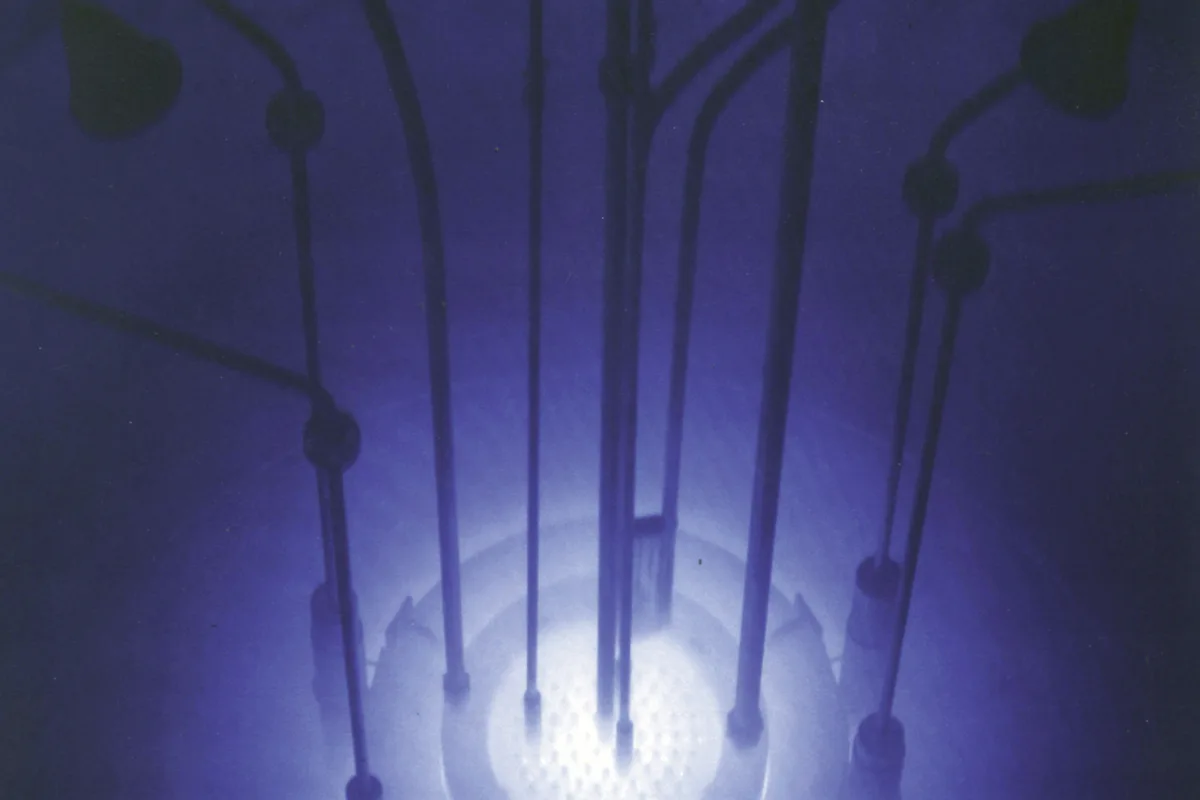
Physics of the Cherenkov Cone: An Optical Sonic Boom in the Deep Abyss
When an ultra-high-energy neutrino travelling at near-luminal velocity collides directly with an atomic nucleus of hydrogen or oxygen in water, deep inelastic scattering occurs. This catastrophic interaction creates a secondary charged lepton — predominantly a muon, electron, or tau particle — that continues racing forward along the original trajectory of the incoming neutrino.
Because the secondary muon travels faster than the local phase velocity of light in water, it polarizes adjacent water molecules, producing an optical equivalent of an acoustic sonic boom: coherent Cherenkov radiation. A conical shockwave of striking azure-blue photons emanates along the track at a precise characteristic angle of 41 to 42 degrees.
This faint optical pulse, lasting mere nanoseconds, is captured by highly responsive photomultiplier tubes capable of registering the arrival of individual photons at depths of thousands of meters.
Coherent azure photonic shockwaves are produced when relativistic secondary muons exceed the phase velocity of light in water.
Thick borosilicate glass spheres encase up to 31 high-precision photomultiplier tubes designed to withstand abyssal compression.
Exceptional optical clarity of deep marine water enables razor-sharp directional reconstruction toward cosmic sources.
Earth bedrock absorbs trillions of atmospheric cosmic rays, permitting only pristine neutrino signatures to reach deep detectors.
KM3NeT and Baikal-GVD: The Vanguard of Global Deep-Water Astrophysics
The Mediterranean KM3NeT facility comprises two specialized deep-sea installations: ARCA (Astroparticle Research with Cosmics in the Abyss), situated off Sicily at a depth of 3,500 meters for high-energy cosmic neutrino astronomy, and ORCA (Oscillation Research with Cosmics in the Abyss), deployed near Toulon at 2,450 meters to scrutinize fundamental neutrino mass hierarchy and oscillations.
Unlike the South Pole IceCube observatory, where deep glacial ice contains microscopic air bubbles that induce photon scattering, deep Mediterranean seawater exhibits remarkable optical homogeneity. The angular resolution of KM3NeT reaches an exceptional 0.1 degrees for muon tracks, turning the detector into an exquisite pointing telescope.
Simultaneously, in Eastern Siberia, the Baikal-GVD (Baikal Gigaton Volume Detector) operates within the pristine freshwater basin of Lake Baikal. Deployed from solid winter surface ice between depths of 750 and 1,300 meters, Baikal-GVD leverages the extraordinary transparency of deep Baikal water and minimal bioluminescent interference to scan the northern celestial hemisphere.
Direct connectivity between deep-sea sensor strings and shore processing facilities is maintained by armored electro-optical umbilical cables, routing gigabits of digitized waveform telemetry in real time.
«Ultra-high-energy neutrinos are the only cosmic messengers capable of traversing billions of light-years without being deflected by magnetic fields or obscured by interstellar dust. Tracking their trajectory in deep transparent waters yields an unhindered pointing vector to the most energetic explosions in the cosmos.»
Marco Circella, KM3NeT Technical Project Coordinator, INFN
Multi-Messenger Astronomy: Unmasking Blazars, Supermassive Black Holes, and Dark Matter
The overarching objective of submerged neutrino observatories is accelerating the golden age of Multi-Messenger Astronomy. When orbiting gamma-ray observatories record a high-energy blazar flare, gravitational-wave interferometers detect spacetime ripples, and underwater neutrino arrays detect coincident neutrino pulses, astrophysicists reconstruct an unprecedented, multifaceted chronicle of the cosmic event.
Unlike charged cosmic ray protons, whose paths are hopelessly scrambled by turbulent intergalactic magnetic fields, neutrinos travel unswervingly from their origin: the roaring accretion disc of a supermassive black hole or the core of an active galactic nucleus.
Furthermore, KM3NeT and Baikal-GVD scrutinize hypothetical sterile neutrinos and search for signatures of Weakly Interacting Massive Particles (WIMPs) annihilating within the gravitational cores of the Sun and the Galactic Center, offering tantalizing clues to the mystery of dark matter.
- Water refractive index of 1.33 reduces the speed of light to 225,000 km/s, allowing Cherenkov luminescence for high-energy particles.
- KM3NeT spans two deep-sea sites: ARCA for high-energy astrophysics and ORCA for fundamental neutrino oscillation measurements.
- Baikal-GVD strings are deployed each spring from Lake Baikal thick ice sheets, exploiting the natural purity of freshwater depths.
- Deep neutrino observatories form the backbone of multi-messenger astronomy alongside gravitational-wave detectors LIGO and Virgo.
Engineering the Ocean Abyss: Navigating 350 Atmospheres and Marine Corrosion
Submerging complex optoelectronic arrays kilometers beneath the ocean surface poses immense engineering hurdles. At depths exceeding three kilometers, hydrostatic pressures reach 300 to 350 atmospheres, necessitating that photomultipliers be housed inside 14-millimeter-thick borosilicate glass spheres engineered to resist crushing force.
The marine biosphere also introduces unique complications: saline corrosion, biofouling from deep-sea organisms, and continuous optical background noise generated by the beta decay of Potassium-40 (K-40) dissolved in seawater. KM3NeT engineers solved this with a pioneering design: each Digital Optical Module (DOM) packs 31 compact 3-inch photomultiplier tubes into a single glass sphere, providing omnidirectional photon tracking.
Advanced Remotely Operated Vehicles (ROVs) execute delicate wet-mate connector installations on the abyssal seafloor, assembling three-dimensional cubic-kilometer sensor grids that pioneer the frontiers of modern science. Читайте также наш связанный материал про relativistic particle jets of cosmic microblazars.