



Anthropological and primatological paradigms have been fundamentally disrupted following field discoveries confirming that apex avian raptors regularly hunt and kill adult male primates weighing over 26 kilograms (nearly 60 pounds). A groundbreaking study published in the American Journal of Biological Anthropology by researchers from the University of St Andrews and Dartmouth College reveals that Verreaux’s eagles (Aquila verreauxii) actively prey upon an isolated population of olive baboons in the sandstone ravines of the Ennedi Plateau in northern Chad. The discovery shatters a long-standing evolutionary rule asserting that nonhuman primates exceeding a 13-kilogram threshold were immune to aerial predation. Because these baboons directly match the body mass of early human ancestors such as Australopithecus, scientists now confirm that eagles hunt baboons of human-like proportions, forcing a comprehensive reassessment of early hominin social vigilance, alarm vocalizations, and group defense.
The Ennedi Redoubt: A Primatological Enclave in the Sahara
The Ennedi Plateau in northern Chad stands as one of the most remote and formidable geological landscapes on the African continent. Monumental sandstone inselbergs, natural arches, and subterranean canyons carve through the arid expanses of the southern Sahara, providing critical microrefugia. Within the gueltas — permanent natural cisterns hidden deep within cavernous gorges — survives an extraordinarily isolated population of olive baboons (Papio anubis), cut off from sub-Saharan conspecifics for thousands of years.

Primatologist Professor Catherine Hobaiter from the University of St Andrews and anthropologist Professor Nathaniel Dominy of Dartmouth College led an expedition in collaboration with African Parks to investigate how these primates survive extreme desert conditions. The researchers anticipated behavioral anomalies linked to water scarcity and foraging ecology. Instead, they discovered a lethal taphonomic phenomenon: numerous skeletal remains of baboons concentrated beneath cliffside eagle perches.
The most striking discovery was the recovery of adult male baboon skulls exhibiting unmistakable circular punctures through their orbital cavities — trauma incompatible with mammalian carnivores and unmistakably matching the lethal strike mechanics of large birds of prey.
Taphonomy of an Aerial Ambush: Subduing 26-Kilogram Primates
For nearly a century, biological consensus dictated that raptors could not hunt animals heavier than roughly 13 kilograms (28.6 pounds). This theoretical threshold derived from the physical aerodynamics of flight: an eagle weighing 3.5 to 5 kilograms cannot achieve takeoff while carrying a carcass heavier than twice its mass.
However, Hobaiter and Dominy demonstrated that carrying prey is entirely unnecessary. In the vertical geography of Ennedi, Verreaux’s eagles utilize cliff promontories to execute high-velocity stoops, smashing into baboons from above. Craniodental and skeletal measurements revealed that the predated baboons averaged 22.2 kilograms, with the largest adult male specimen estimated at over 26.2 kilograms — approximately six times the raptor’s own weight.
Detailed forensic analysis of nine crania and postcranial skeletons confirmed diagnostic raptor signatures. The eagle’s massive posterior talon (hallux), capable of generating immense crushing force, was driven directly through the baboon’s eye socket, instantly penetrating the frontal lobe and preventing the primate from deploying its lethal canine teeth. Paired longitudinal grooves (“rakes”) along the shoulder blades and clavicles marked where the raptor’s talons anchored the struggling quarry.
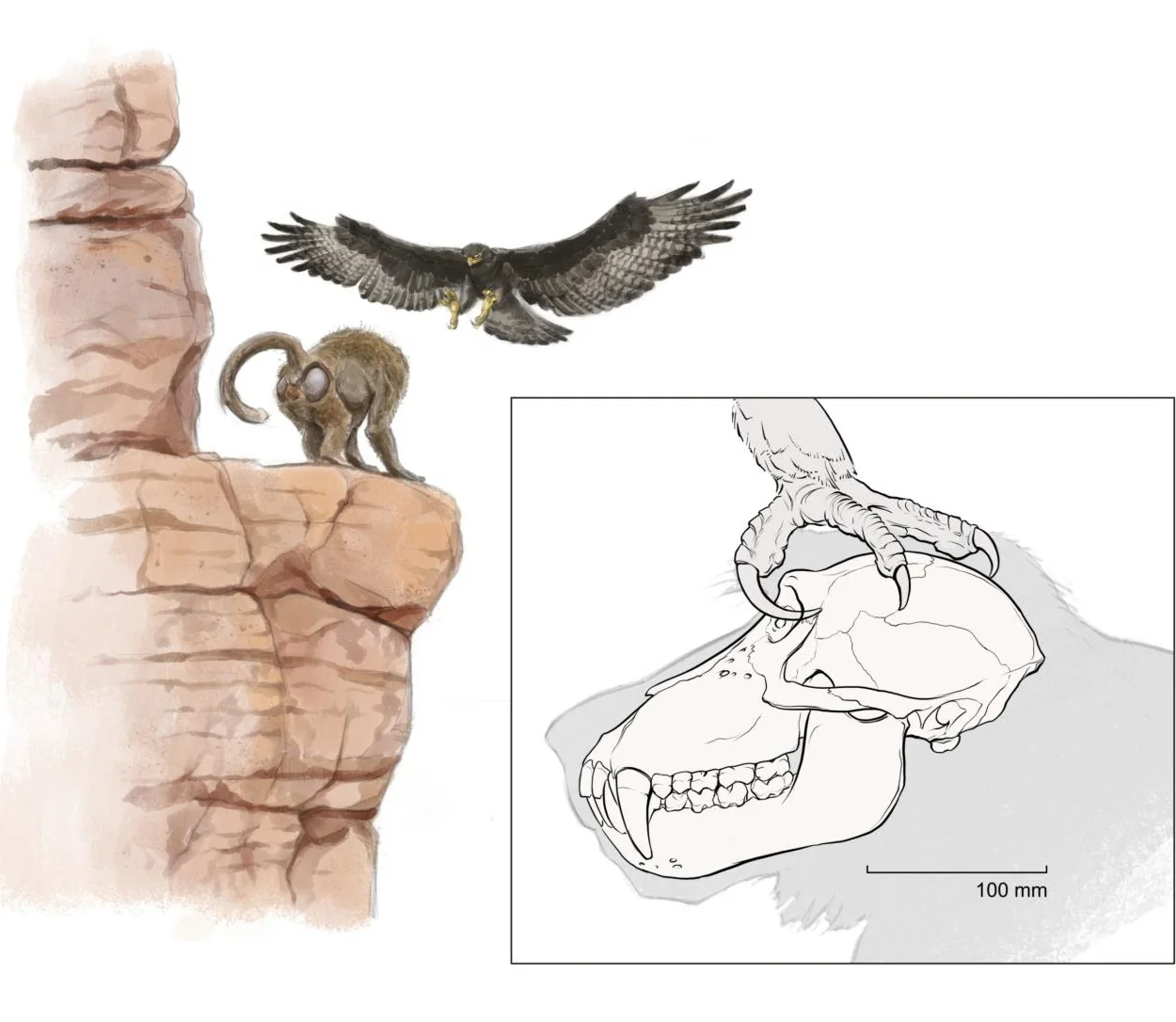
«At first, the idea of eagles hunting adult male baboons seemed to exist on the thin edge of possibility, until it didn’t. Our scepticism slowly gave way to acceptance. The evidence of lethal talon punctures through the orbits was convincing.»
Nathaniel Dominy, Professor of Anthropology at Dartmouth College
Hominins Under the Sky: Dismantling the 2.5-Million-Year Dogma
The implications of these findings for human evolution are profound. Anthropologists previously believed that early hominins were vulnerable to birds of prey only during infancy. The famous 2.8-million-year-old Taung Child (Australopithecus africanus), discovered in South Africa in 1924, preserves identical orbital puncture marks inflicted by a crowned eagle. However, conventional theory posited that once hominins exceeded 15 to 20 kilograms, they were safe from aerial attack.
The Chad evidence overturns this assumption. Adult specimens of Australopithecus afarensis (such as the famed “Lucy”) weighed approximately 25 to 30 kilograms, while Paranthropus robustus and early Homo occupied comparable weight brackets. If a 4-kilogram modern eagle can kill an aggressive, formidable adult male baboon, the extinct giant raptors of the Plio-Pleistocene would have viewed adult hominins as standard, accessible prey.
Much as early hominin survival and hunting strategies were vital for managing dangerous terrestrial megafauna, the ubiquitous threat of aerial ambushes required hominins to maintain constant visual vigilance and coordinated group vigilance.
Evolutionary biologists long assumed primates exceeding 13 kg had escaped raptor predation due to flight lift mechanics. The Chad study proves eagles do not carry large prey away; they dispatch them on the ground or cliff edges.
Nine adult baboon crania exhibited distinctive circular perforations through orbital bones caused by the eagle’s hypertrophied hallux talon, alongside paired raking incisions on scapulae and clavicles.
Early hominins like Australopithecus afarensis weighed between 20 and 35 kg. The findings prove that our direct evolutionary ancestors remained under acute lethal threat from Pleistocene giant eagles.
Defending against a raptor diving at over 150 km/h requires specialized acoustic alarm calls, rapid spatial threat classification, and coordinated counter-assaults by adult males.
Vocal Alarms and Mobbing Defense: The Roots of Cooperation
Evasive strategies against terrestrial carnivores like sabre-toothed felids or leopards differ radically from defense against avian raptors. Against land predators, primates seek refuge in trees or high rocks. Conversely, an eagle dive exceeds 150 km/h, turning trees into exposed hunting perches.
Field observations at Ennedi documented remarkable tactical discipline among the baboons. The troop ignored circling vultures and crows, but the silhouette of a Verreaux’s eagle elicited immediate acoustic alarm barks. Females and infants flattened themselves against subterranean cliff recesses, while adult males mounted an aggressive counter-assault — forming a cohesive defense perimeter, roaring, baring their teeth, and hurling rocks toward the raptor.
This behavioral response, known as mobbing, requires acute social trust, instant threat categorization, and precise vocal communication. Many evolutionary anthropologists argue that differentiating between aerial and terrestrial threats provided crucial selective pressure for the emergence of proto-language and semantic alarm systems in early hominins.
- Predation on 26-kg primates conclusively invalidates the assumption that hominins outgrew avian predators roughly 2.5 million years ago.
- Verreaux’s eagles execute fatal strikes by targeting eye sockets with rear talons, instantly destroying cerebral tissue and disabling ferocious retaliatory bite forces.
- Persistent aerial ambush pressure acted as an evolutionary catalyst for referential vocal communication and mutual protective cooperation.
- Plio-Pleistocene hominin species coexisting in East and South Africa likely cooperated in multi-species troops to maintain collective aerial surveillance.
Cooperation Over Conflict: A New Vision of the Plio-Pleistocene
The study, documented under DOI 10.1002/ajpa.70377 in the American Journal of Biological Anthropology, also sheds light on multi-species primate dynamics. In modern African biomes, distinct primate species frequently form stable polyspecific associations to pool their surveillance capacities against aerial hunters.
During the Plio-Pleistocene, multiple hominin species coexisted across East and South Africa. Rather than engaging in perpetual violent competition, shared aerial threats likely encouraged cross-species cooperation, shared sentinel duties, and peaceful social interaction across ancient landscapes.
The discoveries in the Ennedi Plateau remind us that human solidarity was forged in the shadow of prehistoric raptors. For millions of years, our ancestors were hunted from above, and surviving those skyborne predators taught humanity to communicate, unite, and endure.