

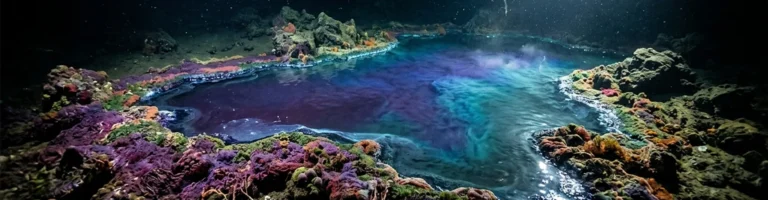

More than a kilometer beneath the sparkling turquoise surface of the Red Sea lies one of the most surreal and alien environments on planet Earth: deep-sea brine pools, colloquially termed underwater lakes of death. Characterized by extreme salinity and a total absence of dissolved oxygen, these secluded aquatic depressions instantly prove fatal to any unsuspecting marine creature that ventures across their shimmering surface. Yet for microbiologists and astrobiologists, these toxic abyssal pools represent an invaluable planetary time capsule—harboring thriving extremophile microbial ecosystems that mirror the harsh conditions of early Earth four billion years ago.
Physics of an Underwater Mirage: Why Salt Brine Does Not Mix with the Ocean
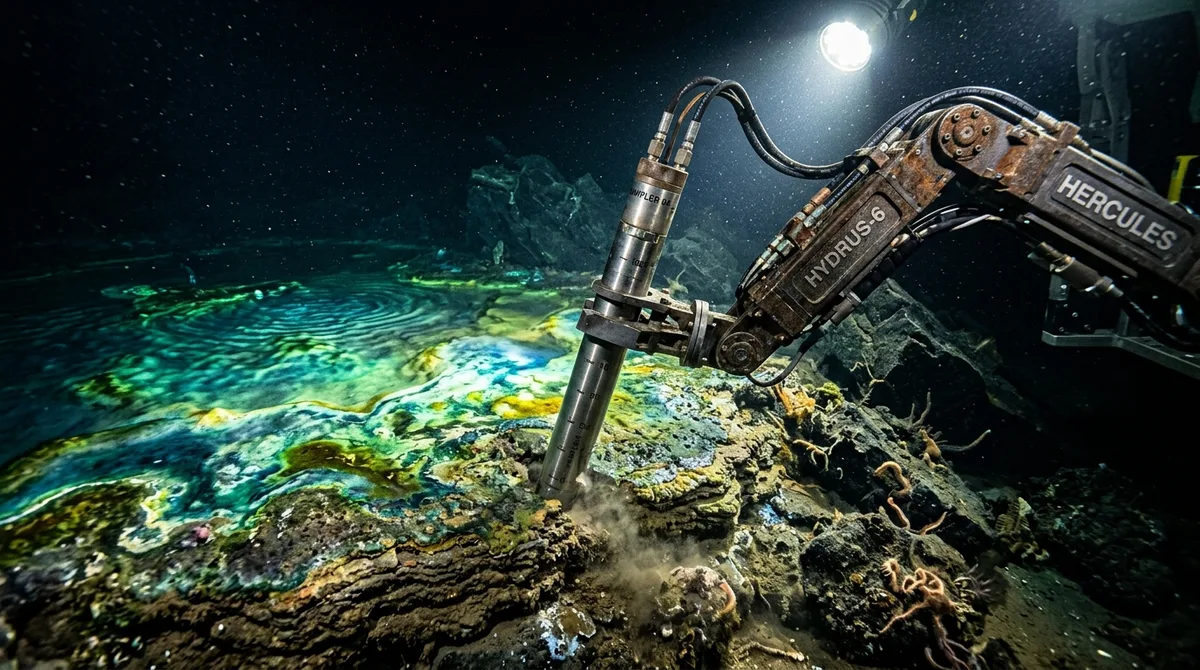
When deep-diving submersibles descend to the seafloor of the Gulf of Aqaba and the central Red Sea rift, oceanographers encounter an optical illusion reminiscent of science fiction. At depths between 1,200 and 1,700 meters, the seabed drops away into what appears to be an authentic lake complete with shoreline ripples, waves, and distinct surface tension. This phenomenon is governed by a halocline—a sharp physicochemical barrier that delineates normal seawater from super-dense mineral brine.
The density of water within these subterranean depressions drastically exceeds that of the surrounding ocean. Mineral concentrations reach staggering levels of 250 to 300 grams per liter, making the brine nearly ten times saltier than typical seawater. Because of this steep density gradient, the two fluid layers cannot intermingle, remaining stratified over thousands of years. The pool remains locked inside tectonic depressions, functioning as an isolated geological time vault.
Anoxia is absolute within these basins: dissolved oxygen levels drop to zero, replaced by high concentrations of hydrogen sulfide, methane, and heavy metal ions. For fish, crustaceans, and cephalopods, crossing this invisible boundary is catastrophic. A predator pursuing prey into the pool experiences severe osmotic shock, is paralyzed within seconds, and sinks lifeless to the brine floor, where it remains perfectly preserved without conventional decay.
Geological Genesis: The Legacy of the Miocene Salinity Crisis
Explaining the origin of these colossal subterranean salt deposits requires examining Earth’s deep geological past. Approximately 23 million years ago, the tectonic divergence of the African and Arabian plates began carving out the embryonic Red Sea rift valley. Throughout the late Miocene epoch, fluctuating sea levels repeatedly severed the basin’s connection to the Mediterranean Sea and the Indian Ocean.
Subjected to intense solar evaporation, the trapped seawater dried out repeatedly, precipitating massive evaporite deposits consisting of rock salt, halite, and gypsum several kilometers thick. As tectonic spreading progressed and marine waters permanently reflooded the rift, deep hydrothermal circulation began interacting with these buried salt beds. Heated subsurface fluids dissolve the ancient evaporites and seep upward into deep seafloor depressions, pooling into hypersaline reservoirs.
Over 25 distinct brine pools have been documented across the Red Sea rift, including the renowned Atlantis II Deep, Kebrit Deep, and Discovery Deep. In certain basins, brine temperatures exceed 60 degrees Celsius (140°F), transforming them into scalding hydrothermal cauldrons rich in gold, silver, copper, and zinc. These dynamic mineral deposits bear striking resemblances to the massive sulfide ore bodies that formed during the Archean eon.
Brine salt concentrations reach up to 300 g/L, nearly ten times higher than typical open ocean seawater.
Complete anoxia combined with hydrogen sulfide proves instantly lethal to any fish entering the pool.
Dense mats of archaea and anaerobic bacteria thrive on chemolithotrophy without any sunlight.
Serves as an essential terrestrial model for subsurface ocean worlds like Europa and Enceladus.
Biochemical Oases: Thriving Where Multicellular Life Perishes
Although inhospitable to vertebrate marine life, deep-sea brine pools represent thriving hotspots of extremophile biodiversity. Along the thin chemocline—the delicate interface where oxygenated seawater meets the toxic brine—dense microbial mats proliferate. In this narrow boundary layer, bacterial and archaeal cell densities surpass background oceanic concentrations by several orders of magnitude, generating a vibrant chemotrophic biomass.
Deprived of sunlight, these single-celled organisms bypass photosynthesis altogether. Their metabolic pathways rely on sulfate reduction, methane oxidation, and the cycling of iron and manganese. Halophilic archaea and anaerobic bacteria have evolved extraordinary molecular defenses: specialized ether-linked lipid membranes prevent osmotic collapse, while unique salt-tolerant enzymes maintain catalytic function in hyper-concentrated brines.
Biotechnologists and pharmaceutical researchers increasingly view these extremophile communities as reservoirs of novel bioactive molecules. Salt-stable and thermostable enzymes extracted from brine pool microbes show immense promise in biofuel synthesis, industrial green chemistry, and the discovery of novel antimicrobial agents designed to combat multidrug-resistant pathogens.
«The Red Sea brine pools are quintessential natural laboratories. They do not merely delineate the outer boundaries of Earth’s biosphere; they provide direct terrestrial analogs for the subsurface oceans of icy moons like Europa and Enceladus, where we aspire to discover extraterrestrial life.»
Professor Sam Purkis, Chair of the Department of Marine Geosciences at the University of Miami
Earth’s Climate Archive and Astrobiological Parallels to Icy Moons
Paleoceanographers analyze undisturbed sediment cores retrieved from brine pool bottoms as pristine environmental archives. Because the lethal anoxia excludes burrowing benthos such as worms and mollusks, the sedimentary strata remain completely devoid of bioturbation. Every millimeter of laminated sediment represents an unbroken chronological record of past climate shifts, mega-tsunamis, and monsoon cycles across the Arabian Peninsula spanning hundreds of millennia.
Beyond terrestrial history, these underwater basins provide crucial windows into the emergence of life on Earth. Approximately four billion years ago, Earth’s nascent oceans were anoxic, hot, and rich in dissolved metallic ions. The extreme conditions within Red Sea brine pools closely simulate this primordial crucible, allowing scientists to test models of prebiotic chemistry and early protocell evolution.
For planetary scientists at NASA and ESA, deep brine pools serve as prime analogues for extraterrestrial ocean worlds. Beneath the frozen crusts of Jupiter’s moon Europa and Saturn’s moon Enceladus lie global subsurface oceans in direct contact with warm silicate seafloors. If life can flourish within the toxic, sunless brine lakes of the Red Sea, the likelihood of finding active biospheres in the outer Solar System increases substantially.
- More than 25 distinct deep-sea brine pools exist along the Red Sea tectonic rift valley.
- Sharp density gradients create visible underwater lake surfaces featuring distinct waves and ripples.
- Pristine unbioturbated sediments preserve hundreds of thousands of years of Earth’s climate history.
- Extremophile enzymes extracted from brine microbes offer breakthroughs in green chemistry and medicine.
Environmental Threats and the Urgent Need for Deep-Sea Conservation
Despite their extreme depth, the brine pools of the Red Sea face growing risks from expanding industrial activities and marine extraction proposals. Rapid coastal development along the Gulf of Aqaba and the northern Red Sea involves extensive desalination facilities, which discharge concentrated brine and thermal effluents into surrounding waters, altering coastal hydrodynamic balances.
A more severe threat arises from deep-sea mining interests targeting the metalliferous muds of the Atlantis II Deep, which harbor billions of dollars in precious and rare earth metals. Commercial dredging or hydraulic extraction would inevitably disrupt the delicate halocline, potentially releasing millions of tons of heavy metals and hydrogen sulfide into the pelagic zone and devastating coral reefs and fisheries.
Leading international marine scientists are advocating for the immediate designation of Red Sea deep brine pools as protected marine sanctuaries under international treaties. Preserving these irreplaceable abyssal laboratories is imperative not only for evolutionary biology, but also for safeguarding the fundamental secrets of how life persists in extreme environments across the cosmos.