


As escalating marine heatwaves threaten tropical reef ecosystems worldwide, groundbreaking research from Stanford University reveals that bleached corals on the brink of starvation possess an extraordinary, previously unrecognized lifeline. In a landmark study published in Science Advances, marine biologists demonstrated that severely heat-stressed corals can achieve a full, rapid recovery within just four to seven weeks when brought into direct physical contact with healthy, genetically identical clones. Through a serendipitous laboratory discovery dubbed the ‘helping hands’ mechanism, researchers observed living tissues fusing into a biological bridge—allowing healthy donor colonies to pump vital photosynthetic dinoflagellates and nutrients directly into dying fragments.
Serendipity in Monterey Bay: How an Accidental Touch Sparked a Discovery
Scientific breakthroughs frequently arise from unexpected moments in the laboratory. At Stanford University’s Hopkins Marine Station in Pacific Grove, California, a research team led by doctoral candidate Danny Collins and marine biology professor Steve Palumbi was investigating heat stress responses in cauliflower coral (Pocillopora damicornis). Subjected to elevated water temperatures, the experimental corals experienced acute thermal shock, expelling their pigmented endosymbionts and transforming into ghostly white skeletons.
During routine aquarium maintenance, a healthy fragment from the same genetic mother colony accidentally slipped from its rack, coming to rest against an adjacent, starving bleached fragment. Weeks later, researchers noticed something astonishing: rather than decomposing, the bleached fragment was actively regaining a deep golden-brown hue originating precisely at the point of physical contact. Closer microscopic examination revealed that the living tissues of the two distinct fragments had seamlessly fused into a continuous coenosarc layer.
Recognizing the potential significance, the team launched a rigorous controlled trial. Bleached fragments were assigned to either isolated control tanks or placed in direct physical contact with healthy donor clones for 7 to 10 days. The findings, published in the peer-reviewed journal Science Advances, fundamentally overturn long-standing assumptions about the irreversibility of acute coral mortality.
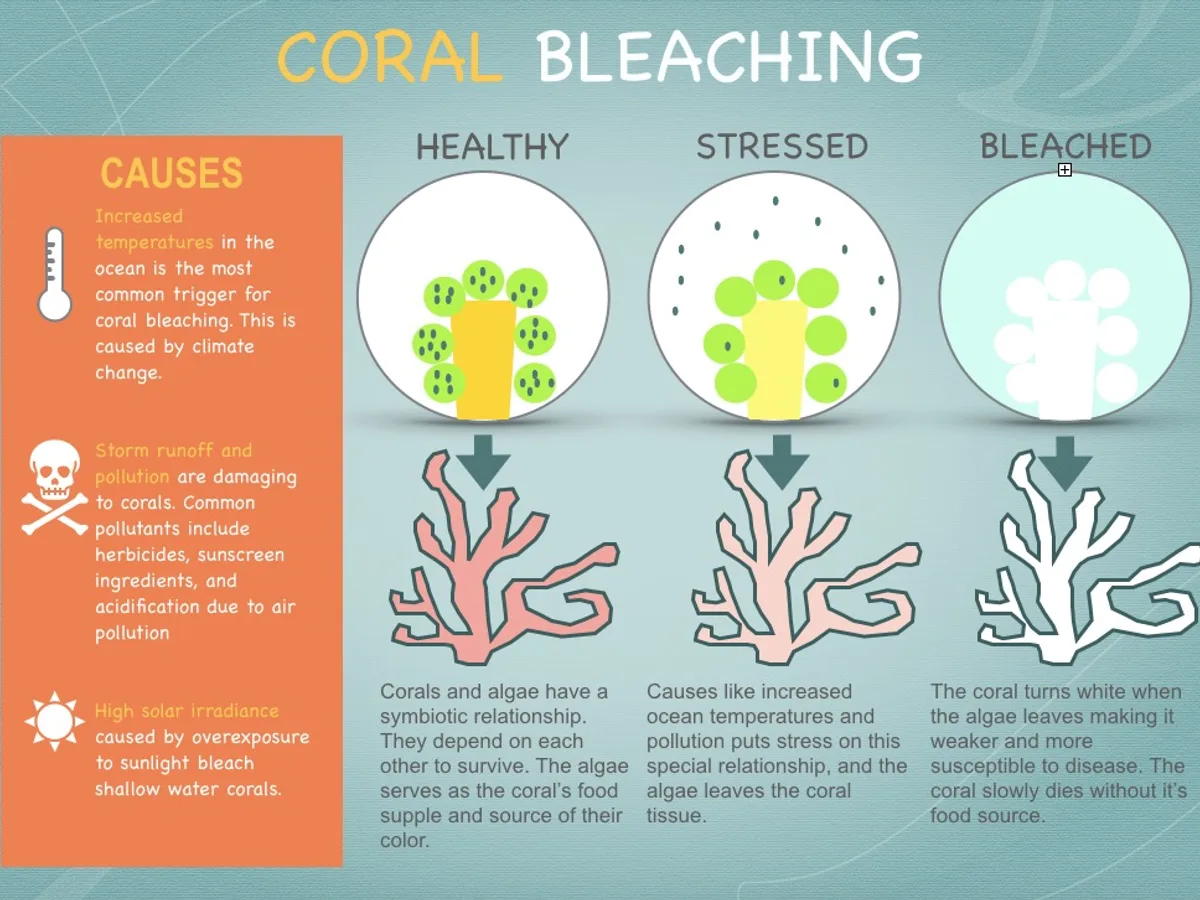
The Biological Highway: Mechanism of Symbiont Translocation and Nutrient Sharing
To understand why this discovery is so profound, one must examine coral physiology. Scleractinian corals rely on an obligate intracellular symbiosis with photosynthetic dinoflagellates of the family Symbiodiniaceae. In exchange for metabolic shelter and inorganic nitrogen, the algae produce up to 90% of the coral host’s energetic budget through fixed carbon. When elevated sea temperatures trigger oxidative damage within the algal photosynthetic apparatus, toxic reactive oxygen species (ROS) force the coral host to expel the microalgae, initiating the lethal starvation state known as bleaching.
Without photosynthetic sugars, polyps metabolize their own lipid reserves, succumbing to starvation and tissue sloughing within weeks. However, Collins’s experiments proved that physical contact with a healthy clone creates a literal biological highway. Because the fragments share identical genetic profiles, allorecognition immune pathways remain dormant. Within 24 to 48 hours, epithelial cells fuse, establishing open vascular conduits across the gastrovascular cavities.
Through this shared circulatory system, the healthy donor colony actively pumps photosynthetic sugars, amino acids, and intact, dividing Symbiodiniaceae cells directly into the depleted tissues. Over four to seven weeks, symbiont densities in the previously bleached corals rebounded to healthy baseline levels—surpassing 1.5 million algal cells per square centimeter. In contrast, 100% of the isolated control corals died. In our previous coverage of marine ecological engineering, we detailed how the SS United States will form a thriving artificial reef, where larval recruitment and coral settlement are paramount.
«We often perceive bleached coral as essentially dead, but bleached does not mean dead yet. Our study shows that living tissue is fighting for survival, and brief physical contact with a healthy clone can reignite a miraculous cascade of cellular rejuvenation.»
Danny Collins, lead author and marine ecologist, Stanford Doerr School of Sustainability
Immunological Boundaries: Allorecognition and the Limits of Interspecies Rescue
A crucial question addressed by the Stanford researchers was whether this rescue phenomenon extends beyond identical clones to different genotypes within the same species. Cnidarians possess sophisticated innate immune systems capable of distinguishing self from non-self. In nature, neighboring coral colonies frequently engage in aggressive spatial competition, deploying specialized sweeper tentacles and mesenterial filaments armed with nematocysts to digest competing neighbors.
When the researchers paired bleached fragments with non-clonal colonies of Pocillopora damicornis, fusion almost never occurred. The donor colonies recognized foreign histocompatibility antigens, generating an aggressive barrier zone of localized apoptosis that blocked vascular integration and algal transfer. Only in select pairings exhibiting close genetic relatedness was partial compatibility observed.
This genetic restriction explains why wild reefs often exhibit patchy, clumped patterns of survival during marine heatwaves. Branching corals frequently reproduce asexually through storm-induced fragmentation, creating extensive fields of clonal colonies. In dense clonal thickets, shaded or deeper branch sections can readily serve as living donors for bleached upper canopies, providing an evolutionary safety net against localized thermal spikes.
When healthy and bleached fragments touch, their outer epithelial layers fuse, creating seamless gastrovascular micro-channels.
In controlled lab trials, bleached Pocillopora damicornis fragments restored normal algal density at unprecedented biological speeds.
The healthy donor transmits millions of dividing symbiotic microalgae directly across the newly forged living tissue bridge.
Cluster-planting protocols based on clone-fusion can vastly enhance juvenile coral survival during catastrophic ocean heatwaves.
Transforming Coral Reef Restoration and Aquaculture Strategies
Beyond fundamental biology, the Stanford discovery provides actionable insights for global marine conservationists. Traditional reef restoration programs, widely pioneered through microfragmentation protocols, involve slicing corals into miniature fragments and growing them on separate ceramic plugs before outplanting them across degraded reefs. However, unseasonal warm-water pulses frequently wipe out these isolated nursery cohorts before they achieve reproductive maturity.
By applying the principles of clonal contact rescue, restoration practitioners can radically revise nursery architecture. Planting genetically matched microfragments in tightly clustered configurations—spaced mere millimeters apart—allows developing colonies to quickly fuse and form mutualistic safety networks. If a portion of the cluster bleaches, surrounding healthy polyps can immediately stabilize the vulnerable tissue.
Furthermore, field researchers envision deploying biodegradable ‘contact splints’ to physically bind nursery-grown donor clones against historic wild colonies following bleaching events, potentially saving century-old brain and star corals that would otherwise take generations to replace.
- Rapid formation of gastrovascular anastomoses between clones without histocompatibility rejection;
- Direct trans-colonial migration of Symbiodiniaceae dinoflagellates via coenosarc conduits;
- Sustained trans-allocation of photosynthetic carbohydrates and glycerol to starving polyps;
- Preservation of protective mucosal barriers, preventing opportunist bacterial necrosis.
A Beacon of Ecological Resilience in a Warming World
The authors emphasize that while the ‘helping hands’ mechanism represents a remarkable biological buffer, it cannot replace aggressive global action to halt greenhouse gas emissions. Prolonged, multi-month marine heatwaves will eventually overwhelm even the most resilient clonal networks if ocean waters remain persistently above survivable thresholds.
Nevertheless, the Stanford study proves that nature’s regenerative arsenal is far more dynamic than previously appreciated. Bleached corals are not passive victims doomed to death; given minimal physical contact with a healthy clone, their capacity for rapid, complete recovery is astonishing. Integrating this knowledge into conservation aquaculture grants coral ecosystems a fighting chance to endure until global climate stabilization is achieved.