

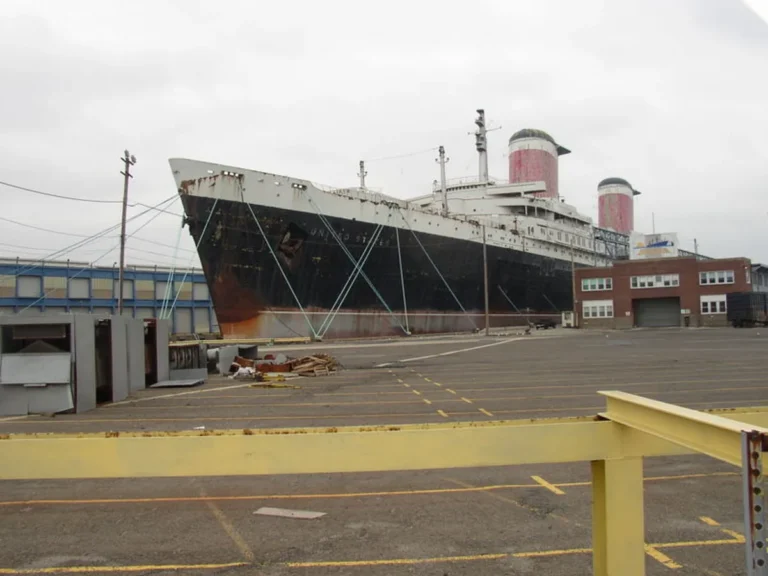

The legendary American transatlantic ocean liner SS United States, undefeated holder of the prestigious Blue Riband transatlantic speed record for over seven decades, is preparing for her final and most consequential voyage. On November 12, 2026, following exhaustive environmental remediation and maritime engineering, the iconic 990-foot (302-meter) vessel will be intentionally scuttled in the Gulf of Mexico off Destin-Fort Walton Beach, Florida. Resting upright in approximately 180 feet (55 meters) of water, this Cold War engineering marvel will be reborn as the largest artificial reef on Earth, surpassing the aircraft carrier USS Oriskany and ushering in a transformative era for marine habitat restoration, coral conservation, and technical diving tourism.
Cold War Masterpiece: The Secret Dual-Use Power of America’s Flagship
When the SS United States entered service in July 1952, she stood as the pinnacle of naval architecture and maritime industrial might. Designed by the visionary marine architect William Francis Gibbs, the vessel was conceived under a top-secret collaborative initiative between the United States Navy and the United States Lines. The federal government funded roughly two-thirds of her staggering $79 million construction budget under one non-negotiable defense stipulation: in the event of an outbreak of global war, the luxury ocean liner had to be rapidly convertible within days into an armed, ultra-fast troop transport capable of ferrying 14,000 soldiers 10,000 nautical miles without refueling.
Beneath her polished first-class lounges lay an astonishing propulsion plant: eight Babcock & Wilcox boilers driving four Westinghouse steam turbines generating over 240,000 shaft horsepower—machinery derived directly from classified aircraft carrier designs. On her maiden transatlantic crossing from New York to Le Havre, she shattered the eastbound record in 3 days, 10 hours, and 40 minutes at an average speed of 35.59 knots, capturing the legendary Hales Trophy and the Blue Riband. Gibbs enforced an obsessive fireproofing protocol: virtually no wood was utilized in her superstructure, furnishings, or artwork, with even the first-class grand piano custom-fabricated from flame-resistant aircraft aluminum.
Yet the commercial golden age of the transatlantic liner proved fleeting. The debut of the Boeing 707 jetliner in 1958 altered international travel economics virtually overnight, reducing multi-day ocean voyages to six-hour flights. In November 1969, the SS United States was abruptly withdrawn from service. For subsequent decades, she bounced between speculative owners and layover berths, eventually arriving at Pier 82 in Philadelphia in 1996, where her stripped hull sat quietly weathering the elements.
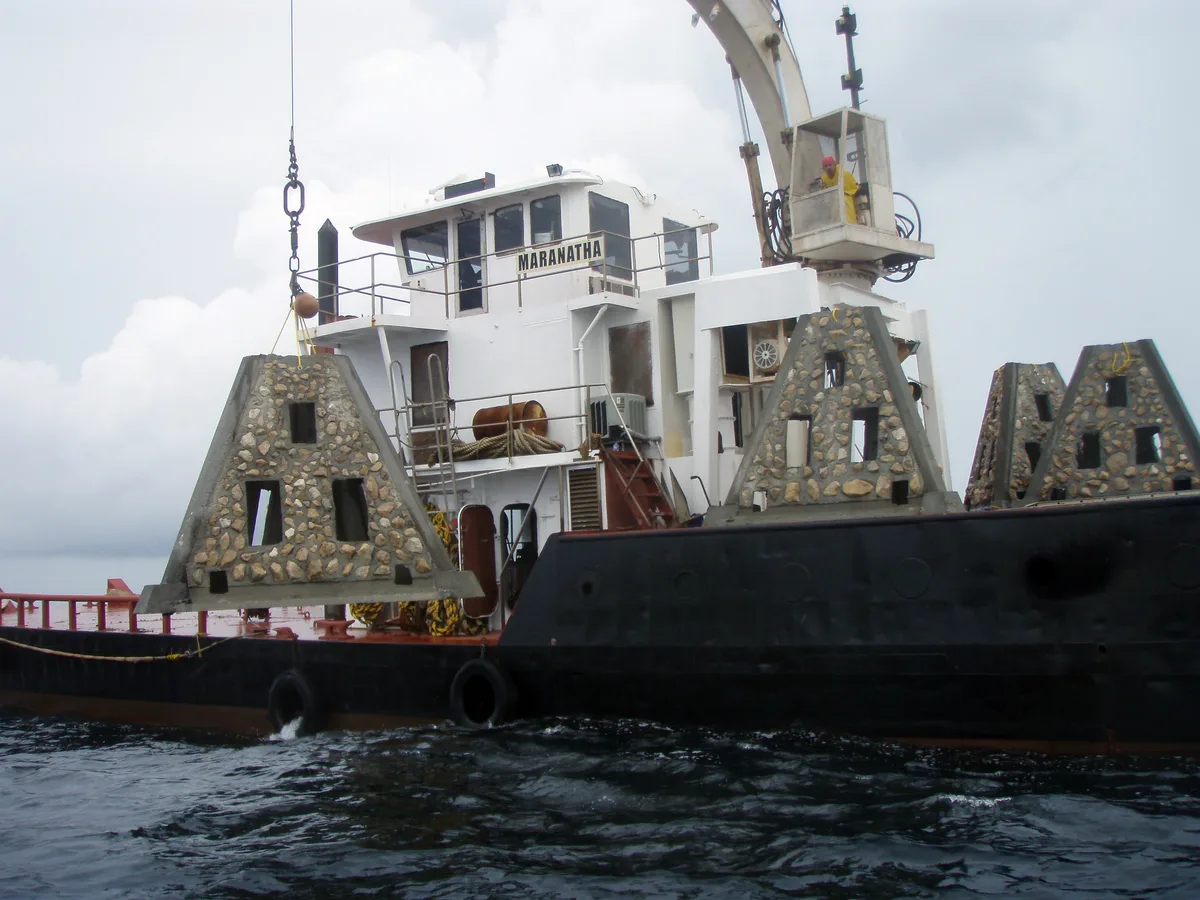
The Battle for Survival: Transforming Impending Scrapping into a Marine Sanctuary
For nearly three decades, the non-profit SS United States Conservancy fought tenaciously to preserve the historic ship, rallying global donors and exploring redevelopment concepts ranging from floating hotels to mixed-use museum developments in New York or Philadelphia. However, comprehensive restoration estimates consistently exceeded $500 million. When a prolonged rent dispute with the pier operator culminated in a federal court eviction deadline, America’s flagship faced imminent disposal at shipbreaking yards in Texas or overseas.
An imaginative breakthrough emerged from the Okaloosa County Board of County Commissioners in the Florida Panhandle. Leveraging over $10 million in revenue from local tourist development taxes (bed tax), the county finalized an agreement to purchase the hull, tow her to Mobile, Alabama for comprehensive environmental remediation, and permanently scuttle her as the crown jewel of Destin-Fort Walton Beach’s artificial reef program. ‘We are not bidding farewell to this legendary vessel; we are granting her a permanent and vital purpose in the sea,’ county tourism officials affirmed.
At the Mobile shipyard, maritime teams spearheaded an extensive abatement protocol under rigorous oversight from the US Environmental Protection Agency (EPA). Crews systematically purged more than 300 tons of hazardous substances, legacy fuels, asbestos insulation, and industrial coatings. Concurrently, the ship’s iconic red, white, and blue forward and aft funnels were carefully severed and transported to Florida, where they will form the focal point of an interactive, multi-million-dollar land-based museum currently under construction at the Destin-Fort Walton Beach Convention Center.
Measuring nearly 108 feet longer than the Titanic, the historic flagship will become the largest purpose-sunk artificial reef structure in human history.
On her maiden voyage in 1952, she crossed the North Atlantic at over 38 knots (71 km/h), a commercial passenger liner record that has never been broken.
Positioned upright in Okaloosa County’s LAARS C permitted zone, her superstructure will rise to within 60 feet of the surface, accessible to recreational divers.
The living marine ecosystem is projected to attract tens of thousands of scientific divers and tourists, revitalizing local fisheries and businesses.
Ecological Catalyst: How a Metal Mountain Reinvents the Seafloor
The northern Gulf of Mexico shelf consists largely of flat, featureless plains of sand and mud, offering scarce natural hard-bottom substrate for benthic marine communities. The introduction of an immense steel structure stretching 990 feet in length and towering nearly 12 stories high dramatically alters local hydrodynamics and establishes a thriving biological oasis. The wreck will provide more than 100,000 square meters of complex surface area for primary colonization.
Within hours of settling onto the ocean floor, opportunistic microalgae and bacterial biofilms will coat the steel plating. Within months, hydroids, encrusting bryozoans, and colonial stony corals such as Oculina will cement themselves across the vertical surfaces. The massive superstructure acts as an artificial upwelling barrier, deflecting deep nutrient-rich currents upward toward the photic zone. This concentration of plankton rapidly draws dense schools of baitfish, which in turn attract apex pelagic predators including king mackerel, blackfin tuna, wahoo, and migratory sharks.
Deep within the labyrinthine interior compartments, heavily protected bottom-dwelling species will find critical sanctuary. Vulnerable species including red snapper (Lutjanus campechanus) and the massive goliath grouper (Epinephelus itajara)—which can exceed 600 pounds—will utilize the hull for spawning aggregations and shelter. Marine biologists anticipate the reef will function as one of the most prolific recruitment engines in the southeastern United States.
«Transforming the SS United States into an artificial reef is not merely rescuing a legendary hull from the scrapheap. It creates a thriving underwater sanctuary that will enrich our oceans, foster biodiversity, and educate generations for centuries to come.»
Warren Jones, Maritime Heritage Preservation Strategist
Precision Sinking Operations: Coordinates, Depths, and Diver Safety
Scuttling a 53,000-ton passenger ship is an extraordinary naval salvage undertaking demanding exact ballast calculations. The liner will be towed to Okaloosa County’s Large Area Artificial Reef Site C (LAARS C), situated roughly 22 nautical miles southwest of Destin Pass at coordinates 30° 07.148′ N, 86° 46.755′ W. The water depth of 180 feet (55 meters) was strategically selected to optimize biological colonization while maintaining ample clearance for surface commercial vessel traffic.
Salvage engineers have pre-cut scores of controlled flooding ports and installed remote-actuated sea valves. By methodically flooding double-bottom fuel tanks and lower machinery compartments in a synchronized sequence, the ship will descend smoothly and rest firmly upright on her keel without rolling or listing. Her uppermost promenade deck will sit approximately 60 feet (18 meters) beneath the surface, placing a substantial portion of the exterior superstructure within safe depth limits for recreational divers holding Advanced Open Water certifications.
For technical and wreck penetration divers, the lower decks will offer an unmatched global destination. All hazardous dead-ends have been sealed off, companionways enlarged, and fluorescent guide markers affixed along primary transit corridors, drastically minimizing entrapment risks while preserving the awe-inspiring experience of navigating an authentic mid-century ocean liner.
- Exhaustive removal of hazardous materials, asbestos insulation, toxic wiring, and petroleum residues across all compartments;
- Preservation and removal of the iconic 55-foot twin funnels and radar mast to serve as centerpieces for a land-based museum in Destin;
- Strict remediation of polychlorinated biphenyls (PCBs) compliant with US Environmental Protection Agency (EPA) marine criteria;
- Cutting of specialized environmental passage ports to optimize water circulation and guarantee safe diver ingress and egress.
Economic Dividends and the New Paradigm of Oceanic Heritage
For the coastal communities of Northwest Florida, the deployment represents an immense economic catalyst. Economic modeling based on the 2006 scuttling of the USS Oriskany off nearby Pensacola demonstrates that a flagship-class artificial reef generates between $20 million and $35 million in direct regional economic output annually, driven by dive charters, lodging bookings, gear rentals, and oceanographic research expeditions.
Researchers from the University of Florida and Florida Sea Grant are deploying an integrated sensor array across the hull. Long-term acoustic receivers, oceanographic data loggers, and water sampling probes will monitor dissolved oxygen, temperature shifts, and fish biomass accumulation, providing vital empirical data on how large-scale artificial reefs contribute to ocean resilience against climate stress.
Ultimately, a vessel forged during the tensions of the mid-20th century to project national prestige and military might now begins an enduring peace mission. Resting on the seabed of the Gulf of Mexico, the SS United States stands as a monument to human engineering ingenuity, repurposed into a vibrant, living ecosystem that will shelter and nourish marine life for generations to come.