



In the public imagination, seasonal influenza is frequently trivialized as little more than a bad cold—an annoying winter inconvenience requiring a week of bed rest, hot tea, and over-the-counter decongestants. Yet for thousands of patients worldwide, including young, vibrant athletes without preexisting medical vulnerabilities, this familiar respiratory virus can trigger catastrophic multisystem failure in a matter of hours. The harrowing survival story of Madi Allen, who spent five weeks in an intensive care coma, suffered double lung collapse, and underwent surgical removal of lung tissue at age 12, serves as a stark reminder of how lethal severe flu complications can be.
From Mild Malaise to the ICU: The Anatomy of a Rapid Clinical Collapse
Madi Allen’s life-altering ordeal began in November 2008 when she was just 12 years old. A seventh-grader living an active, athletic lifestyle, she played soccer and basketball competitively, with no notable chronic health issues beyond mild sports-induced asthma that rarely required intervention. When she developed a slight fever and fatigue on a Saturday, her family assumed it was standard seasonal indisposition. Over-the-counter antipyretics offered brief respite, but each time the medication wore off, the underlying exhaustion deepened.

By Sunday evening, total-body myalgia had become excruciating. Madi was unable to sit upright comfortably, finding relief only when cradled in her mother’s arms. By Monday morning, her condition deteriorated with shocking speed: her lips turned an alarming gray-ash hue, her eyes appeared sunken, and her legs gave way completely beneath her weight. Recognizing an acute medical emergency, her parents abandoned their errands and rushed her directly to the regional pediatric emergency department.
Upon arrival, triage staff registered an oxygen saturation of approximately 60%—far below the normal threshold of 95%—indicating severe arterial hypoxemia. The influenza virus had rapidly overwhelmed her airway defenses, triggering fulminant bilateral viral pneumonia and Acute Respiratory Distress Syndrome (ARDS).
Five Weeks on the Brink: Induced Coma, Mechanical Ventilation, and Sepsis
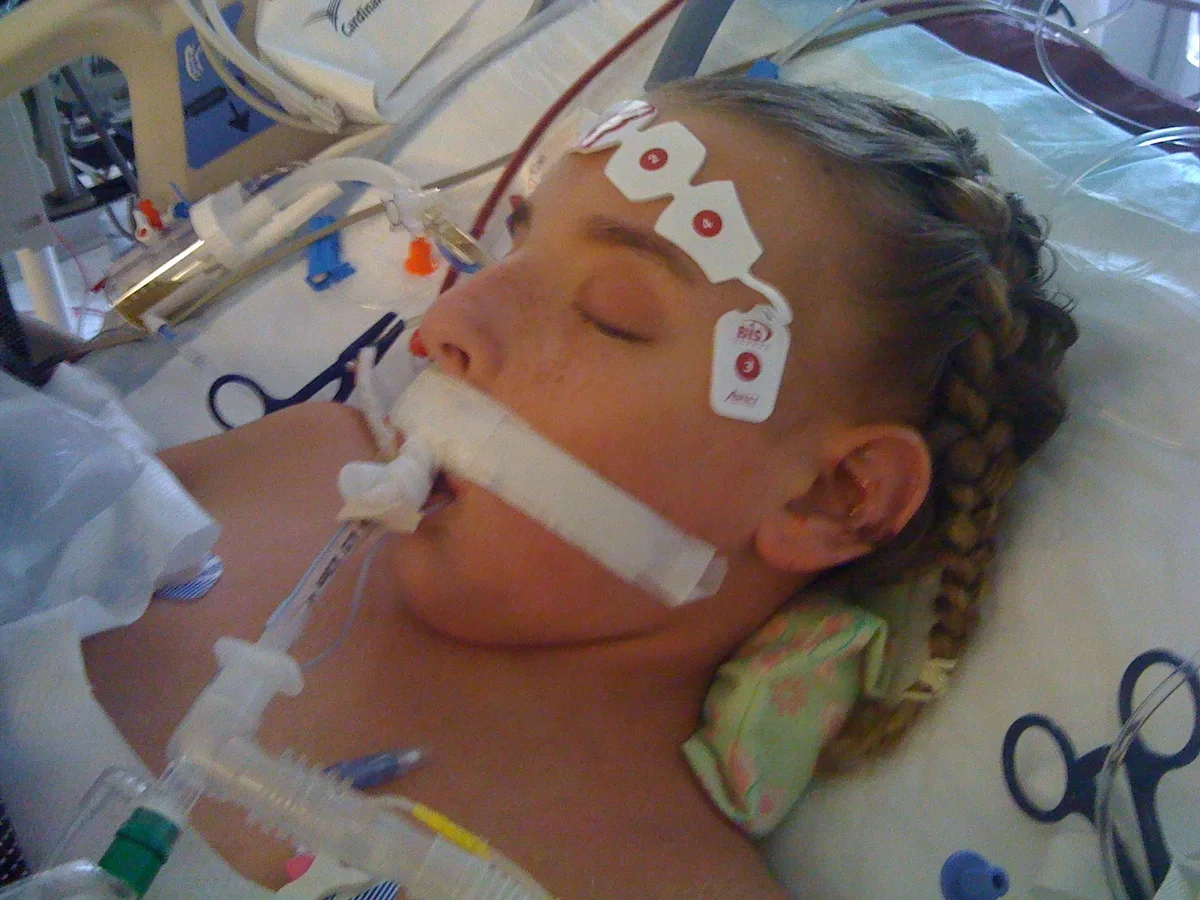
Faced with imminent asphyxiation, emergency physicians intubated Madi immediately and admitted her to the Pediatric Intensive Care Unit (PICU), placing her into a medically induced coma. In her pulmonary tissue, an uncontrolled cytokine storm raged—a hyperinflammatory cascade where the host immune response damages capillary endothelial cells and alveolar membranes while attempting to eradicate viral particles.
Her crisis was further magnified by secondary bacterial sepsis and septic shock, as opportunistic pathogens breached her denuded respiratory epithelium. To deliver oxygen across fluid-filled alveoli, medical ventilators had to deliver high positive airway pressures. The immense mechanical stress precipitated severe barotrauma: both of Madi’s lungs ruptured in succession (bilateral pneumothorax), forcing trauma teams to insert bilateral thoracic chest tubes through her ribs to evacuate trapped air.
For five harrowing weeks, Madi hovered between life and death. Clinicians advised her family that even if she survived, permanent cognitive or neurological impairment was a grave possibility due to prolonged tissue hypoxia. Yet through the relentless efforts of intensive care specialists, pulmonologists, and respiratory therapists, her physiological parameters slowly stabilized.
«So many people still regard influenza as something trivial. But when both my lungs filled with fluid and failed in the pediatric ICU, dropping my oxygen saturation to life-threatening depths, doctors told my parents to prepare for the worst. This virus destroyed my respiratory system in less than two days.»
Madi Allen, severe influenza survivor and respiratory therapy professional
‘My Body Forgot How to Walk’: The Grueling Reality of Intensive Rehabilitation
Emerging from a six-week induced coma marked the beginning of an arduous secondary recovery battle. Months of continuous immobility combined with paralytic medications had induced profound skeletal muscle atrophy. Madi was completely bedridden, unable to lift her arms, support her neck, or feed herself. Furthermore, prolonged endotracheal intubation severely traumatized her vocal cords, leaving her completely aphonic for months, communicating only through a faint, hoarse whisper.
Rehabilitation required painstaking physical, occupational, and respiratory therapy. Madi had to relearn basic motor coordination, sitting balance, and independent ambulation from scratch. Her academic and social adolescence was abruptly suspended, replaced by nebulizer treatments, pulmonary function testing, routine clinical surveillance, and high-dose corticosteroid regimens.
The psychological toll was equally profound. The traumatic reality of ICU delirium, nightmares, and invasive interventions produced post-traumatic stress disorder, aligning with findings from clinical research into human immune response and physiological recovery during protracted physical trauma.
Oxygen saturation plummeted to 60% with ashen, gray lips and profound weakness in less than 48 hours from initial symptom onset.
Prolonged medical coma and invasive mechanical ventilation preserved organ perfusion during total respiratory arrest.
Irreversible necrosis and cavitation in the right lung necessitated surgical excision of the diseased lobe years later.
Annual influenza vaccination decreases pediatric ICU hospitalization risk by 40% to 60% and drastically lowers mortality.
Thoracic Surgery and ‘Long Flu’: The Lasting Anatomical Toll of Influenza
Although Madi survived the acute infectious crisis, the viral onslaught inflicted irreversible anatomical damage upon her lungs. A segment of her right lung developed severe localized necrosis and cavitation, leaving behind non-functional, scarred tissue that became a recurring reservoir for persistent bacterial infections and hemoptysis (coughing up blood).
Years after her discharge from the ICU, thoracic surgeons performed an open surgical lobectomy to excise the damaged right lung lobe. Removing the necrotic tissue halted chronic infection cycles but permanently reduced her total pulmonary capacity.
Epidemiological research increasingly recognizes the burden of ‘Long Flu’—a syndrome of protracted organ pathology mirroring post-acute sequelae of COVID-19. As confirmed by official clinical data from the Centers for Disease Control and Prevention (CDC), influenza strains can cause chronic cardiovascular and pulmonary remodeling extending far beyond the acute infectious phase.
- Acute Respiratory Distress Syndrome (ARDS): rapid inflammatory exudation flooding pulmonary alveoli and precipitating refractory hypoxemia.
- Secondary bacterial sepsis: virulent staphylococcal or pneumococcal superinfections colonizing respiratory tissue following viral denudation.
- Bilateral pneumothorax: alveolar barotrauma caused by elevated mechanical ventilator pressures needed to oxygenate stiff, diseased lungs.
- Necrotizing post-viral lung destruction: permanent parenchymal necrosis and fibrosis requiring thoracic surgical lobectomy.
- Post-acute ‘Long Flu’ syndrome: profound skeletal muscle wasting, vocal cord paresis, chronic fatigue, and prolonged pulmonary impairment.
From ICU Patient to Respiratory Therapist: Dedicating Life to Patient Survival
Rather than allowing her trauma to define her in defeat, Madi Allen channeled her survival experience into a lifelong vocation. Now 28, she completed her university degree and enrolled in respiratory therapy training—the specialized medical discipline tasked with managing mechanical ventilators, airway patency, and cardiopulmonary emergencies in critical care units.
‘During my darkest days in the ICU, the respiratory therapists were my lifeline. They suctioned my airway, adjusted ventilator pressures, and kept me alive breath by breath,’ Madi reflects. ‘Now, standing beside critically ill patients in the ICU, I know exactly what their vulnerability and fear feel like.’
Her journey carries a vital public health message: influenza is not a benign nuisance, but a formidable pathogen capable of devastating healthy individuals. Annual vaccination, prompt recognition of clinical warning signs (dyspnea, cyanosis, persistent high fevers), and immediate medical intervention remain paramount in preventing life-threatening viral tragedies.