

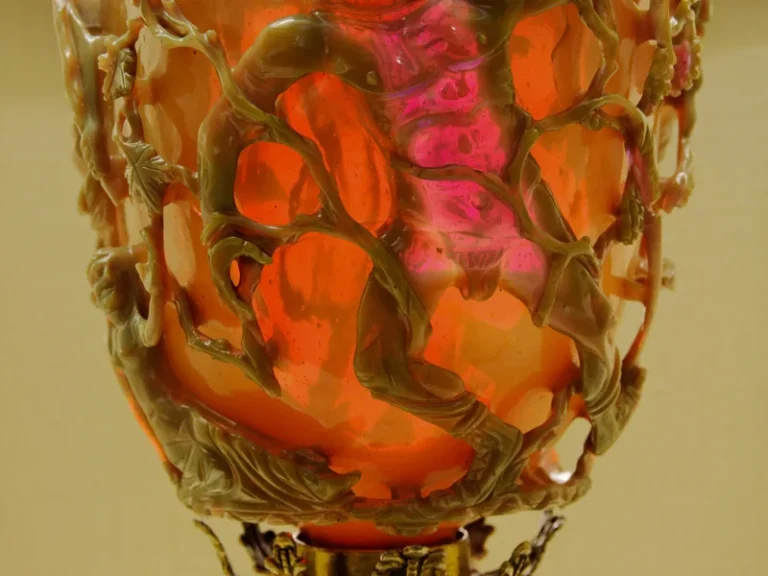

The Lycurgus Cup, housed in the British Museum in London, has captivated historians, physicists, and artisans for over a century as antiquity’s greatest materials mystery. Crafted in the 4th century CE, this extraordinary Roman cage cup exhibits a startling optical chameleon effect: under normal ambient reflected light, it appears opaque jade or olive green; however, when illuminated from within or backlit, it instantly glows with a radiant, translucent ruby-red brilliance. Now, materials scientists at the University of Sheffield have successfully cracked and replicated the ancient manufacturing recipe in modern high-temperature furnaces.
The Mystery of the Lycurgus Cup: Ancient Dichroic Glass in the British Museum
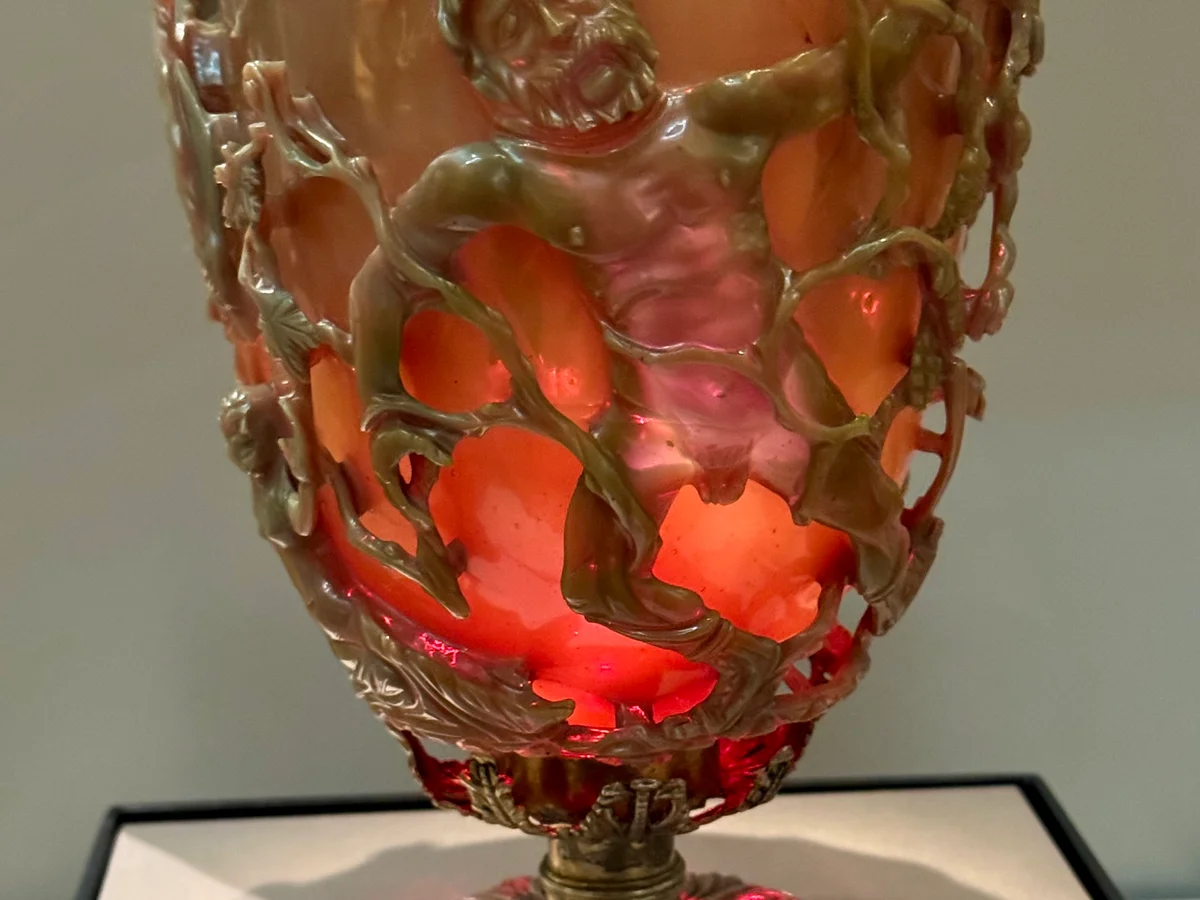
Among the vast collections of antiquity in the British Museum, the Lycurgus Cup occupies an unrivaled pedestal of prestige and perplexity. Fabricated in the 4th century CE, likely in high-status glassmaking workshops in Rome or Alexandria, this artifact is a cage cup (diatretum) measuring approximately 16.5 centimeters in height. Its exterior is sculpted with a dramatic narrative from classical mythology: King Lycurgus of Thrace, driven mad and attacking the maenad Ambrosia, is trapped and strangled by living grapevines summoned by the god Dionysus.
Yet the cup’s worldwide fame stems not merely from its virtuoso openwork relief, but from its astonishing optical trickery. Under everyday reflected light (such as when displayed in a room or lit from the front), the glass appears dull, opaque olive or jade green. However, the moment a light source is placed behind or inside the vessel, the material undergoes an enchanting transformation: it turns completely translucent, glowing with a deep, fiery ruby-red luminosity. For centuries, this dichroic effect was deemed an alchemical secret or an unrepeatable fluke.
Purchased by the British Museum from Lord Rothschild in 1958, the chalice became the focus of intense scientific scrutiny. In 1990, transmission electron microscopy (TEM) unmasked the secret: ancient Roman artisans had successfully engineered and applied nanotechnology sixteen hundred years before the term was coined. Suspended throughout the silica matrix were billions of microscopic metal nanocrystals measuring between 50 and 100 nanometers in diameter.
The Physics of Plasmon Resonance: How Nanoparticles Manipulate Light
The physics governing the Lycurgus Cup’s color change is recognized today as localized surface plasmon resonance (LSPR). When photons of visible light strike metallic nanoparticles smaller than the wavelength of light, the conduction electrons on the particle’s surface oscillate collectively in resonance with the incident electromagnetic field.
Chemical analysis revealed that these Roman nanocrystals are composed of a specialized alloy: approximately 70% silver and 30% gold, with trace inclusions of copper. Silver nanoparticles exhibit a pronounced plasmonic scattering resonance in the blue-green portion of the visible spectrum (around 400 to 450 nanometers). When front-lit, these particles scatter green light back toward the observer’s eyes, imparting an opaque jade appearance.
Conversely, when light shines through the glass in transmission, the silver-gold nanocrystals absorb and scatter the blue and green photons out of the direct line of sight. Only the longer, unscattered wavelengths of the red spectrum (650 to 700 nanometers) pass cleanly through the material. To the human eye, the transmitted light registers as brilliant ruby. Just as the rock-carved tombs of Petra concealed the engineering genius of ancient desert architects, the Lycurgus Cup demonstrated an intuitive mastery of subatomic physics.
The glass contains microscopic nanoparticles of a 70% silver and 30% gold alloy roughly 50–70 nanometers wide, uniformly dispersed in silica.
Silver nanoparticles scatter shorter blue-green wavelengths when front-lit, but transmitted light allows only long red wavelengths to pass through.
Artisans melted glass above 1050°C and maintained delicate redox conditions, enabling controlled nucleation during slow cooling at 600–700°C.
Roman glasscutters hand-carved an openwork outer cage and intricate figural reliefs from a single thick blown blank with minuscule bridges.
The Technological Bottleneck: Why Modern Glassmakers Could Not Repeat It
Although modern science knew the elemental composition of the cup by the early 1990s, replicating the process proved notoriously elusive for over three decades. Simply throwing gold and silver into a batch of molten glass yielded muddy, unusable results: the precious metals either agglomerated into coarse visible blobs, turning the glass murky brown, or remained completely dissolved as invisible ions without exhibiting dichroism.
«The core difficulty is that you cannot just melt gold and silver into silica; you must induce the nanocrystals to nucleate and grow to a precise threshold of 50 to 70 nanometers while remaining perfectly isolated in an ultra-viscous melt», explains Professor Caroline Jackson, an expert in archaeological materials. The concentration of metal in the Lycurgus Cup is vanishingly small: roughly 40 parts per million of silver and 300 parts per million of gold. Formulating such delicate dilutions in wood-fired furnaces demanded extraordinary craft discipline.
Furthermore, Roman artisans lacked optical pyrometers, thermocouple probes, or oxygen sensors. They gauged furnace environments solely by the color of the flame, the smell of furnace gases, and the drag of the glass gather. To understand how ancient glasscutters achieved such repeatable excellence, materials scientists at the University of Sheffield set out to reverse-engineer the thermal recipe.
«For decades, physicists knew WHAT was inside the glass, but nobody could figure out HOW Roman artisans got gold and silver nanoparticles to grow to precisely 50 to 70 nanometers within thick, viscous molten glass. It required dozens of experimental melt cycles balancing furnace oxidation and slow annealing to reproduce the exact jade-to-ruby color shift.»
Dr. Lisa Hollands, lead materials researcher at the University of Sheffield
The Sheffield Breakthrough: Re-engineering the Ancient Thermal Formula
Led by materials scientist Dr. Lisa Hollands, the Sheffield research team conducted dozens of experimental melts inside specialized electric and gas-controlled kilns. The breakthrough lay in using recycled Roman cullet glass and introducing silver and gold as pre-dissolved metal chlorides alongside antimony oxide, which acted as a chemical nucleating agent.
The researchers discovered that primary melting must occur at temperatures exceeding 1050°C under mildly reducing atmospheric conditions, preventing premature metal oxidation. At this peak heat, gold and silver atoms dissolve uniformly throughout the silica matrix. However, the true optical alchemy occurs during secondary thermal processing—a slow, meticulously controlled annealing phase between 600°C and 700°C.
During this critical thermal window, the supersaturated metal solution undergoes controlled phase separation, causing gold and silver atoms to coalesce into spherical nanocrystals. If cooled too rapidly, the crystals never form, leaving the glass a pale yellow; if heated too long, the particles ripen and clump, turning the glass opaque. By pinpointing the exact thermal threshold, Dr. Hollands successfully grew 55-nanometer alloy particles that matched the transmission spectrum of the original 4th-century artifact.
- The Lycurgus Cup dates to roughly 300–350 CE and stands as the crowning achievement of late Roman cage-cup glassmaking (diatretum).
- Dr. Lisa Hollands and Professor Caroline Jackson at the University of Sheffield worked for over five years to unlock the thermal recipe.
- The concentration of precious metals is astonishingly low: roughly 40 parts per million of silver and 300 parts per million of gold.
- The recreated glass was supplied to master glass artist Elliot Walker to blow and carve a modern sculptural homage.
Artistic Rebirth and the Modern Future of Plasmonic Nanomaterials
To prove the artistic viability of the recreated glass, Sheffield scientists collaborated with celebrated British glassmaker Elliot Walker, winner of Netflix’s hit competition series «Blown Away». Working with batches of the newly minted dichroic formulation, Walker sculpted a contemporary glass masterpiece inspired by the Lycurgus myth. Unveiled at the Millennium Gallery during Sheffield’s Festival of the Mind, the sculpture stunned onlookers with the same hypnotic optical shift: olive jade under gallery spotlights, transforming into glowing scarlet when illuminated from behind.
This experimental victory permanently dispels the theory that the Lycurgus Cup was a lucky accident. Roman artisans possessed a rigorous empirical tradition of materials science, passing recipes down through guilds across centuries. The rediscovery of this manufacturing technique carries profound implications far beyond historical archaeology.
Today, localized surface plasmon resonance in gold and silver nanoparticles forms the bedrock of ultra-sensitive diagnostic biosensors capable of detecting single cancer biomarkers, viral antigens, and environmental toxins by measuring minute refractive shifts. The ancient Roman artisans who engineered a party cup to amaze banquet guests laid the groundwork for modern quantum nanotechnology—crafting an enduring testament to human ingenuity across millennia.