

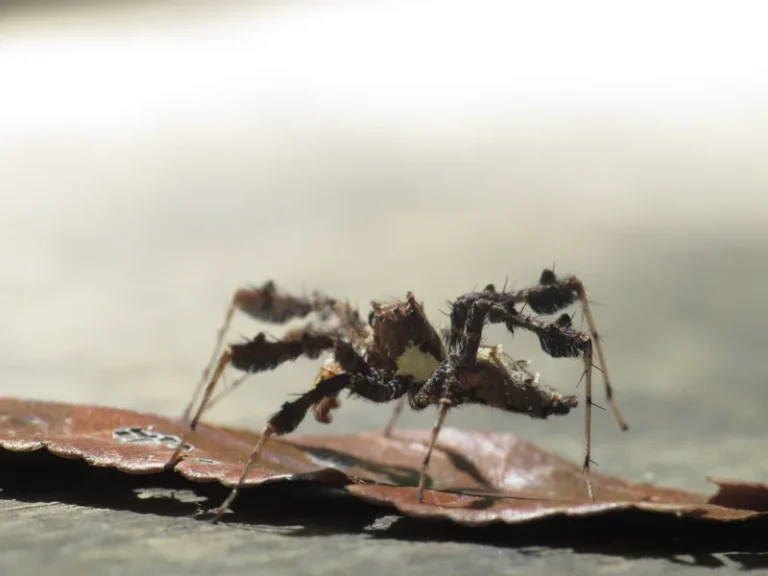

For centuries, science assumed that complex, multi-stage sleep accompanied by dreams and rapid eye movements was a unique luxury reserved for warm-blooded vertebrates like mammals and birds. However, an international team of behavioral ecologists has shattered that paradigm: researchers have confirmed for the first time that jumping spiders experience genuine, regulated sleep featuring a distinct REM-like (rapid eye movement) stage. While suspended upside down from silk safety lines at night, these agile predators exhibit rhythmic twitches of their limbs, curl their legs, and oscillate their retinal tubes in patterns remarkably analogous to human dreaming states.
The Mystery of Invertebrate Rest: Do Spiders Truly Sleep?
Whether invertebrates truly sleep or merely undergo passive bouts of metabolic torpor has been an active debate among neurobiologists for decades. In animal physiology, true sleep is not defined merely by a lack of locomotion; it must satisfy rigorous behavioral and neurological criteria. These include adopting a stereotypical resting posture, showing a heightened arousal threshold (diminished sensitivity to environmental cues), and exhibiting homeostatic sleep regulation—commonly referred to as paying off sleep debt. If deprived of rest, an organism inevitably compensates with deeper, prolonged sleep.
While simple insects like fruit flies have long been known to possess circadian resting periods, jumping spiders (family Salticidae) occupy a unique cognitive tier. Blessed with exceptional spatial cognition, acute three-dimensional depth perception, and flexible hunting strategies, their brains manage immense sensory data streams. To maintain neural homeostasis, such visual complexity demands restorative sleep. Careful observation of their nighttime behavior revealed unexpected physiological dynamics.
In specialized environmental chambers at the University of Bonn, researchers tracked the nocturnal habits of these creatures under continuous infrared illumination. Rather than resting on the substrate, spiders spun a durable tether of dragline silk, attached it to the enclosure ceiling, and dropped down to dangle freely upside down. There they remained suspended for hours, periodically undergoing intense, synchronized bouts of physiological movement.
Translucent Exoskeletons: An Anatomical Window into the Brain
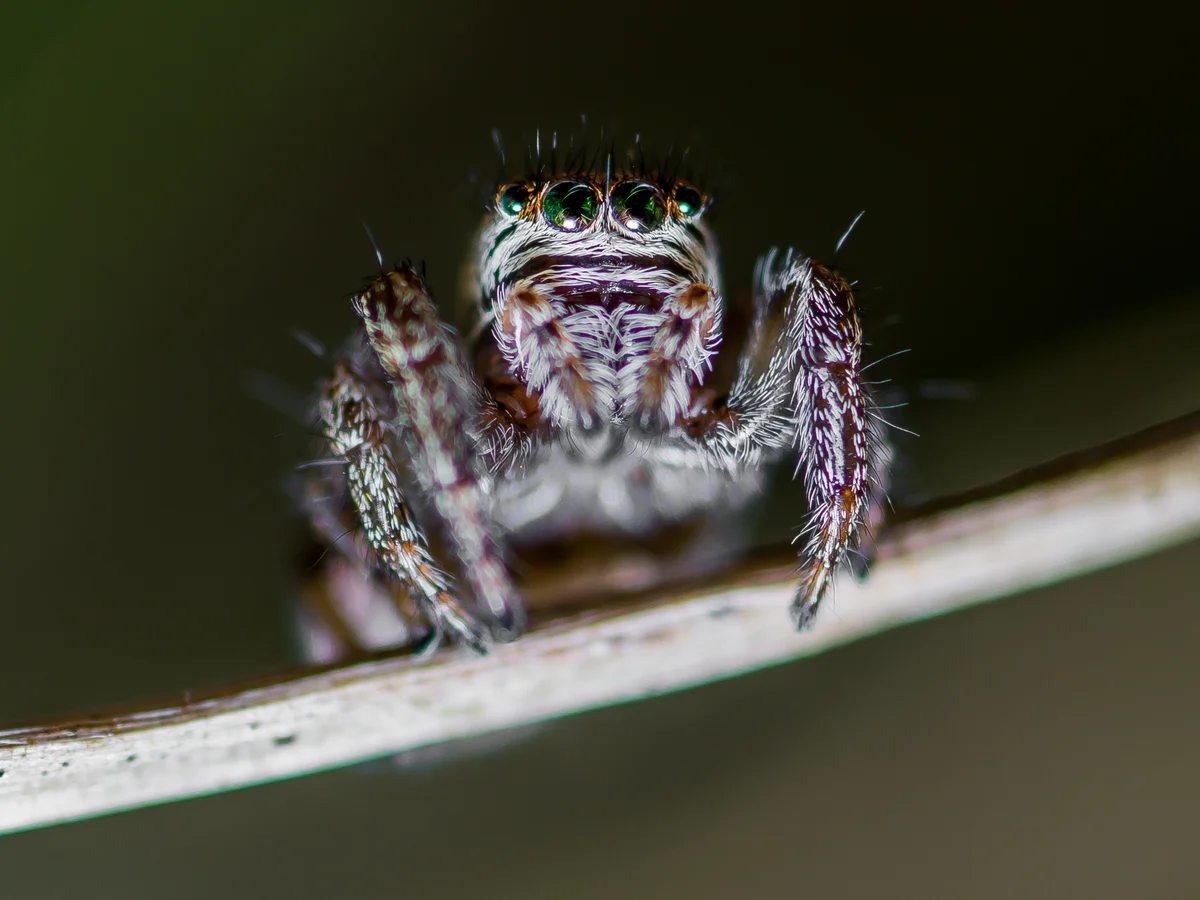
The breakthrough was made possible by studying juvenile European jumping spiders (Evarcha arcuata) alongside the celebrated araneophagic hunter Portia fimbriata. Unlike humans, whose entire eyeball rotates within a socket, jumping spiders have fixed outer corneal lenses fused directly into their cephalothorax. However, behind these lenses sit long, flexible optical tubes that carry the retinas, actuated by minuscule oculomotor muscles to sweep across the visual field.
In young spiders, the chitinous cuticle has not yet developed dark pigmentation, rendering the front of their head completely translucent. By pointing high-magnification macro lenses under infrared illumination at resting spiders, the researchers could literally observe the internal anatomy in action. At regular intervals throughout the night, the internal retinal tubes began to twitch, sweep, and oscillate erratically—mirroring the rapid eye movements documented in sleeping vertebrates.
Statistical analysis of the video feeds confirmed that these retinal movements followed regular cycles lasting between 20 and 80 seconds, recurring every 15 to 20 minutes throughout the dark phase. During the day, retinal movements are tightly synchronized with target acquisition. At night, however, the oscillations were uncoupled from external stimuli, indicating spontaneous internal activation within the central visual neuropils.
Juvenile translucent spiders exhibited synchronous, periodic movements of their internal eye tubes identical to rapid eye movement (REM) phases.
Leg twitches and curling reflect temporary reductions in hemolymph pressure, indicating muscular atonia and motor relaxation during sleep.
When subjected to nocturnal sleep deprivation, spiders spent nearly double the time in the REM-like phase on subsequent recovery nights.
The presence of REM-like sleep in arthropods pushes the evolutionary emergence of memory consolidation mechanisms back over 500 million years.
Leg Twitches, Limb Curling, and Hydraulic Atonia
Retinal movement alone was not the sole hallmark observed. Simultaneous video recording revealed that every bout of eye flutter coincided with unmistakable physical twitches across the spider’s body: their palps quivered, their chelicerae (jaws) contracted slightly, and the spinnerets at the tip of their abdomen pulsed rhythmically.
Most telling was the periodic curling of their legs. Arachnids do not possess extensor muscles in their leg joints; they extend their limbs via internal hydraulic hemolymph pressure and flex them using flexor muscles. During REM-like sleep bouts, hydraulic pressure dropped, causing the limbs to curl inward into an iconic, relaxed posture. This mirrors the muscle atonia experienced by humans and dogs during REM sleep—a physiological safeguard preventing the physical enactment of dreams.
Had the spider been resting on a flat surface, the sudden drop in hydraulic pressure would cause it to tip over. Dangling securely from a silk anchor line solves this biomechanical problem, allowing complete muscular relaxation while remaining safely suspended away from predatory nocturnal insects. During peak twitching episodes, the spiders exhibited marked behavioral quiescence and heightened sensory thresholds.
«When we first observed the coordinated leg twitches and rhythmic oscillations of the retinal tubes in motionless spiders hanging on their silk lines, it looked strikingly identical to a sleeping dog or cat kicking in a dream. Our subsequent sleep deprivation assays conclusively proved that this fulfills all physiological criteria of sleep, including homeostatic rebound.»
Dr. Daniela Rößler, lead behavioral ecologist at the University of Bonn
Sleep Deprivation Experiments: Demonstrating Rebound in Portia fimbriata
To prove this state was regulated by genuine sleep homeostasis rather than random muscle spasms, the research team designed an active deprivation experiment. Whenever resting spiders entered an REM-like phase, the scientists triggered delicate vibrations or introduced live fruit flies to interrupt their rest and force them into an alert posture.
The results were definitive: on subsequent recovery nights, sleep-deprived spiders initiated sleep significantly faster and spent nearly twice as long in the REM-like twitching state compared to undisturbed controls. This classic REM rebound effect confirms that the phase fulfills an indispensable biological restorative need. In much the same way that avian brains in crows reorganize synaptic plasticity during rest, spiders require undisturbed sleep cycles to recalibrate their visual circuits.
Conversely, when non-REM resting states were interrupted, the rebound effect was far less pronounced. This indicates that quiet rest and REM-like sleep serve distinct physiological purposes: quiet rest handles basic metabolic clearance and energy restoration, while REM-like sleep is crucial for neural plasticity, visual calibration, and cognitive processing.
- Dr. Daniela Rößler and her team at the University of Bonn conducted hundreds of hours of infrared video recordings of Evarcha arcuata and Portia fimbriata.
- Spiders sleep suspended upside down from a fine silk dragline, keeping them safe from nocturnal ground-dwelling predators.
- During active bouts of retinal movements, spiders displayed markedly elevated arousal thresholds, failing to react to mild ambient vibrations and light.
- The findings challenge long-standing assumptions about how cognitive states and dream architectures evolved in nature.
Do Spiders Dream? Evolutionary Implications of Ancient Consciousness
Could these rhythmic eye movements signify that jumping spiders experience visual dreams? While science cannot probe the subjective inner world of an arachnid, jumping spiders are predominantly visual organisms. They track targets, assess distances, and retain spatial memories of their surroundings. Rhythmic twitching of retinal tubes paired with motor firing suggests that the sleeping spider brain might be actively replaying diurnal visual stimuli and hunting sequences.
If the neural machinery driving REM-like sleep originated in the common ancestor of bilateral animals or evolved convergently to solve neural consolidation challenges, structured sleep is vastly older than the first vertebrates. Just as the Dsup protein in tardigrades demonstrates nature’s resilience, the discovery of spider sleep proves that the biological roots of memory processing and dream states run hundreds of millions of years deep into planetary history.
Moving forward, researchers aim to use in vivo optical imaging and microelectrode recordings to map neural activity in sleeping jumping spiders. Should future experiments detect selective activation of memory centers during these nocturnal twitching bouts, it will prove that dreaming is not an exclusive mammalian phenomenon, but a universal property of complex neural systems navigating a dynamic visual world.